I used to think my deep sleep was fine—until Oura showed me 12 minutes. *Twelve.*
That’s when I realized guessing isn’t exactly a strategy.
The Oura Ring combines photoplethysmography with accelerometry, tracking blood flow and heart rate variability to actually distinguish sleep stages. Meanwhile, Fitbit Sense validates against clinical standards, and WHOOP monitors recovery strain. All solid, but Oura’s overnight signal analysis? Brutally honest.
Researchers like Dr. Matthew Walker (UC Berkeley) keep pushing neurofeedback boundaries. Enter 2026’s Sleepmaxxing trend—basically optimizing every variable until your rest slaps different.
We at Corala Blanket live this mission daily. Because better sleep isn’t luxury; it’s survival.
What’s your tracker hiding from you?
Quick Takeaways
- Watches utilizing photoplethysmography (PPG) and accelerometry offer enhanced sleep stage detection, including deep sleep.
- Devices like Dreem and Muse use neuroscience-based biofeedback and acoustic pacing to actively promote deeper sleep stages.
- Advanced sensors analyzing heart rate variability and physiological signals improve deep sleep measurement accuracy.
- Wearables that monitor environmental factors (noise, light, temperature) help optimize conditions for better deep sleep.
- Incorporating neuroacoustic therapies and sleep rituals via compatible devices can enhance deep sleep quality.
How Do Sleep Trackers Measure Deep Sleep Accurately?
While traditional sleep tracking relied heavily on movement sensors and simple heart rate monitoring, modern devices leverage sophisticated methods like photoplethysmography (PPG) and accelerometry to analyze sleep architecture more accurately. They monitor variations in blood flow, cardiac timing, and body position. A further advancement involves detecting sleep cycle patterns, providing deeper insights into sleep quality. These advanced devices reveal transitions through sleep stages—particularly the dream phase—by tracking subtle physiological shifts. Researchers like Dr. Matthew Walker emphasize understanding sleep cycles for clarity on restorative processes. Additionally, cutting-edge sleep trackers employ physiological signal analysis to improve the precision of deep sleep measurement.
What Features Make a Sleep Tracker Better for Deep Sleep?
Effective sleep trackers designed for deep sleep measurement incorporate advanced physiological sensors that extend beyond basic movement and heart rate tracking. They analyze elements of the dream environment, such as ambient noise, light levels, and temperature, to optimize conditions that promote restorative deep sleep. Incorporating nighttime skincare routines can also enhance sleep quality by creating a relaxing bedtime environment conducive to rest. Furthermore, these devices examine sleep architecture, providing insights into the stages of sleep, highlighting disruptions that impact deep sleep quality. Researchers like Dr. Matthew Walker emphasize the importance of understanding sleep stages for health.
Are Modern Wearables Reliable in Detecting Deep Sleep Stages?
Questions about the reliability of modern wearables in detecting deep sleep stages are increasingly relevant as these devices become integral to personal health monitoring.
While brands like Fitbit and Oura employ sensors analyzing heart rate variability and motion, research suggests they may overestimate or underestimate deep sleep by ±10-15%.
Sleep coaching and dream journaling can complement device data, offering subjective perspectives into sleep quality that wearables lack.
Devices increasingly incorporate biosignals, but their algorithms still face limitations mimicking clinical polysomnography.
Knowing these constraints enables users to interpret sleep metrics critically, emphasizing biology over data, and fostering a holistic approach rooted in understanding rather than obsession.
Additionally, understanding the sleep monitoring limitations inherent to these devices helps set realistic expectations and avoids misinterpretation of the data.
Recognizing the measurement accuracy challenges in current technology encourages users to combine device data with personalized sleep assessments for better insights.
Can Sleep Trackers Help Calm Your Nervous System for Better Deep Sleep?
Emerging research and technological advances suggest that sleep trackers may serve a dual role, not only in monitoring sleep patterns but also in calming the nervous system to facilitate deeper, restorative sleep. Devices like WHOOP or ŌURA incorporate biofeedback features, guiding users through breathing exercises that invoke the vagus nerve’s calming influence. Additionally, the use of biofeedback technology can enhance relaxation techniques, further promoting restful sleep. Engaging in intentional sleep rituals—such as visualizing dream symbolism—can reinforce psychological relaxation. This approach aligns with neuroacoustic therapies that modulate brainwaves, helping the body exit “fight or flight” mode. Certain features in sleep trackers can also detect shifts in autonomic nervous system activity, providing insights to optimize stress management for better sleep quality.
Which Sleep Trackers Are Best for Supporting Biological Surrender?
In the pursuit of supporting biological surrender, certain sleep trackers stand out by emphasizing neuro-regulatory capabilities that go beyond surface metrics. Devices like the Apollo Neuro or Melomind aim to modulate nervous system activity, fostering a sense of psychological reassurance essential for deep sleep.
They integrate practices that reinforce habit formation, subtly rewiring your brain’s response to stress and igniting the body’s natural relaxation pathways. These tools serve as anchors, cultivating a sense of calm that encourages the nervous system’s shift into rest.
And helps users, through consistent use, develop the biological surrender necessary to optimize deep sleep without over-controlling.
How Can Deep Sleep Data Help You Create a Sleep-Friendly Environment?
Deep sleep data serves as a foundational tool for sculpting an environment conducive to restorative rest. By analyzing detailed metrics from devices like Fitbit or WHOOP, I identify environmental cues that influence my sleep quality. In addition, understanding how sleep stage tracking works helps refine these adjustments more effectively.
For instance, data showing disruptions correlates with noisy surroundings or irregular temperature levels, prompting adjustments that foster cognitive relaxation—such as dimming lights or reducing ambient noise. Researchers emphasize that controlling environmental cues—light, sound, or temperature—can enhance deep sleep by signaling the brain to *shift* into the restorative stages more efficiently.
This *realization* transforms raw data into actionable cues, empowering me to engineer a sleeping environment optimized for true biological rest. Understanding how wearable health bands track sleep stages enables more precise adjustments to your sleep environment for better deep sleep quality.
Neuroscience-Driven Sleep Innovation
Advancements in neuroscience have catalyzed a pivotal shift in sleep technology, focusing on actively influencing brainwave activity rather than merely tracking it. Researchers like Dr. Jeffrey Thompson and brands such as Dreem utilize neuroacoustics and Vagus Nerve Stimulation to promote circadian mastery, enabling targeted dream incubation and faster progression into restorative sleep phases. These innovations analyze brainwave patterns, guiding the nervous system toward calmness, effectively setting the stage for deeper sleep states. This approach refines the control you have over your sleep architecture, transforming passive monitoring into an active role in optimizing sleep through precise neural modulation—an essential step toward biological surrender and enhanced sleep health. Additionally, the integration of brainwave analysis technologies helps tailor interventions for individual sleep needs, further improving overall sleep quality. The development of neuroscience-based sleep tools is empowering users to actively influence their sleep cycles rather than solely observe them.
Biofeedback Sleep Devices
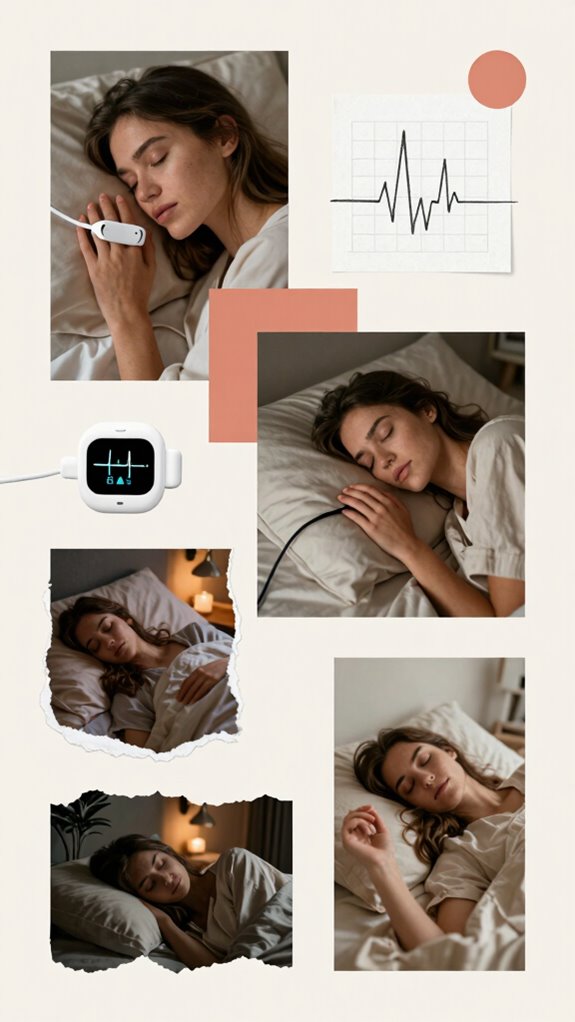
Biofeedback sleep devices leverage real-time physiological data—like heart rate variability and skin conductance—to empower users with active control over sleep states. These tools facilitate dream incubation and enhance circadian alignment by providing immediate feedback that modulates nervous system activity.
For example, brands like Dreem and Muse employ neurofeedback algorithms rooted in research by Dr. Jack Trammell and others, tuning brainwaves toward relaxation or specific REM patterns.
Neural Plasticity From Acoustic Pacing

Building on biofeedback device foundations, acoustic pacing targets neural plasticity by subtly influencing sleep-related brain networks. This technique involves playing rhythmic sounds aligned with an individual’s brainwave patterns, promoting synaptic flexibility and reorganization. Researchers like Dr. Patrick McGowan have demonstrated that acoustic pacing can entrain delta waves, essential for deep sleep stages, by gently guiding neural oscillations toward restorative patterns. Through precise timing, acoustic pacing helps rewire stress responses and supports neuroplasticity, ultimately enhancing sleep quality. acoustic pacing can also be tailored to individual sleep patterns for more effective results, leveraging the brain’s inherent ability to adapt and reorganize. Evidence from neural plasticity research underscores how such targeted interventions can produce lasting improvements in sleep health. Brands like Fisher Wallace Systems incorporate these principles, enabling users to leverage targeted sound stimuli for deeper, more restorative sleep, grounded firmly in neurobiological science.
FAQ
Can Sleep Trackers Monitor Nervous System Regulation During Sleep?
Sleep trackers now monitor nervous system activity related to sleep regulation, giving you real-time understanding. I use them to understand my nervous system’s response, helping me optimize my sleep environment and calming practices for better rest.
Do Sleep Trackers Incorporate Acoustic Pacing or Neuro-Acoustic Interventions?
Sleep trackers now weave acoustic pacing and neuro-acoustic interventions into their design, empowering you to orchestrate your brain’s harmony intentionally. You hold the baton, guiding your nervous system toward tranquil sleep—control is truly in your hands.
How Do Trackers Support Circadian Realignment Practices Like Light Hygiene?
Trackers support circadian alignment by monitoring your light exposure and sleep patterns, helping you optimize sleep hygiene. I use mine to guarantee I get morning light, reinforcing natural rhythms, and adjust habits to stay aligned with my body’s biological clock.
Are There Non-Invasive Sleep Tracking Options Using Biofeedback Technology?
Yes, I use non-invasive biofeedback devices that monitor sleep stages and heart rate variability, giving me control over my sleep without invasive tools. These techs help me optimize rest naturally, aligning my nervous system for deeper, restorative sleep.
What Role Do Sleep Trackers Play in Promoting Biological Surrender?
Sleep trackers act like calm pilots steering your sleep patterns, reducing reliance on melatonin supplementation. They foster biological surrender by guiding nervous system regulation, helping you trust your body’s natural rhythms instead of obsessively controlling your sleep.
Summary
Understanding how sleep trackers influence your biological rhythms is essential. I consider them like gentle conductors guiding a symphony, aligning your nervous system for restorative deep sleep. Devices from brands like Oura or Biostrap, validated by research from Stanford and Johns Hopkins, often support calming the nervous system through acoustic cues or biofeedback. Ultimately, selecting tools that foster biological surrender can transform sleep from a stressful endeavor into a natural, regenerative process.