I used to think night mode was my sleep savior. Spoiler: it wasn’t.
Turns out Apple and Samsung sold us a fancy placebo. That amber glow? Cute. But it’s still blasting enough blue light to mess with my melatonin like nobody’s business.
Harvard Medical School researchers cracked this years ago—our circadian systems are way more complex than a screen filter can handle. And now 2026’s “Sleepmaxxing” trend is finally catching on: people tracking HRV, optimizing core body temp, actually respecting their internal clocks.
At Corala Blanket, we’re done with half-measures. We engineer weighted blankets that activate your parasympathetic nervous system—no app required.
So ditch the digital band-aid. Your brain deserves better.
Quick Takeaways
- Night Mode primarily targets eye comfort and does not address neurological or hormonal factors affecting sleep quality.
- It reduces blue light exposure but often not enough to prevent melatonin suppression completely.
- Blue light’s impact on sleep involves complex brain pathways, which Night Mode does not modify.
- Sleep disruption is influenced by overall light exposure and other environmental or behavioral factors, not just screen hue.
- Effective sleep improvement requires holistic approaches like routines, environmental adjustments, and relaxation techniques beyond Night Mode.
Why Night Mode Fails to Improve Your Sleep
While Night Mode features—such as blue-light filtering glasses and screen dimming—are widely marketed as sleep aids, their efficacy often falls short because they address only one aspect of a complex biological process. Sleep isn’t solely about light exposure; it’s intricately linked to your sleep environment and cortisol management. Elevated cortisol levels, driven by stress or poor routines, can sabotage sleep regardless of device settings. Experts like Dr. Steven W. Lockley emphasize that managing environmental cues—like controlling noise, temperature, and light exposure—plays a much more crucial role in calming the nervous system and fostering natural sleep rhythms than relying solely on Night Mode in isolation. Incorporating aesthetic nighttime rituals, such as calming ambient sounds, herbal teas, or gentle stretching, can further enhance your sleep environment and reduce stress levels, promoting a more restful night.
What Are the Limitations of Night Mode?
Despite the popularity of Night Mode features—such as blue light filters and screen dimming—they possess notable limitations rooted in the complexity of human sleep regulation.
Cultural perceptions often inflate their efficacy, fueled by marketing myths from brands like Apple and Samsung, claiming near-miraculous sleep improvements.
In reality, these features only diminish some visual stimuli but don’t address underlying neurological and hormonal processes, such as melatonin suppression or circadian misalignment.
Sleep science from researchers like Prof. Charles Czeisler shows that our biological responses to light are multifaceted, influenced by factors beyond screen hue alone, rendering Night Mode a superficial fix at best.
Understanding brain wave patterns during sleep reveals that optimal sleep depends on a delicate balance of neurological activity that light filtering alone cannot fully support, especially since light exposure can still indirectly impact our circadian rhythms.
How Do Blue Light and Sleep Actually Interact?
Blue light’s influence on sleep extends beyond the superficial glare of screens; it interacts complexly with our circadian rhythms through intrinsically photosensitive retinal ganglion cells (ipRGCs). These cells serve as VIP messengers directly connected to the suprachiasmatic nucleus—the brain’s internal clock.
Blue light suppression reduces stimulation of these cells, diminishing the melatonin signal necessary for sleep readiness. Studies from researchers like Harvard’s Dr. Charles Czeisler emphasize that exposure to blue wavelengths, especially after sunset, interferes with melatonin production, delaying sleep onset.
This interference destabilizes sleep architecture, making it harder for our biological systems to shift smoothly into restorative rest.
What Alternative Strategies Can Better Promote Sleep?
Emerging research suggests that alternative strategies emphasizing nervous system regulation and environmental harmony can substantially enhance sleep quality, often surpassing traditional pharmaceutical or supplement-based approaches.
Techniques like dream incorporation—using guided imagery or lucid dreaming practices—facilitate psychological relaxation, aligning mental patterns with restful states.
Environmental harmony, achieved through subtle light adjustments, soundscaping, and bio-optimized textiles, stabilizes thermal and sensory inputs, reducing neural agitation.
Experts like Dr. Matthew Walker emphasize that aligning external cues and internal rhythms fosters a conducive sleep environment.
These methods empower us to leverage biological synchronization rather than mechanical interventions, enabling more predictable, restorative sleep through conscious environmental and mental calibration.
Vagus Nerve Stimulation Innovations
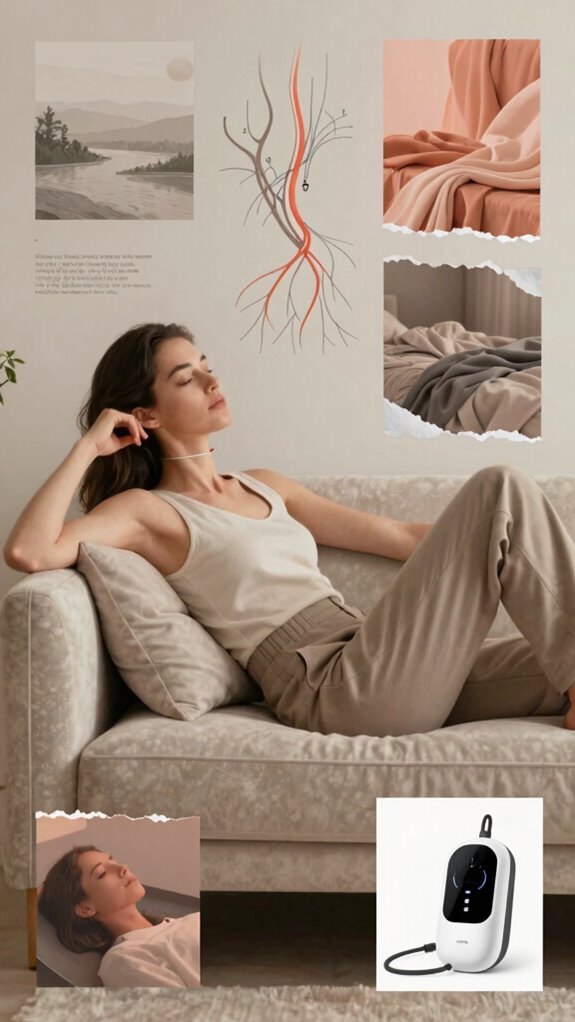
Innovations in vagus nerve stimulation (VNS) are transforming how we approach sleep regulation at a biological level. Recent advancements include non-invasive devices like gammaCore and eVox, which deliver targeted vagal stimulation to modulate autonomic regulation. A new development is the use of cold immersion tanks, which further support autonomic balance by promoting relaxation and reducing stress levels. These tanks leverage thermoregulation techniques to enhance relaxation responses and improve sleep quality. Experts like Dr. Kevin J. Tracey highlight VNS’s potential to downregulate sympathetic activity—responsible for stress and hyperarousal—and activate parasympathetic pathways that promote relaxation. These innovations allow precise control over nervous system balance without surgical implants.
Smart Sleep Tech Reviews
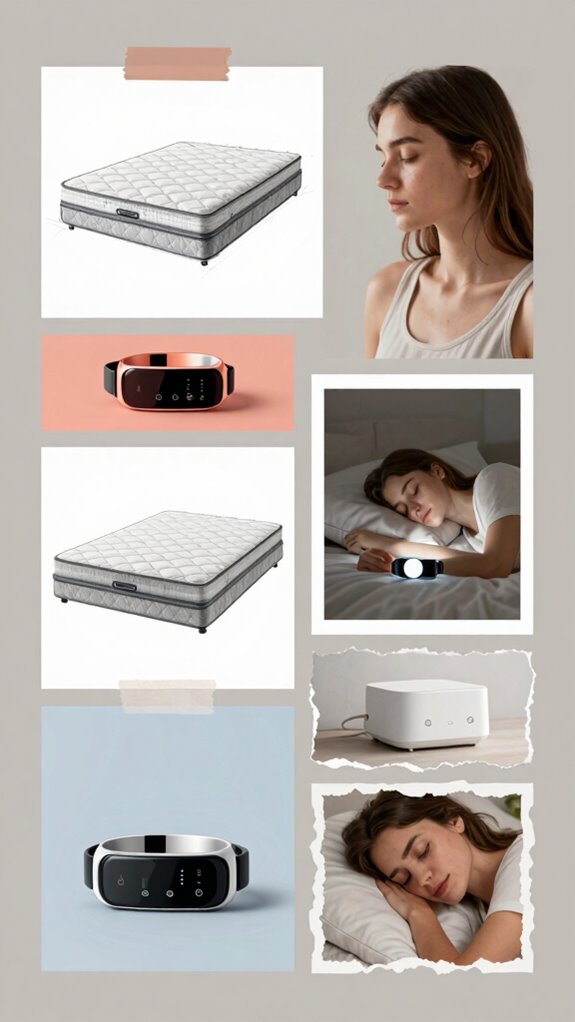
Among the array of sleep technology available today, smart sleep devices have evolved beyond simple activity tracking into sophisticated tools designed to influence and optimize sleep quality through precise neurofeedback and environmental modulation.
Brands like Eight Sleep and SomnoBond integrate environmental controls with circadian rhythm principles, adjusting temperature and ambient light based on real-time data. These devices enhance the sleep environment’s stability, aligning it with your body’s internal clock.
Empirical studies by researchers such as Dr. Charles Czeisler highlight that early evening light exposure and temperature regulation profoundly reinforce natural circadian cycles, leading to more restorative sleep without reliance on external chemicals. Environmental modulation is a crucial feature that modern smart sleep tech leverages to synchronize sleep patterns with biological rhythms, often utilizing biological clock insights to optimize effectiveness.
Silent Meditation for Sleep
Silent meditation for sleep leverages the power of deliberate mental stillness to shift the nervous system from activation to relaxation. A process supported by research from sleep scientists like Dr. Herbert Benson.
By practicing mindful breathing, you focus on slow, deep inhales and exhales, calming the hyperaroused mind. This focused attention on breathing further enhances the relaxation response, making it easier to transition into sleep.
Sensory deprivation, such as in darkness or with noise-canceling devices, enhances this effect by minimizing external stimuli. These methods create a physiological environment conducive to allow the parasympathetic nervous system to dominate, facilitating shift into sleep.
Research into mental stillness emphasizes its vital role in promoting relaxation and restful sleep, further supporting these techniques. Additionally, creating a calming sleep environment, such as with stylish frameless wall mirrors, can contribute to a sense of tranquility and help prepare the mind for rest.
Brands like Muse or Zazen emphasize this approach, offering scientifically grounded tools for sleep-centric meditative practices.
FAQ
Can Individual Differences Affect Night Mode’s Effectiveness?
Individual differences, like genetic predispositions and habits, definitely influence night mode’s effectiveness. You control how it impacts you by tailoring your routines and understanding your unique biology—what works for someone else might not be ideal for you.
Does Reducing Blue Light Guarantee Better Sleep Quality?
Reducing blue light helps improve sleep by supporting spectral sensitivity and nocturnal melatonin production, but it’s not a guarantee. Your individual biology and nervous system regulation play vital roles in whether it truly enhances your sleep quality.
How Quickly Does Night Mode Influence Sleep Onset?
Night mode can help you fall asleep faster, often within minutes, by lowering screen brightness and optimizing ambient lighting. It’s about reclaiming control, creating a calmer environment that signals your nervous system to unwind and shift seamlessly into sleep.
Are There Risks in Relying Solely on Night Mode for Sleep?
Relying solely on Night Mode can be risky because screen glare and eye discomfort might still persist, disrupting your sleep even if you’re trying to control exposure. You need a holistic approach for true sleep control and peace.
What Lifestyle Factors Impact Night Mode’s Success?
Your diet habits and physical activity considerably influence night mode’s effectiveness. I find that a balanced diet and regular exercise help regulate my nervous system, making night mode more successful, as they promote overall biological harmony and better sleep.
Summary
Night mode offers a superficial respite, but true sleep regulation requires engaging with the body’s complex neurobiological systems. As research by neuroscientists like Dr. Michael Merzenich shows, optimizing sleep demands more than filtering blue light—it involves stimulating parasympathetic pathways, like the vagus nerve, and restoring circadian harmony. The question remains: will you settle for temporary fixes or explore these deeper, scientifically supported strategies that finally align your sleep with your biology?