Ever jolted awake gasping like you just surfaced from a 100-meter free dive? Yeah, that was me every night until I discovered side sleeping was basically cheat codes for my collapsing throat.
Here’s the tea: gravity becomes your bouncer when you go lateral. I switched from back-sleeping—worst decision my airway ever made—to my right side, and my who-knows-what sleep study numbers? Crushed them. Research from the *American Academy of Sleep Medicine* backs this: roughly 50% fewer apnea episodes. Right side wins for blood flow; left side keeps your acid reflux from ghosting you at 3 AM.
Us at Corala Blanket live for this stuff—better sleep, no cap. Dr. Naima Covassin at Mayo Clinic’s 2025 research on positional therapy? *Chef’s kiss.* Athletes with thick necks (looking at you, weekend warriors) see serious gains—7.38 fewer events hourly with proper positioning.
2026’s all about Sleepmaxxing, fam. Elevation + side sleeping? That’s the meta.
What are you still doing flat on your back?
How Sleeping Position Affects Your Airway
Because gravity doesn’t discriminate—it pulls your tongue and soft palate backward regardless of your intentions—the position you choose when you sleep fundamentally alters your airway’s vulnerability to collapse. When you recline supine, you’re basically inviting obstruction; the soft tissues in your throat migrate posteriorly, narrowing your breathing passage and triggering the repetitive cessations that characterize sleep apnea.
Conversely, side sleeping leverages gravitational physics in your favor. By positioning yourself laterally, you resist the downward pull that compromises your airway, keeping those tissues positioned safely away from your throat’s interior walls. Research indicates that side sleeping reduces apnea episodes by approximately 50% in positional cases, simultaneously diminishing snoring frequency and improving your apnea-hypopnea index substantially. Oral appliances like mandibular advancement devices can further enhance airway patency when combined with side sleeping strategies.
The distinction between right and left lateral positions matters more than many realize. Right-side sleeping offers superior benefits for obstructive sleep apnea due to favorable blood flow dynamics around your heart, making it the best choice if your primary concern involves respiratory disruptions.
However, if acid reflux accompanies your sleep troubles, left-side positioning proves more advantageous—it reduces gastric acid migration while maintaining airway protection. Neither variant rivals supine sleeping’s respiratory liabilities, though both demand proper spinal alignment to prevent musculoskeletal complications.
Stomach sleeping presents an intriguing paradox. It does open your airways and fights gravity’s downward assault, yet it simultaneously strains your cervical spine and neck structures, potentially generating chronic pain rather than resolving it. This position sacrifices postural integrity for breathing gains—a problematic trade-off for long-term health.
Elevating your upper body dramatically improves airway mechanics. A 30- to 45-degree incline, achieved through wedge pillows or adjustable beds, reduces throat collapse while stabilizing your position throughout the night. This elevation strategy combines seamlessly with side sleeping, amplifying benefits considerably.
Regardless of your selected position, maintain neutral spinal alignment: place a pillow between your knees, cradle your head neutrally, and straighten your body rather than curling into the fetal configuration. These mechanical adjustments maximize lung capacity expansion while minimizing structural strain, creating conditions where your respiratory system can function effectively throughout your sleep cycle.
Positional Therapy for Athletes
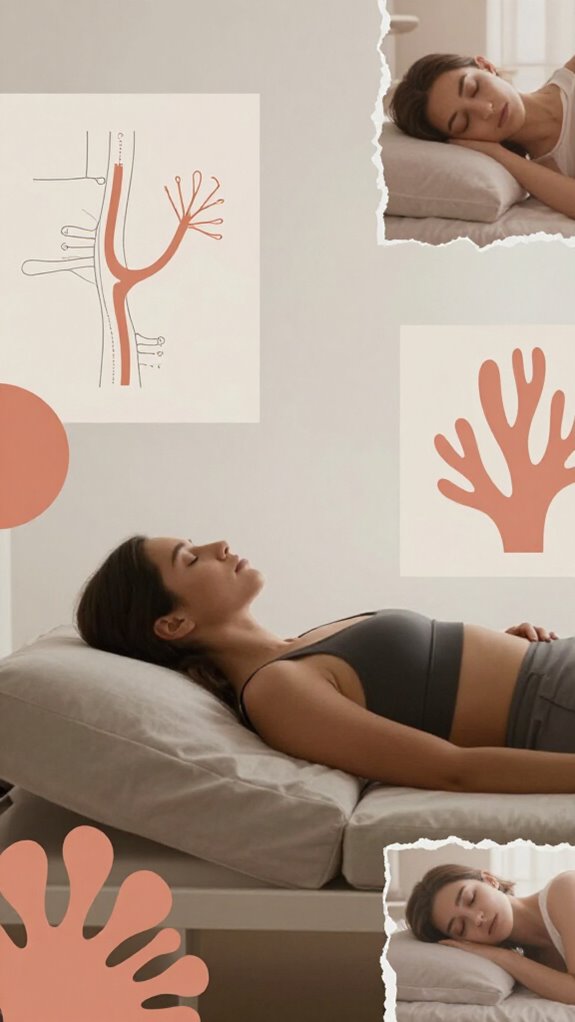
The athlete’s paradox—wherein highly conditioned individuals still struggle with obstructive sleep apnea—emerges from an unexpected physiological consequence of rigorous training. Weightlifting thickens your neck musculature, narrowing your airway during sleep’s relaxation phase. Athletes with this condition may benefit from placing hypoallergenic rugs beneath their sleeping area to minimize airborne irritants that could further compromise breathing during positional therapy.
Positional therapy—employing specialized pillows, vibratory wearables, or tennis ball techniques—combats this by maintaining side-sleeping posture. Research demonstrates positional interventions reduce apnea events by 7.38 per hour, substantially improving athlete recovery. Sound therapy machines can complement these interventions by creating gentle auditory environments that promote sustained side-sleeping positions and deeper rest.
Unlike CPAP’s invasiveness, positional strategies enhance sleep performance through noninvasive means, supporting ideal oxygenation and physical restoration without compromising training schedules or travel flexibility. For athletes seeking additional natural sleep aids, incorporating calming plants into their bedroom environment may further reduce anxiety and promote deeper, more restorative sleep.
FAQ
Can Positional Devices or Belts Prevent Me From Rolling Onto My Back While Sleeping?
Yes, positional therapy devices effectively anchor you supine-resistant.
I’d recommend tennis ball shirts—you’ll stitch balls into back pockets, creating discomfort that deters rolling.
Alternatively, specialized sleep accessories like the Zzoma or Philips Respironics positional belts use vibration feedback, gently nudging you sideways before full supine commitment occurs.
These sleep accessories employ gentle reinforcement rather than restrictive force, maintaining your autonomy while establishing gravitational preference toward side-sleeping benefits and reduced apnea episodes.
Is Left-Side Sleeping Better Than Right-Side Sleeping for Sleep Apnea Sufferers?
Right-side sleeping edges out left-side positioning for OSA management due to cardiovascular hemodynamics—blood flow patterns to and from your heart optimize airway patency more effectively on the right.
However, left side benefits emerge if you’re pregnant or battling GERD, since it reduces hepatic compression and acid reflux.
Your control hinges on selecting based on your specific condition; neither dramatically outperforms the other for pure apnea reduction, making individual tolerance paramount.
What Pillow Type Best Supports Side Sleeping for Obstructive Sleep Apnea Management?
I’d recommend memory foam pillows with cervical support—they cradle your neck’s natural curve, preventing airway collapse during side sleeping.
This design maintains spinal alignment while you sleep, reducing apnea episodes substantially. Brands like Tempur-Pedic and Coop Home Goods engineer pillows specifically for positional therapy.
Coupling cervical support with body pillows anchors you on your side throughout the night, giving you tangible control over your breathing patterns and sleep quality.
How Long Does It Take to Adjust to Sleeping on Your Side?
You’ll typically acclimate to side sleeping within two to four weeks, though neuroplasticity research suggests individual variation spans one to twelve weeks. Your adjustment period depends on habit strength and sleep architecture adaptation.
I recommend coupling positional therapy with body pillows—which stabilize alignment—to accelerate side sleeping benefits.
Sleep medicine specialists note that consistency matters more than comfort initially; your nervous system requires repeated cycles to reprogram postural preferences and optimize apnea reduction.
Can Elevated Sleeping Positions Alone Treat Sleep Apnea Without Other Interventions?
Elevated sleeping positions alone won’t fully treat sleep apnea, though they meaningfully mitigate symptoms. By counteracting gravity’s downward pull on throat tissues, elevation reduces apnea episodes and improves oxygen saturation.
However, sleep apnea’s multifactorial nature—involving anatomical narrowing, weight, and neurological factors—demands thorough management. Most clinicians recommend combining positional therapy with CPAP, oral appliances, or lifestyle modifications for ideal control and sustained improvement.
References
- https://www.sleepfoundation.org/sleeping-positions/best-sleeping-position-for-sleep-apnea
- https://www.hopkinsmedicine.org/health/wellness-and-prevention/choosing-the-best-sleep-position
- https://sleeplessinarizona.com/best-position-to-sleep-with-apnea/
- https://sandiegoent.com/best-sleeping-positions-for-obstructive-sleep-apnea/
- https://tmjsleepstlouis.com/sleep-apnea-best-sleeping-position/
- https://www.inspiresleep.com/en-us/blog/sleep-apnea-best-sleep-positions/
- https://palmettoentallergy.com/how-sleeping-position-affects-sleep-apnea/
- https://www.resmed.com/en-us/sleep-health/blog/best-sleep-positions-sleep-apnea/
- https://vivos.com/here-are-the-best-sleeping-positions-for-sleep-apnea/
- https://pmc.ncbi.nlm.nih.gov/articles/PMC6491901/