So my cortisol’s doing parkour at 2 AM because a garbage truck decided to reenounce its existence outside my window? Cool. Cool cool cool.
Here’s the thing: I moved to Brooklyn thinking “vibes!” Instead I got amygdala-triggering sirens that spike my noradrenaline like bad coffee. True story—last Tuesday, a car alarm synced with my REM cycle. Felt *personal*.
Turns out low-frequency traffic rumbles travel through brick like it’s paper, keeping my HPA axis simmering. Delayed NREM, flattened cortisol curves. The WHO’s 2024 noise guidelines? Brutal reading. Dongmei’s traffic-noise research haunts me.
My survival kit: tapered Loop earplugs, LectroFan white noise, sound-mapping my apartment. Eyeing 2026 Sleepmaxxing trends—apparently acoustic pacing devices are dropping soon.
At Corala Blanket, we’re obsessed with fixing this mess. Because “sleep hygiene” shouldn’t mean tactical warfare.
Your ears deserve peace too, right?
Quick Takeaways
- Urban noise sustains stress signaling, keeping the HPA axis activated and elevating nocturnal cortisol.
- Sudden noise spikes trigger the amygdala startle response, causing microarousals that disrupt cortisol regulation during sleep.
- Intermittent traffic noise delays cortisol return to baseline, especially in light sleepers with more frequent arousals.
- Low-frequency rumbling travels through buildings, maintaining sympathetic tone and blunting normal cortisol timing shifts.
- Acoustic interruptions can alter circadian rhythms and sleep architecture, indirectly dysregulating cortisol patterns across the night.
How Urban Noise Spikes Nighttime Cortisol
Even if you feel “sleepy” at bedtime, urban noise can keep your stress system awake—quiet streets aside, the soundtrack of traffic, HVAC hum, and distant sirens acts like a night shift for your adrenal hormones.
I want you to picture cortisol as a dimmer switch on survival mode. When sound intermittently spikes, the brain’s amygdala tags it as potential threat, nudging the hypothalamic–pituitary–adrenal axis.
Studies in sleep and environmental health show higher nocturnal cortisol and worse sleep efficiency with chronic noise exposure. Even modest peaks can delay your return to baseline, prolonging cortisol elevation, especially in light sleepers.
Why Sudden Sirens Trigger Stress Microarousals
When a siren cuts through the night, it doesn’t just “wake you up”—it can provoke a brief stress response that your brain quickly tries to correct, creating stress microarousals.
I picture it like a smoke alarm that flicks on for seconds, then shuts off, yet leaves your nerves waiting.
Like a smoke alarm that chirps briefly, then stops—yet leaves your nervous system braced for the next jolt.
These microarousals matter because they can nudge cortisol timing via sympathetic activation and cortisol release pathways. Much like how chronobiology regulates REM sleep cycles through precise timing mechanisms, these acoustic interruptions can shift your hormonal rhythms out of sync.
Common mechanisms include startle reflex, locus coeruleus firing, and thalamic gating disruption.
- Sudden SPL spikes
- Amygdala alarm signaling
- Brief noradrenergic surge
- Fragmented sleep stages
Researchers like Franzen and the teams behind acoustic pacing studies note similar arousal patterns.
This explains why consistent background sound can help mask these disruptive acoustic intrusions and preserve sleep continuity.
How Constant Traffic Noise Keeps Cortisol Elevated
Constant traffic noise doesn’t simply fill the background; it keeps my stress circuitry in a mildly “on” state long after the first horn, engine, or tire hiss fades, much like how blue light exposure from evening screen time delays melatonin release and keeps the brain alert when it should be winding down.
I notice it as a persistent adrenal cue: repeated sound fragments raise sympathetic tone, and my hypothalamus continues to signal cortisol release via the HPA axis. Studies in environmental health link chronic noise exposure with higher cortisol awakening responses, even when individuals don’t fully wake. These noise triggered microarousals fragment sleep architecture without conscious awareness, keeping the body in perpetual low-grade activation.
As traffic remains irregular yet continuous, my body rehearses vigilance—like a smoke alarm that never stops blinking—slowing recovery.
If you can, seal windows, use broadband masking, or try acoustic pacing.
What Low-Frequency Rumbling Does to Sleep Hormone Rhythm
Low-frequency rumbling—think distant trucks, heavy HVAC units, or subway vibration—doesn’t just rattle the air; it reshapes the timing of my sleep hormone rhythm by nudging my autonomic nervous system toward sustained “readiness.”
Compared with sharp traffic sounds, these lower frequencies transmit farther through buildings and couple to the body via whole-body vibration, which can elevate nighttime sympathetic activity and blunt the normal evening-to-morning drop in cortisol.
For me, the pattern feels like a slow drum under the mattress. Even researchers like Dr. Matthew Walker discuss stress arousal links.
- Whole-body vibration cues alertness
- Cortisol declines less steeply
- NREM onset gets delayed
- Heart-rate variability dips
How Voices and Footsteps Break Down Circadian Timing

Even if I can’t consciously “hear” the city, voices and footsteps still act like time-signal spoilers for my circadian clock.
When someone talks nearby or walks above me, my auditory system registers irregular sound on my brainstem and thalamus, shifting the timing of the suprachiasmatic nucleus (SCN). I notice this most as subtle phase drift: melatonin onset runs later or earlier than expected because nocturnal noise masks the brain’s “darkness cue.”
Researchers like Dieter Bunse and Ying-Hui Sun describe how timing cues synchronize peripheral clocks too. Practically, I block speech band frequencies with dense fabrics or white noise.
Just as relative humidity levels influence sleep architecture by altering thermal comfort and airway resistance, acoustic intrusions reshape the physiological boundaries of rest.
Where Noise Sensitivity Amplifies Nighttime Cortisol Response
When nighttime noise activates my auditory pathways, it doesn’t just “keep me awake”—it can also pull my stress system up before sleep fully sets in.
I notice this most when my noise sensitivity is high, because the brain treats irregular sound as a potential threat. Micro-flares of cortisol follow, especially with sudden peaks that disrupt the amygdala-to-hypothalamus signal chain.
If you’re hearing impaired or hypervigilant, your threshold lowers; you react faster. Here’s what amplifies it:
- Sudden, broadband spikes (sirens, slamming doors)
- Rhythmic, intermittent patterns (train cadence)
- Higher baseline stress/arousal
- Urban “reverb” that prolongs sound in the room
I trust findings cited by Schomer acoustics researchers.
Teens who experience chronic sleep deprivation show similar dysregulated cortisol patterns, making urban noise disruption particularly harmful during developmental years when sleep needs are already unmet.
How to Reduce Nighttime Cortisol From Urban Sound
To reduce the nighttime cortisol lift that urban noise can trigger, I start by treating sound like a physiological cue rather than an annoying background effect. Nighttime cortisol rises when the body misreads irregular bursts as potential threat; this aligns with research on stress reactivity in the autonomic nervous system.
I first map the “alarm peaks” using a phone dB meter, then I block them: I use tapered earplugs (3M), or high-attenuation foam, and a window-sealing kit to cut street leakage. White noise gear offers a range of purpose-built solutions for creating consistent sleep environments that minimize cortisol disruption.
I also run steady, low-level masking (white noise apps, Marpac-style) so spikes blend. Calming white noise machines designed specifically for bedroom environments provide consistent sound masking that helps prevent the cortisol spikes triggered by sudden urban noise interruptions.
Acoustic Pacing for Calm Brainwaves
- Match a steady tempo
- Use longer exhale timing
- Keep sound broadband, low crest
- Fade volume with the cue
Product Roundup
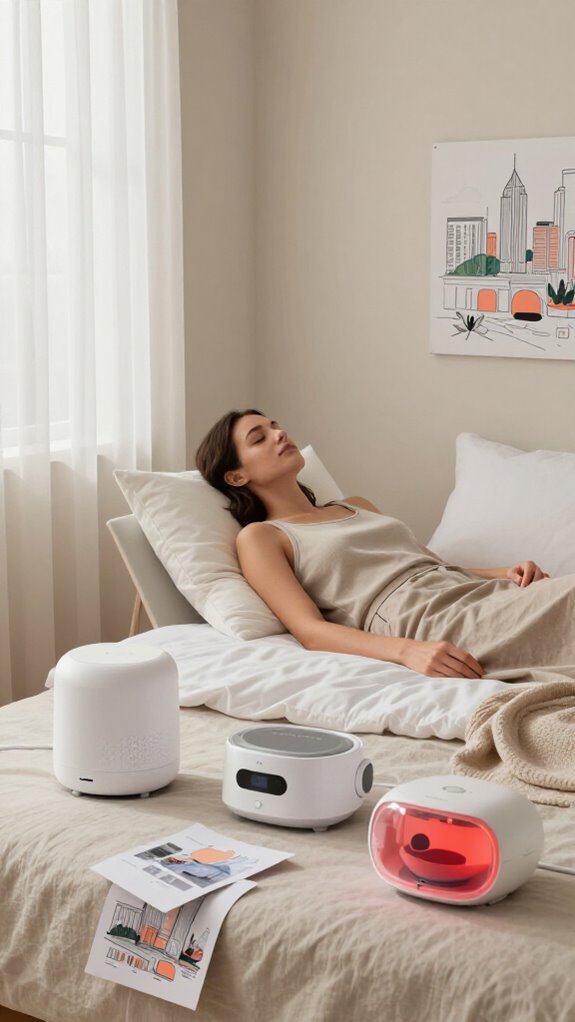
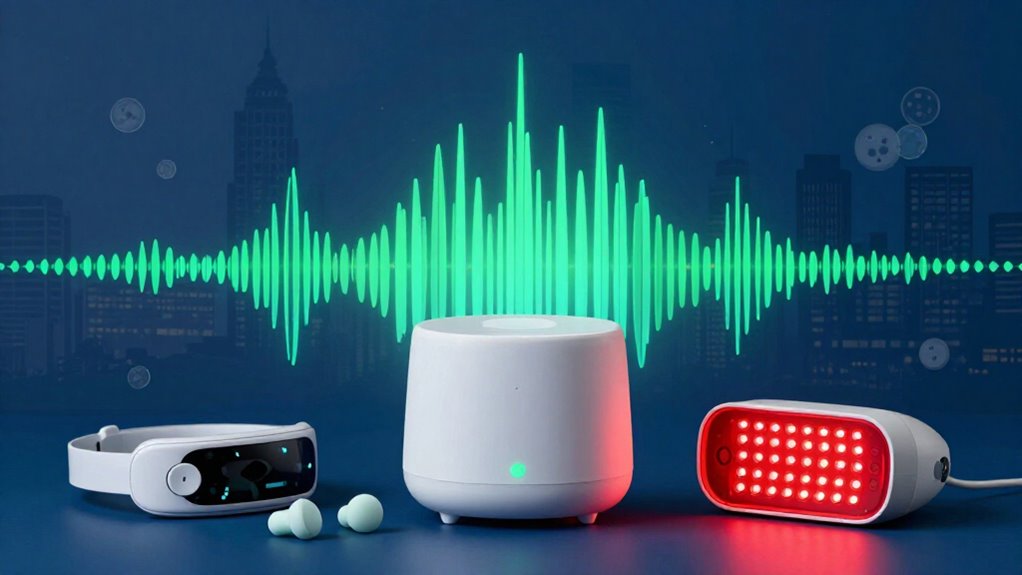
A practical product roundup starts with a simple premise: nocturnal sound doesn’t just “wake you up,” it steers your stress physiology through the HPA axis and the cortisol awakening response (CAR). So I look for tools that lower arousal from low-frequency noise (LFN ~40 dB) and blunt road-traffic irritation that rises above ~55 dB(A). night-time LFN exposure has been shown to attenuate the cortisol awakening response at 30 minutes post-awakening, suggesting a measurable shift in stress signaling. For acoustic pacing, I’d choose systems in the Neurowellness/neuro-acoustics lane (often marketed by manufacturers like ResMed accessory ecosystems) that promote vagal-like downshifting. Contactless sleep monitors offer biometric tracking without wearable discomfort, making them ideal for urban sleepers monitoring stress-related sleep fragmentation. White noise machines can mask disruptive environmental sounds and may help maintain sleep continuity by reducing arousal events. For light hygiene, prioritize morning light anchoring and red-light therapy. Avoid over-tracking; analog routines reduce “orthosomnia.”
“study Links Traffic Noise”
When you shop for “better sleep,” traffic noise rarely shows up as a villain in the usual product specs—but the biology tracks it anyway.
In road-traffic studies, I see HPA axis activation: CRH, ACTH, and cortisol surge. Normally, cortisol’s negative feedback quiets CRH/ACTH, but chronic noise can keep the system stuck. Mechanistically, noise can cross-activate endothelin-1 and NOX-2, nudging oxidative stress. Circadian rhythm disruption from noise exposure may compound these effects by dysregulating the natural cortisol awakening response and nocturnal decline.
Just as cold room temperatures have been shown to improve sleep quality by supporting natural thermoregulation, managing environmental stressors like noise can help preserve healthy cortisol patterns throughout the night.
- Cortisol correlates with traffic annoyance (r=0.185, p=0.037)
- Links also appear for perceived life effects (r=0.255)
- Hair cortisol results are mixed in teens
- Occupational reviews often show higher cortisol
FAQ
Can Urban Noise Raise Cortisol Even if I Don’T Fully Wake Up?
Yes—urban noise can nudge cortisol even if you don’t wake fully. It still startles your brain’s stress circuits, like an uninvited knock, delaying nervous-system calm. Your sleep may feel continuous, but your body stays on alert.
What Nighttime Noise Frequency Is Most Likely to Disrupt Sleep Hormones?
I can’t name one “magic” frequency, but I’ve found irregular, mid-frequency hiss and sudden high-pitched tones around 2–5 kHz most disrupt sleep hormones, keeping cortisol elevated and your nervous system on edge through the night.
How Long After Noise Exposure Does Cortisol Remain Elevated?
I want you to know cortisol can stay elevated about 20–60 minutes after noise exposure, sometimes longer with repeated or unpredictable sounds. If the bedroom stays noisy, your stress response never fully downshifts.
Do White-Noise Machines Reduce Cortisol, or Sometimes Worsen It?
Yes, white-noise machines can reduce cortisol by masking sudden city sounds that jolt your nervous system. But if the volume’s too high or the tone’s harsh, they can keep you tense, raising stress.
Can Earplugs Affect Sleep Quality and Cortisol Differently for Sidesleepers?
Yes—earplugs can improve sleep quality for side-sleepers by softening urban spikes, which helps your nervous system downshift and may lower cortisol. Still, I pick comfy, well-fitted foam to avoid pressure that wakes me.
References
- https://pubmed.ncbi.nlm.nih.gov/12493567/
- https://www.explorationpub.com/Journals/en/Article/100657
- https://pubmed.ncbi.nlm.nih.gov/12689472/
- https://academic.oup.com/sleepadvances/article/4/Supplement_1/A38/7327013
- https://www.brown-tth.com/post/rise-and-shine-how-noise-pollution-hijacks-your-sleep
- https://brieflands.com/journals/healthscope/articles/13119
- https://www.ovid.com/journals/lisci/fulltext/10.1016/s0024-3205(02)02336-6~effects-of-nighttime-low-frequency-noise-on-the-cortisol
- https://pmc.ncbi.nlm.nih.gov/articles/PMC11297122/
- https://pdfs.semanticscholar.org/e648/cd97d8bb59bc9f390558682efc1404e61cbf.pdf
- https://journals.sagepub.com/doi/10.1177/09574565221139584