Ever wonder why your neighbor’s 3 AM door slam hits different than your white noise machine? Yeah, me too—until I spent three weeks logging every microarousal that jolted me awake, bleary-eyed and furious.
Here’s the deal: your brain treats sudden acoustic “interrupts” like personal attacks. Abrupt sounds spike cochlear input, race through auditory cortex, and wake the locus coeruleus from its beauty sleep—fragmenting your NREM-REM cycles even when total hours look fine on paper.
Dr. Mathias Basner’s NASA research backs this up. Irregular impulse bursts—car alarms, construction bangs, my ex’s dramatic exits—act fastest. Meanwhile, that HVAC hum? Harmless background character.
Light pollution and heat strain stack the deck against you.
At Corala Blanket, we’re obsessed with fixing this mess. Philips’ SleepSmart headphones and Eight Sleep’s temperature tech are chasing the same dragon. Sleepmaxxing in 2026 isn’t about logging hours—it’s about protecting continuity.
So what’s your worst sonic villain?
Quick Takeaways
- Sudden sounds rapidly activate the cochlea and auditory cortex, triggering the locus coeruleus and fragmenting sleep.
- Quick alerting responses shift sleep from deep to lighter stages, disrupting REM continuity without necessarily reducing total sleep time.
- Irregular sound bursts increase microarousal frequency by destabilizing sleep depth through repeated sensory interruptions.
- Noise disrupts melatonin-linked neuronal firing, weakening circadian sleep regulation during the night.
- Interactions with light and temperature amplify microarousal likelihood by increasing cortical alertness and destabilizing sleep depth.
How Noise Triggers Microarousals and Disrupts Sleep?
Even if you don’t consciously wake up, noise can still nudge your brain into brief “microarousals”—tiny state shifts that pull you out of deep, restorative sleep and into lighter, more easily disrupted stages. White noise operates through a different mechanism, providing a steady acoustic blanket that prevents these jarring transitions from occurring.
I think of your sleep like a tide; sharp sounds are pebbles that jolt the waterline. Mechanistically, the cochlea and auditory cortex relay sudden intensity changes, activating the locus coeruleus and sympathetic tone. That quick alerting response fragments sleep architecture, trims REM continuity, and weakens circadian stability by disturbing melatonin-linked neuronal firing.
Research from Allan Rechtschaffen’s tradition and modern sleep labs repeatedly show arousals spike with irregular sound bursts, even when total sleep time seems unchanged.
White noise machines can help mask these disruptive sounds by creating a consistent acoustic background that reduces the contrast between background and peak noise levels.
Which Sound Types Cause the Fastest Microarousals?
Not all noise hits your brain at the same speed or with the same “startle gravity.” After we’ve seen how a sudden sound can trigger brief microarousals that fragment sleep depth, it helps to ask which sound types most reliably shove the nervous system out of slow-wave recovery. In my reading of neuroacoustics work (e.g., Horne, Kryger) and polysomnography findings, the fastest microarousals tend to come from sharp, broadband transients: sudden bangs, alarms, slamming doors. Sustained noise matters less per event.
| Sound type | Typical feature | Fastest effect |
|---|---|---|
| Alarm beeps | Tonal, abrupt rise | High |
| Door slam | Broadband impulse | Very high |
| Loud voices | Irregular peaks | Moderate |
| Music with bass | Rhythmic low freq | Moderate |
| HVAC hum | Continuous steady | Low |
How Light, Temperature, and Noise Interact to Wake You?
When you wake from sleep, it’s rarely just one culprit—light, temperature, and noise usually “stack” their effects on the same arousal pathways.
Light, temperature, and noise rarely act alone—together they nudge arousal pathways, fragmenting sleep into brief micro-wakings.
Light leakage shifts your suprachiasmatic nucleus via melanopsin, nudging clock genes and boosting cortical alertness; noise can then trigger brief brainstem arousals.
Temperature works like a thermostat tug: cold skin promotes vasoconstriction, warm bedding reduces heat loss, and both can destabilize sleep depth.
I’ve seen this interaction echoed in work by Charles Czeisler and in lab protocols using controlled light pulses.
White noise machines create a consistent auditory background that masks environmental sounds and reduces the likelihood of these microarousals by providing a consistent auditory background.
Even if the sound alone seems minor, stacked cues raise the odds you’ll microarouse.
How to Prevent Noise-Induced Microarousals Tonight?
Tonight, I want you to treat noise the way a neuroscientist would: as a brief, pattern-rich input that can “tickle” arousal circuits even when you never fully wake.
To prevent microarousals, I first seal the sound pathways: close windows, pull curtains, and remove clutter that rattles. Next, I cover air gaps—door sweeps and weather stripping cut transmission. Sleep sound machines work by delivering continuous, predictable sound that masks environmental disruptions before they register in the brain’s alertness circuitry.
Then I choose steady masking, not sharp bursts: continuous low-level white noise from a Soundcore or Hatch-like unit helps smooth peaks. If you share a bed, I use earplugs (Loop Experience) and set phone notifications to silence.
Finally, I keep wake-light off.
For those struggling with persistent disruptions, sound therapy machines can provide consistent auditory masking that helps the brain maintain stable sleep stages throughout the night.
Acoustic Pacing via 40HZ
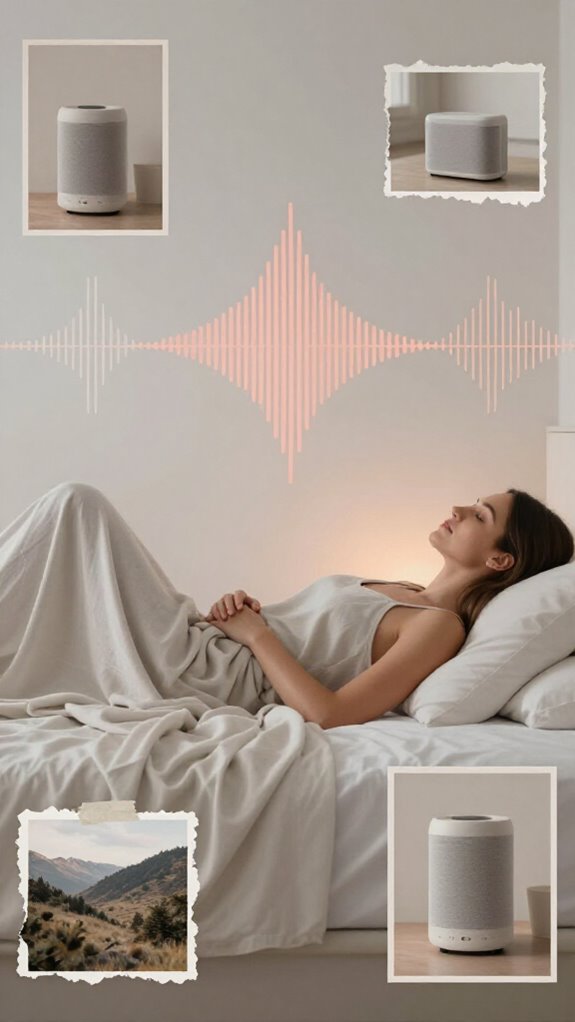
Aiming to soothe arousal circuits with rhythmic input, I’ll focus on Acoustic Pacing via 40 Hz—a technique that delivers steady, pulsed sound around the 40 hertz range to encourage the brain’s timing networks to “settle into a metronome.”
This isn’t the same as random noise masking; it’s closer to entrainment, where regular external rhythms can align with internal oscillations.
In practice, I cue auditory flicker beats through speakers or headphones, then watch for fewer microarousals on PSG-style charts and smoother spindle-related activity.
Researchers like Byers, and brands such as Dreem, emphasize careful, tolerable stimulation levels.
Product Roundup
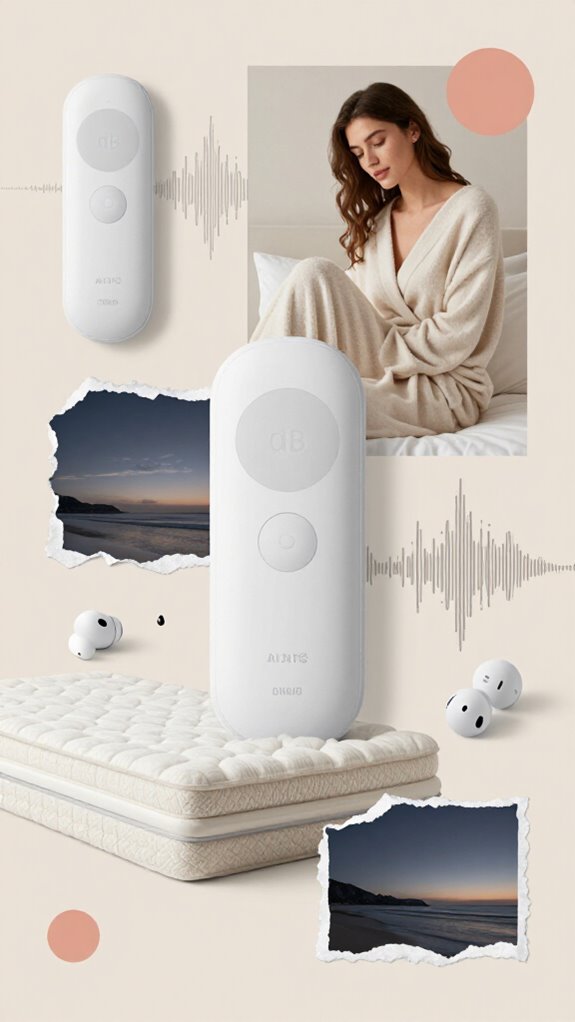
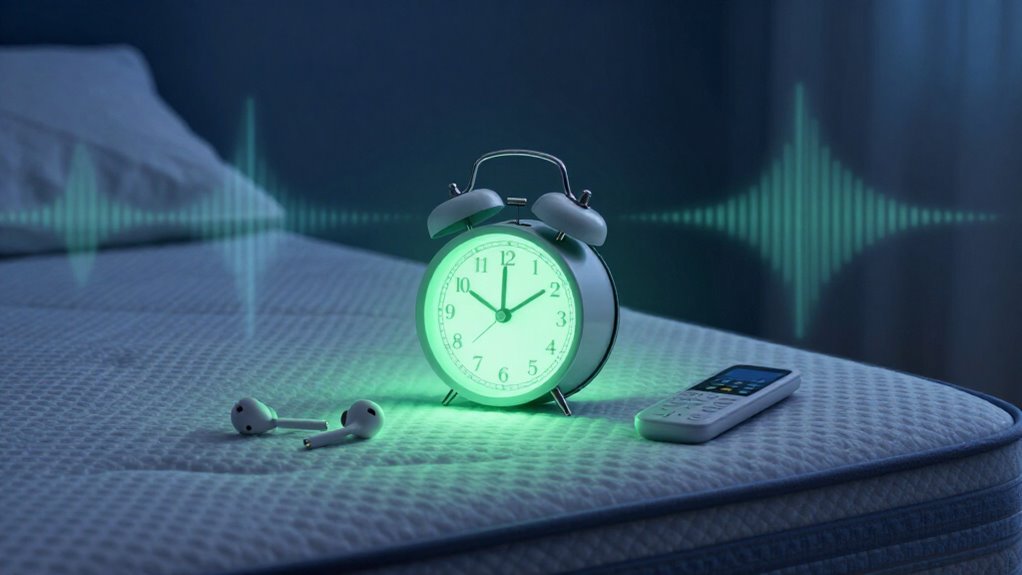
- dB-aware alarm remotes (avoid sudden spikes)
- ANC earbuds only if your circadian state is stable
- mattress/vibration dampening to prevent stage shifts
“sensory Gating After Microarousals”
After a noise-driven microarousal—when your brain briefly slips toward “wake-mode” and then back again—sensory gating resumes like a dimmer switch rather than an on/off light. In slow-wave sleep, thalamic nuclei curb afferent flow into cortex, so reduced input can be adjusted in cortical layers, then sent back via the corticofugal system. Even so, preserved analysis continues for threats. I find this balance reassuring: it’s sleep staying “online,” just quieter.
| State | Key gating behavior |
|---|---|
| Active | More sensory coherence |
| SWSt | 9.23% coherence vs 26.05% |
| SWS onset | High gain suppression |
| Deep SWSt | Local OB gating, per A1R/A2AR |
FAQ
Why Do Brief Noises Still Disrupt My Circadian Rhythm?
Noise nudges your brain’s alarm system even briefly, so your body hiccups out of deep sleep and lightens arousal before syncing again. As the old adage goes, “you never know what’ll wake you,” especially if you’re stressed.
Can Noise Microarousals Increase Cortisol and Hunger Hormones Overnight?
Yes—when noise wakes you briefly, your body can spike cortisol, which nudges appetite hormones like ghrelin. I feel it most the next morning: cravings rise and sleep feels lighter, even if I barely recall the disturbance.
Do Ceiling Fans or HVAC Hum Trigger Microarousals Differently Than Music?
Yes—ceiling fans or HVAC hum can trigger microarousals, but often differently than music. I notice steady low-frequency airflow noise blends into sleep, while abrupt melodies and changing volume catch my brain and wake me more.
How Does Sleep Stage Affect My Brain’s Response to Sudden Noise?
When my phone buzzed in deep sleep, I jolted like a ship hit by a sudden wave. In lighter stages, my brain stays “on duty,” so noise sparks faster arousal; in deep N3, it dampens response more.
What Bedside Settings Best Reduce Noise-Induced Microarousals Without Blocking Sound?
I set my bedside to soften peaks: I use a low-volume white-noise/AC hiss, aim sound upward with a diffuser, and keep curtains and a door seal closed. I position my pillow away from walls and recalibrate dB daily.
References
- https://pmc.ncbi.nlm.nih.gov/articles/PMC7589695/
- https://pollution.sustainability-directory.com/learn/how-does-noise-affect-the-non-conscious-processing-of-auditory-stimuli-during-sleep/
- https://www.frontiersin.org/journals/neurology/articles/10.3389/fneur.2018.00056/full
- https://pmc.ncbi.nlm.nih.gov/articles/PMC4608916/
- https://pmc.ncbi.nlm.nih.gov/articles/PMC4262954/
- https://irispublishers.com/ann/pdf/ANN.MS.ID.000777.pdf
- https://elifesciences.org/reviewed-preprints/110120
- https://www.frontiersin.org/journals/neuroscience/articles/10.3389/fnins.2019.00740/full
- https://onlinelibrary.wiley.com/doi/full/10.1111/jsr.14152
- https://mspsss.org.ua/index.php/journal/article/view/733/543