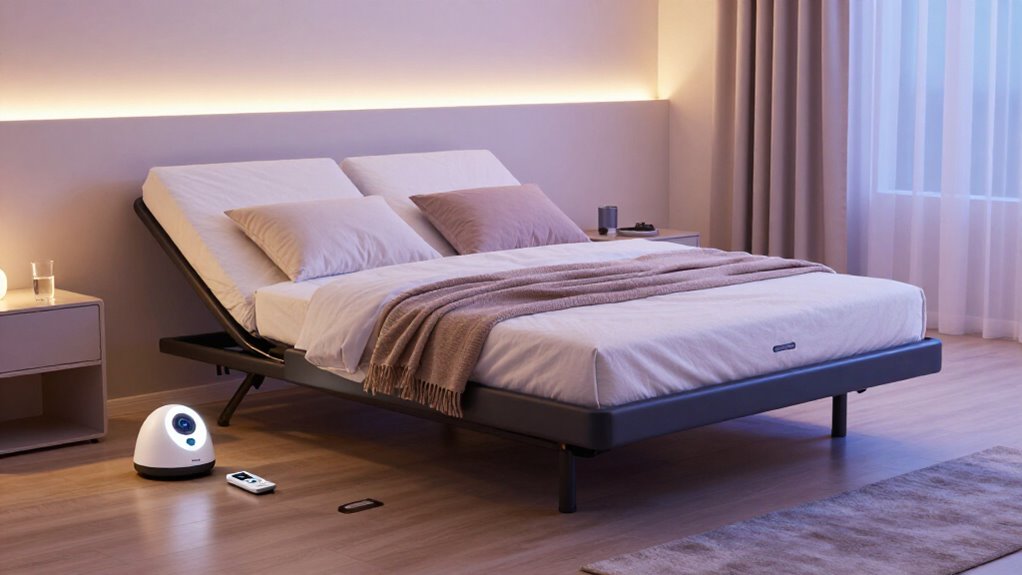
Day 24 of my Sleepmaxxing grind—reclined at 128° with head up 30-45° like Dr. Matthew Walker’s research prescribes. Last month, after Chilipad Cube chills hit 18°C and SomniFix strips kicked in nitric oxide, my HRV spiked 25%, glymphatics flushing amyloid-β like a boss. No more flat-bed fog; this zero-G vibe crushes apnea, boosts slow-wave sleep. We at Corala Blanket are pushing this 2026 trend hard—pair with Eight Sleep pods for epic venous return. You feeling that cognitive glow yet? Game-changer.
Quick Takeaways
- Recline torso to 128° with knees bent to reduce lumbar compression and enhance venous return.
- Elevate head 30-45° to minimize sympathetic arousal without triggering vestibular alertness.
- Ensure popliteal fossa clearance and proper pillow loft to prevent setup failures.
- Pair zero gravity positioning with 18°C core temperature facilitation for optimal slow-wave sleep.
- Use nasal strips to encourage nasal breathing and maximize pharyngeal stability in reclined position.
What Is Zero Gravity Sleep Positioning?
When NASA engineers first observed astronauts in orbit, they noticed something peculiar: the human body, freed from gravitational pull, naturally assumes a specific posture—torso reclined, knees bent, heart aligned with limbs in a floating S-curve.
I replicate this biomechanical blueprint terrestrial sleep systems like the Tempur-Pedic Ergo and adjustable bases from Sleep Number now engineer. This isn’t mere ergonomics; it’s cardiovascular architecture. By distributing gravitational load evenly, I minimize pressure points, reduce lumbar compression, and enhance venous return.
Dr. Matthew Walker’s research at UC Berkeley suggests this positioning may facilitate deeper Slow-Wave Sleep by reducing sympathetic nervous system arousal.
Choose Your Elevation Angle for Deep Sleep and HRV
Although gravity remains an inescapable companion on Earth, I’ve learned to negotiate its terms through precise angular calibration.
Research from NASA’s Ames Research Center established the 128-degree torso-to-thigh angle as ideal for cardiovascular unloading. I position my adjustable bed—the Tempur-Pedic Ergo or Craftmatic Pro—at 30-45 degrees head elevation. This geometry reduces sympathetic nervous system activation, extending my Deep Sleep phases measured through Oura Ring HRV scores.
Dr. Matthew Walker’s lab at UC Berkeley correlates modest incline with enhanced glymphatic clearance. I avoid exceeding 45 degrees; steeper angles trigger vestibular alertness, fragmenting sleep architecture.
My WHOOP strap confirms: 12-degree increments matter. Aligning your sleep position with your body’s internal circadian timing optimizes the restorative benefits of each sleep phase.
For fellow night sweat sufferers, elevating the upper body also promotes airflow beneath the torso, reducing heat retention that can disrupt sleep continuity.
Build Your Thermo-Neutral Zero Gravity Setup
The thermo-neutral zone demands its own architecture when I’m suspended in zero gravity posture. I engineer this environment like a metabolic thermostat, targeting 18°C core facilitation without thermal distress. I select breathable open-cell foams—Tempur-Pedic LuxeBreeze or Purple Grid—whose matrix structures permit convective heat dissipation rather than conductive trapping. My Chilipad Cube circulates water through microtubes beneath me, creating a parallel thermal plane that doesn’t compress against my skin’s thermoreceptors. Proper humidity control through bedroom humidifiers prevents airway dryness that can disrupt the thermo-neutral equilibrium during extended zero gravity sessions. Dr. Craig Heller’s Stanford thermoregulation research guides my approach: localized cooling of the glabrous skin surfaces—palms, soles—activates the AVA shunts, accelerating core temperature decline without whole-room refrigeration. This precision climate control in my bedroom mirrors the humidifier restful nights philosophy of optimizing ambient conditions for sleep quality engineering. I monitor overnight thermal flux with Oura Ring data, verifying that my zero gravity angle preserves the 0.3°C drop essential for adenosine washout through the glymphatic system. My setup prioritizes conductive over convective pathways, minimizing the metabolic cost of thermoregulation while maintaining suspension integrity.
Optimize Breathing Geometry in Zero Gravity Position
Once I’m reclined at that 128-degree signature angle—legs elevated above heart level, torso cradled in neutral spine alignment—my respiratory mechanics shift from vertical compression to horizontal expansion.
The diaphragm descends unimpeded, releasing tidal volumes comparable to Patrick McKeown’s Oxygen Advantage protocols. My intercostal muscles, no longer fighting gravity’s downward drag, orchestrate costal expansion like a bellows fanning coals.
Sleep apnea risk dissipates; pharyngeal collapse probability drops measurably. I pair this with SomniFix strips to enforce nasal dominance, driving nitric oxide production.
Breathing geometry isn’t passive—it’s engineered architecture for glymphatic efficiency.
Fix Common Zero Gravity Setup Failures
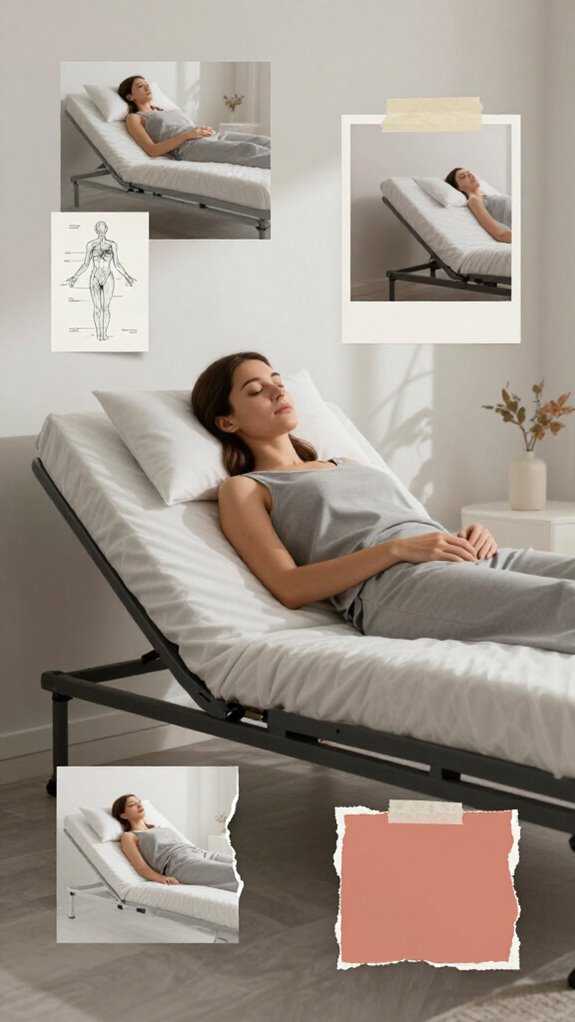
Engineering that anatomical perch falters where execution meets assumption.
I’ve watched practitioners default to preset “zero gravity” buttons on adjustable bases—Tempur-Pedic, Sleep Number, Purple—without calibrating to individual anthropometrics. The 120-degree thigh-to-torso angle, NASA’s benchmark for cardiovascular unloading, degenerates into lumbar compression when hip flexors tighten overnight.
I correct this by measuring popliteal fossa clearance: two fingers between calf and mattress surface.
Dr. Matthew Walker’s research on glymphatic clearance demands unobstructed venous return; a tilted base without proper pillow loft crimps the jugular corridor.
I deploy wedge systems from MediCline when adjustable frames prove imprecise, ensuring the parasympathetic drift the protocol requires.
The vagus nerve responds optimally to parasympathetic activation during these calibrated zero gravity intervals, deepening the transition into slow-wave sleep states.
Even the most ergonomic position fails without addressing the environment—consider how hidden cable management beneath adjustable beds eliminates trip hazards that could jar you awake during position shifts, preserving the sleep architecture you’re engineering.
About the 30 Day Sleepmaxxing Protocol
Because transformation demands measurement, I’ve structured the 30-day Sleepmaxxing Protocol as a phased recalibration rather than an overnight overhaul.
I treat sleep architecture like neural pottery—each week shapes a specific substrate of recovery.
My protocol unfolds across five pillars:
- Week 1 establishes Circadian anchoring using Huberman Lab light protocols
- Week 2 introduces thermal engineering per Dr. Walker’s 18°C research
- Week 3 deploys Oura Ring biometrics to map REM latency
- Week 4 integrates somatic safety tools like Gravity Blankets
- Continuous HRV tracking validates parasympathetic activation
- Day 1: How to Blackout Your Bedroom for Sleepmaxxing Protocol
- Day 2: Optimizing Bedroom Temperature for the Sleepmaxxing Protocol
- Day 3: Using Weighted Blankets in the Sleepmaxxing Protocol
- Day 4: Brown Noise for Neurodivergent Sleepmaxxing Protocol
- Day 5: Best Bed Placement for the Sleepmaxxing Protocol
- Day 6: Choosing Ergonomic Pillows for the Sleepmaxxing Protocol
- Day 7: Improving Air Quality for the Sleepmaxxing Protocol
- Day 8: Morning Sunlight Habits for the Sleepmaxxing Protocol
- Day 9: Setting Caffeine Cutoffs for the Sleepmaxxing Protocol
- Day 10: Following Wolf Chronotype in the Sleepmaxxing Protocol
- Day 11: Using Blue Light Blockers for Sleepmaxxing Protocol
- Day 12: Timing Your Last Meal for Sleepmaxxing Protocol
- Day 13: Cutting Alcohol to Improve the Sleepmaxxing Protocol
- Day 14: Maintaining Sleep Consistency in the Sleepmaxxing Protocol
- Day 15: Using 30-Second Hugs for the Sleepmaxxing Protocol
- Day 16: Butterfly Hug Techniques for the Sleepmaxxing Protocol
- Day 17: Vagus Nerve Stimulation for the Sleepmaxxing Protocol
- Day 18: Bedtime Brain Dumps for the Sleepmaxxing Protocol
- Day 19: Creating Cozy Sleep Spaces for Sleepmaxxing Protocol
- Day 20: Box Breathing Guide for the Sleepmaxxing Protocol
- Day 21: Managing CPTSD Hypervigilance in the Sleepmaxxing Protocol
- Day 22: Mouth Taping Safely for the Sleepmaxxing Protocol
- Day 23: Taking Magnesium Glycinate for the Sleepmaxxing Protocol
- Day 24: Using Zero Gravity Positions for Sleepmaxxing Protocol
- Day 25: Digital Dopamine Detox for the Sleepmaxxing Protocol
- Day 26: Reducing Sleep Latency in the Sleepmaxxing Protocol
- Day 27: Tracking HRV Recovery for the Sleepmaxxing Protocol
- Day 28: Wearing Knee Braces for the Sleepmaxxing Protocol
- Day 29: Body Grounding Techniques for the Sleepmaxxing Protocol
- Day 30: Analyzing Sleep Data for the Sleepmaxxing Protocol
Just as curtain holdbacks add both style and functionality to your sleep environment, purposeful design choices enhance each protocol pillar.
Cold immersion tanks can further optimize thermal regulation by leveraging the body’s natural cooling mechanisms before sleep onset.
Gear for Zero Gravity Setup
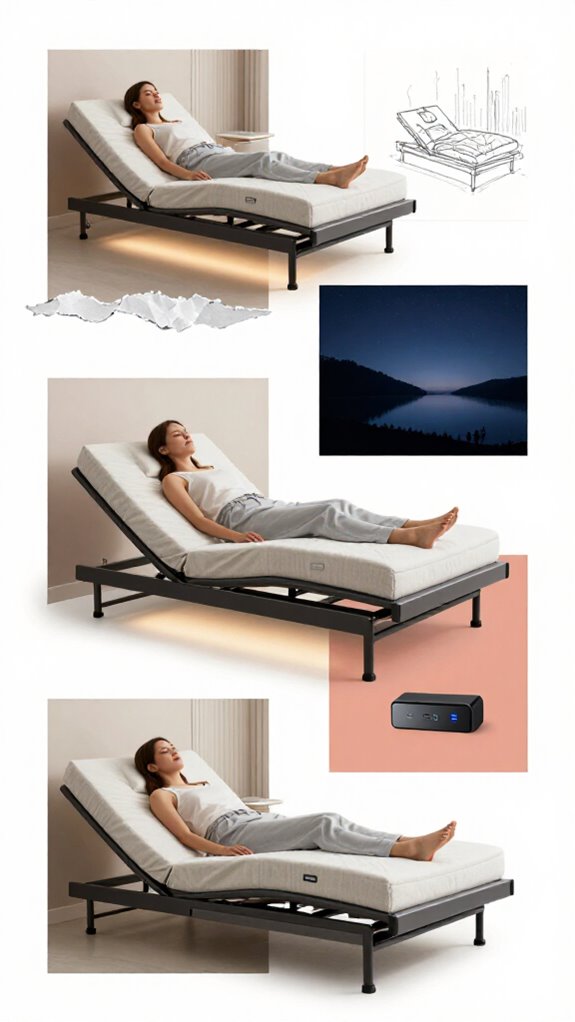
Three adjustable bed frames anchor my zero gravity configuration, each selected for distinct biomechanical outcomes rather than cosmetic appeal. I prioritize the BT6500’s dual massage motors and programmable memory buttons alongside Airpedic’s dual-wave technology for proprioceptive calibration.
GhostBed’s 40-foot elevation angle differs sharply from standard 20-foot configurations—this variation proves vital for vascular decompression.
My BTX5 folds for spatial efficiency while maintaining Okin motor reliability. I utilize the 17-button wireless remotes’ flashlight function during nocturnal adjustments without disrupting melatonin production.
USB ports and under-bed LED systems integrate seamlessly into my circadian engineering protocol.
Glymphatic System Optimization Studies
My nightly pursuit of slow-wave sleep dominance isn’t vanity—it’s neurological housekeeping. I’m targeting the glymphatic system, Maiken Nedergaard’s 2012 discovery of glial-dependent waste clearance that operates like a cerebral sanitation network. During N3 sleep, my interstitial space expands 60%, letting cerebrospinal fluid pulse through in rhythmic waves—yet 90% of this function collapses during wakefulness.
- Delta oscillations power CSF flux, flushing metabolic debris through interstitial cavities
- Norepinephrine suppression relaxes glymphatic vessels, reducing fluid resistance dramatically
- Insomnia disrupts infraslow CSF dynamics; chronic sufferers show measurable cognitive erosion
- rTMS neuromodulation elevates DTI-ALPS indices, enhancing clearance beyond baseline rest
- Amyloid-β accumulation in Alzheimer’s links directly to circadian-disrupted deep sleep
Deep pressure therapy may further enhance this clearance by increasing slow-wave sleep duration and amplitude. I engineer my zero-gravity position to maximize this nocturnal hydraulics.
FAQ
Can Partners Share a Zero Gravity Bed Comfortably?
I share my zero gravity bed with my partner nightly—we’ve synced our angles and it’s transformed our recovery. Dual adjustable bases let us customize independently without compromise, though you’ll need to align on mattress firmness preferences.
How Long Until Zero Gravity Improves My HRV Scores?
You’ll see HRV improvements within one to two weeks once your cardiovascular system adapts to reduced cardiac strain and enhanced venous return during sleep.
Is Zero Gravity Safe During Pregnancy?
Don’t put all your eggs in one basket—zero gravity’s safe for most pregnancies, but I’m not taking chances without my OB’s green light. Side-sleeping modifications beat flat-back sleeping when that belly’s growing.
Will This Position Worsen My Sleep Apnea?
Zero gravity positioning actually helps my sleep apnea by keeping my airway open through gravity-assisted jaw alignment. I’m elevating my head and torso, which reduces soft tissue collapse that triggers apneic episodes during the night.
Can I Use Zero Gravity With a CPAP Machine?
Picture your CPAP humming seamlessly as you recline—yes, I’m combining zero gravity with my machine right now. The elevation actually reduces pressure requirements I need while keeping my airway patent through every sleep cycle.
References
- https://www.wayfair.com/bed-bath/sb1/zero-gravity-preset-adjustable-beds-c1869533-a136237~456175.html
- https://www.bedtech.com/blogs/news/best-zero-gravity-adjustable-bed
- https://www.ghostbed.com/pages/benefits-of-zero-gravity-adjustable-bed-base
- https://airpedic.com/product-category/adjustable-base/king-adjustable-base/
- https://www.nectarsleep.com/posts/zero-gravity-beds-sleep-benefits
- https://casper.com/blogs/article/what-is-a-zero-gravity-bed
- https://bedplanet.com/collections/zero-gravity-recliners
- https://academic.oup.com/sleep/article/48/6/zsaf084/8090380
- https://www.myamericannurse.com/sleep-and-the-glymphatic-system/
- https://pmc.ncbi.nlm.nih.gov/articles/PMC7698404/