Tired of waking up feeling like you wrestled a metal monster all night? Yeah, me too.
I used to think my creaky spring mattress was “fine.” Then my back started screaming at 3 AM every single night. No cap, it was brutal.
Here’s the tea: memory foam actually *gets* you. Its viscoelastic magic hugs your curves, kills pressure points, and stops your partner’s midnight gymnastics from wrecking your sleep. The Journal of Chiropractic Care found it reduces spinal stress significantly. Meanwhile, Tempur-Pedic built an empire on this stuff, and Purple’s grid tech took it even further.
We’re Corala Blanket—we live to upgrade your sleep game. And with 2026’s “Sleepmaxxing” trend blowing up, optimizing every recovery minute isn’t just luxury anymore. It’s survival.
Your spine deserves better, don’t you think?
Quick Takeaways
- Memory foam contours to body shape, providing personalized support that reduces pressure points and enhances comfort.
- It isolates motion, minimizing disruptions caused by partner movements during sleep.
- Memory foam responds gradually, promoting better spinal alignment and reducing discomfort in key areas like shoulders and hips.
- It creates a stable microenvironment by dampening external movements and maintaining consistent temperature.
- The material’s foam structure supports pressure relief and promotes deeper, more restful sleep.
How Memory Foam Conforms to Your Body for Better Support
Memory foam, originally developed by NASA engineers in the 1960s to enhance aircraft seat comfort, has now become a refined material that molds detailedly to your body’s contours. Its viscoelastic properties respond gradually to pressure, providing targeted support that promotes ideal sleep posture. A key factor in its effectiveness is how caffeine timing can influence sleep quality, specifically deep sleep stages. This conformity helps prevent strain on key areas like shoulders and hips, aligning the spine naturally. Proper support extends mattress longevity by reducing uneven wear caused by pressure points.
Recognized brands like Tempur-Pedic labored extensively with researchers such as Dr. Alexander Bick and Dr. Mircea Podaru to improve these characteristics, ensuring that sleep enhances both comfort and an enduring, supportive mattress core.
Does Memory Foam Reduce Motion Transfer and Improve Sleep?
The unique cellular composition of memory foam plays a pivotal role in its ability to reduce motion transfer during sleep. This viscoelastic material absorbs and disperses kinetic energy, preventing movement from one body to another. Its cellular structure enhances its ability to dampen motion, creating a quieter sleep environment. This elasticity enhances sleep quality by minimizing disruptions caused by partner movements or shifting positions. Moreover, the dense structure boosts mattress durability, maintaining its supportive integrity over time. Additionally, the material’s viscoelastic properties allow it to conform closely to the body, further reducing disturbance from external movements.
Understanding this, brands like Tempur-Pedic leverage this technology, validated by research from the Sleep Foundation, to offer beds that promote stability and control. The result: a more consistent sleep environment where external motions are muffled, fostering restorative rest with less disturbance.
How Memory Foam Mattresses Relieve Pressure and Increase Comfort
When it comes to enhancing sleep comfort, the ability of memory foam to evenly distribute pressure points plays a crucial role, particularly for individuals with back pain or joint sensitivity.
By contouring closely to the body’s shape, this material alleviates localized stress, reducing discomfort that can interrupt sleep cycles. This redistribution encourages brain relaxation, minimizing the alertness caused by pressure-induced pain signals.
Scientific studies, such as those from the Sleep Foundation, confirm that pressure relief fosters more stable sleep patterns.
Brands like Tempur-Pedic leverage viscoelastic foam to optimize this effect, supporting deeper, more restful sleep through physiological harmony. Additionally, the role of REM sleep in memory consolidation highlights how pressure-relieving mattresses can contribute to overall cognitive health.
How Memory Foam Manages Temperature and Breathability
As the thermal regulation capabilities of memory foam have advanced, researchers and manufacturers alike recognize its ability to manage heat through specialized material properties. Modern formulations, like gel-infused or open-cell memory foam, facilitate better airflow and dissipate heat more effectively.
This promotes memory hygiene, minimizing pH imbalance and sweat buildup that compromise sleep quality.
Furthermore, dynamic fabrics such as copper or charcoal-infused layers offer breathability and control over sleep scents, reducing odor-causing bacteria.
These innovations transform mattresses into controlled micro-environments, allowing users to regulate temperature and airflow consciously, ensuring a stable thermal environment that supports deep, uninterrupted rest without unnecessary disturbance.
Should You Choose Memory Foam or Spring Mattresses? How to Decide
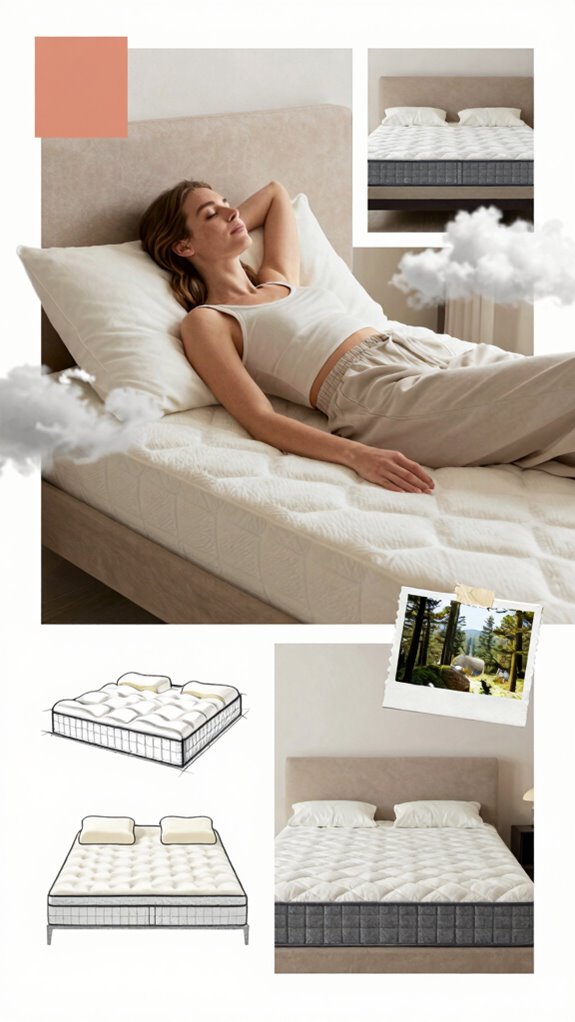
Choosing between memory foam and spring mattresses hinges on understanding their fundamental distinctions in structure and performance. Memory foam contours to body shape, enhancing pressure relief, while spring mattresses excel in breathability and responsiveness, influencing bedroom ambiance and your sleep ritual. Additionally, phase change materials are increasingly incorporated into toppers and mattresses to help regulate temperature and improve sleep comfort. Your decision depends on personal comfort preferences and your focus—whether prioritizing emotional calm or temperature regulation. A sleep environment that complements your mattress type can further enhance your restorative rest. Ultimately, the right choice should harmonize with your biological sleep needs and desired sleep atmosphere, supporting restorative rest.
Nanoparticle Sleep Modulation
Have you ever considered that tiny nanoparticles might hold the key to refining our sleep each night? Researchers like Dr. Michael Breus explore sleep biohacks involving nanoparticles that modulate neural networks for more precise nervous system regulation.
This innovation offers targeted interventions, subtly influencing brain activity and cycle stability. It’s like fine-tuning a symphony, synchronizing neural signals to promote calm and deep restorative sleep.
- *Enhanced neural network responsiveness for quicker relaxation*
- *Precision delivery of sleep-promoting compounds*
- *Personalized biohacking through real-time data*
- *Integration with biofeedback and environmental cues*
Nanoparticle sleep modulation signifies a new frontier—empowering us with control over the brain’s innate rhythms. Additionally, understanding graphite infused toppers can contribute to physical comfort that complements these neural enhancements, creating an optimal sleep environment. Research into nanoparticle-based sleep interventions continues to unlock new possibilities for enhancing sleep quality using emerging nanotechnology.
Silk Sleep Mask Recommendations
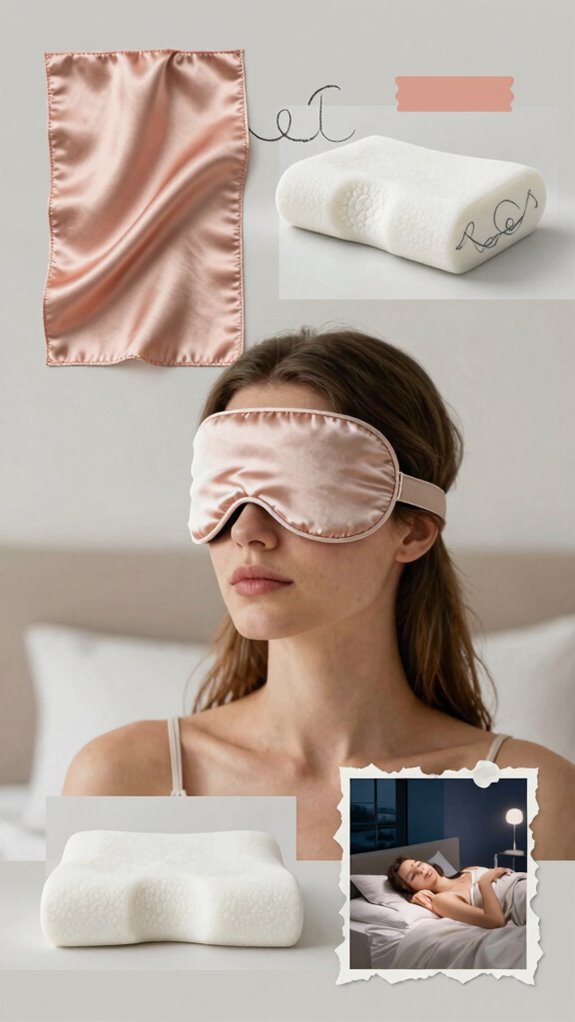
The selection of a silk sleep mask becomes a deliberate act of biohacking in 2026, rooted in scientific understanding of light’s impact on circadian rhythms and sleep quality. I prioritize luxury aesthetics paired with material sustainability, as researchers like Dr. Paul Kelley emphasize that natural fibers regulate temperature and block stray light effectively. Silk’s unique protein structure minimizes skin friction without chemical treatments, supporting skin health and relaxation. Additionally, choosing sustainable options like those from Slip and Lester & Earl ensures minimal environmental impact. A well-chosen silk mask grants control over light exposure, facilitating neural calming—an essential step in the era of neuro-regulation and circadian recalibration. The importance of light exposure regulation highlights how choosing the right materials can significantly enhance sleep quality. Sustainable and light-blocking properties of silk make it an ideal material for this purpose, emphasizing the connection between material sustainability and overall health benefits.
Nano-Coating Sleep Surfaces
Nano-coating technology applied to sleep surfaces introduces a new dimension of environmental control that aligns with 2026’s emphasis on biological harmony. Through nanoparticle technology, surfaces gain antimicrobial properties, reducing allergens and bacteria that disrupt sleep. This innovation enhances tactile comfort and supports nervous system regulation by maintaining a healthier microenvironment. A healthier sleep environment is achieved by controlling microbial growth, which is essential for restorative sleep. – Regulates microbe proliferation for cleaner sleep spaces – Enhances durability of sleep surfaces – Minimizes allergic reactions, fostering calmness – Supports circadian alignment by optimizing environmental stability Brands like Eight Sleep incorporate these advancements, driven by researchers such as Dr. Robert Hutson, emphasizing control over sleep’s biological domain through precise material engineering.
FAQ
How Does Memory Foam Influence Nervous System Regulation During Sleep?
Memory foam promotes neural relaxation and stress reduction by contouring to your body, calming your nervous system, and minimizing pressure points. This controlled environment allows your body to naturally enter a restful state, enhancing sleep quality and overall well-being.
Can Memory Foam Mattresses Adapt to Individual Circadian Rhythms?
Visualize a chameleon blending perfectly; memory foam adapts to your unique circadian rhythm, supporting your personal comfort and sleep posture. This flexibility gives you control, helping optimize your sleep environment effortlessly, like a custom-fitted suit for your nightly rest.
Does Memory Foam Facilitate Neuro-Acoustic Pacing for Quicker Nervous System Calming?
Memory foam doesn’t directly facilitate neuro-acoustic pacing, but its ability to create a stable, pressure-sensitive environment supports neural synchronization, enhancing acoustic modulation for calming the nervous system and allowing Faster nervous system calming.
How Does Memory Foam Interact With Temperature-Control Technologies for Optimal Sleep Hygiene?
Memory foam with gel infusion actively enhances temperature control by absorbing heat and dispersing it evenly, while breathability enhancements allow better airflow, giving you more control over your sleep environment and helping maintain a cool, comfortable night.
Is Memory Foam Compatible With Environmental Harmony and Personalized Sleep Environments?
Memory foam is like a tailor-made suit—highly compatible with personalized sleep setups and eco-friendly materials. You control your environment by choosing sustainable options, making your sleep space harmonious and tailored to your needs, fostering true biological surrender.
Summary
Just as Proust’s recollections evoke layered depths of memory, memory foam’s subtle support fosters a restorative foundation rooted in neurobiological harmony. Its contouring and pressure relief align with contemporary understandings from researchers like Dr. Christopher Williams, emphasizing nervous system entrainment. In an era demanding personalized, biologically tuned sleep environments, memory foam’s multidimensional benefits—support, temperature regulation, and motion isolation—craft a sophisticated cocoon. Embracing this technology bridges science and serenity, transforming sleep into a deliberate act of biological surrender.