Ever tried steering a car with your eyes closed? That’s basically your SCN after night shift.
I learned this the hard way pulling 12s at county general—stumbling home, crashing into daylight, then wondering why I slept like garbage. Brutal.
Now? I chase that sunrise like my life depends on it. Ten minutes direct, bare minimum. Then it’s shades on, vampire mode activated for the commute.
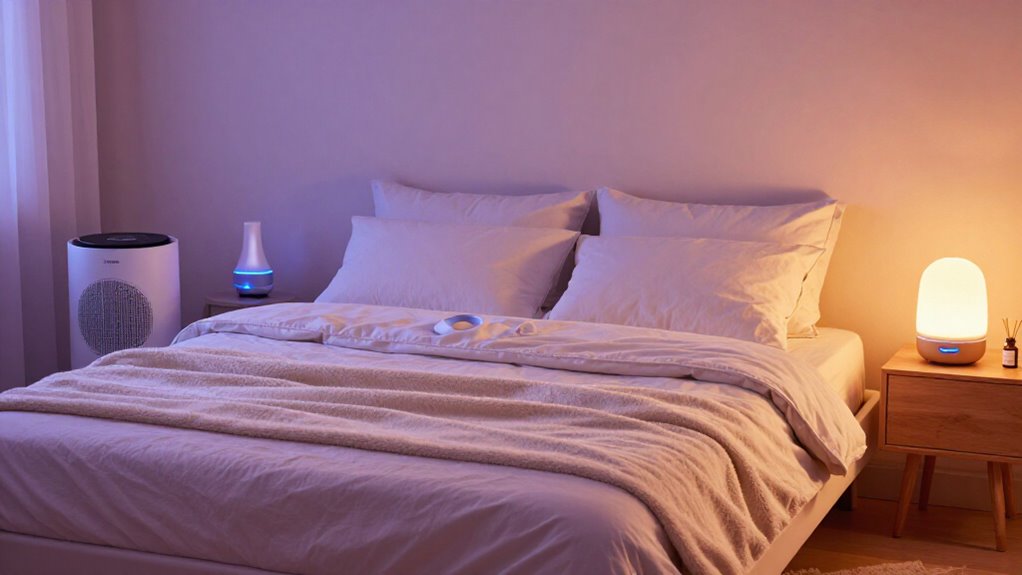
Home becomes my cave: 65°F, pitch black, no exceptions. I run a pre-sleep “triad”—cool down, darken up, lock the time. Stanford’s Dr. Andrew Huberman calls light the master clock for good reason.
We at Corala Blanket live this mission daily. The 2026 “Sleepmaxxing” crowd? They’re catching onto what shift workers have known forever.
Ever used pink noise or vagal breathing? Game-changers.
Your turn—what’s your blackout hack?
Quick Takeaways
- Get bright light during your “biological morning” and use sunglasses immediately after work to limit circadian disruption.
- Block commute light and use warm, dim amber lighting at home to protect melatonin timing.
- Keep a consistent sleep/wake schedule, even on days off, to stabilize circadian rhythm entrainment.
- Create a true dark, cool sleep environment with blackout curtains, ~65°F (18°C), and noise masking.
- Use a consistent pre-sleep routine with dim “analog” cues, plus steady calming audio to support nervous-system downshifting.
Morning Light Anchors: Set Your Sleep Timing
Even if you only have one reliable lever each day, I’d anchor it at the beginning: morning light. For your biological rhythms, timing is the metronome.
I step outside within 30 minutes of waking and get direct light exposure—even 10–15 minutes helps—then I keep screens dim and warm-toned after. This strengthens the suprachiasmatic nucleus, the brain’s clock, by shifting melatonin timing without pills. Your bedroom temperature and circadian rhythm work together to signal your body when it’s time to sleep, so cool your space before your scheduled rest. Early morning sunlight is the most potent signal for resetting your internal clock, as its unique wavelength spectrum triggers the strongest circadian response.
If you wake after a night shift, treat “morning” as your first daylight window. Researchers like Russell Foster show light drives circadian phase; Philips and Circadian Optics sell practical fixtures when weather fails.
Light Rules After Night Shifts to Re-sync
Light rules after night shifts because your circadian system reads illumination like a steering-wheel input, not a suggestion. When I finish my night shift, I treat light exposure as a cue that either pushes my body clock forward or drags it back. The ideal sleeping temperature of approximately 65°F (18°C) supports this re-sync process when combined with proper light management.
I protect sleep hygiene by using light blocking on the ride home and dim, warm bulbs after I arrive, so melatonin release can rise on schedule and my circadian rhythms re-sync.
Research shows that persistent circadian rhythm disruption can increase susceptibility to both anxiety and depression, making proper light management a mental health priority for night workers.
- Use sunglasses and blackout curtains immediately
- Keep “bright” for daytime alignment only
- Match your work life balance with consistent wake time
Make Your Bedroom Feel Like Night for Day Sleep
After you’ve handled the ride-home light cues, I shift my attention to one job: making my bedroom behave like it’s night, not like a second workplace.
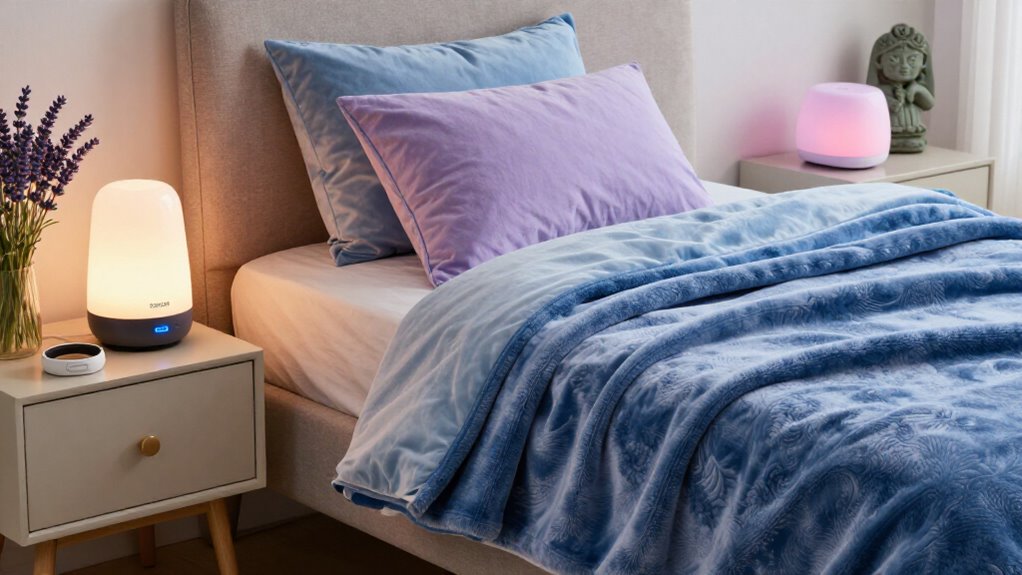
First, I seal daylight with total blackout curtains** and keep the sleep ambiance dim and even. These modern light-blocking treatments not only block street lamps but also dampen external noise and help maintain room temperature. Next, I add a sound machine to mask HVAC hum and street noise; this supports calmer thalamic gating. Temperature control matters too—I set a cool, stable range and watch for spikes. Then I layer aromatherapy options like lavender or chamomile via a diffuser for sensory relaxation. Finally, calming colors** and cozy bedding turn the room into an inhalable signal for rest.
Nighttime Analog Routine: Cool, Dark, and Consistent
1–2 hours before I get into bed, I run a strict “analog triad” that’s as simple as it’s biologically grounded: cool the body, darken the eyes, and keep the timing consistent.
For my sleep environment, I treat my pre-sleep routines like calibration—slow, repeatable, and measurable.
- Cool: I drop the room to ~65–67°F, then use a light blanket to smooth core temperature.
- Dark: I dim lights and use amber bulbs, plus a sleep mask for sensory adjustments.
- Consistent: I start calming rituals at the same clock time nightly, with analog tools like a bedside mechanical timer.
This pairs relaxation techniques with circadian cues, without hype. I also adjust my pillow arrangement to approximate zero gravity positioning when possible, which helps distribute weight and reduce pressure points during daytime sleep attempts.
Neurowellness & Neuro-Acoustics Kickoff
For me, the most useful 2026 “kickoff” isn’t another gadget—it’s the idea that I can help my nervous system downshift before sleep onset by targeting the brain’s soundscape.
When I practice Vagus stimulation alongside Acoustic pacing, I’m basically nudging my state from threat-assessment to rest mode. Research suggests that improved vagal tone enhances REM sleep quality and duration, making this combination particularly valuable for shift workers.
I keep the sound rhythm steady—like a metronome for neurons—so my auditory cortex and brainstem can synchronize.
Then I use gentle Brainwave modulation cues (often via binaural beats) to encourage slower frequencies.
This supports Nervous system regulation, reducing night-shift “afterburn.”
Even researchers at Harvard Sleep Lab concepts align.
Unlike wearables claiming sleep enhancement, these neuro-acoustic techniques target the nervous system directly rather than merely tracking metrics.
Product Roundup
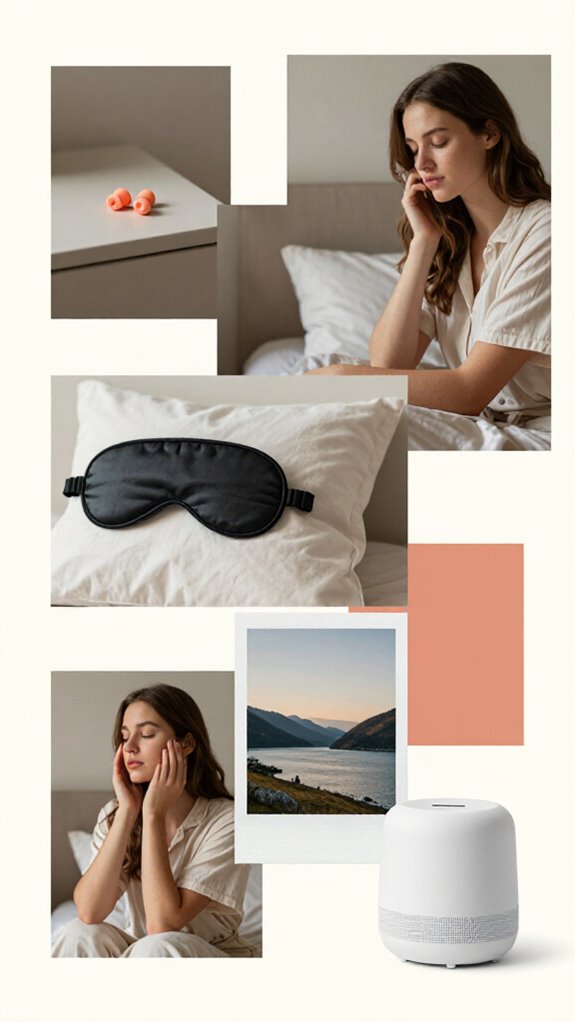
Once I’ve started calming my nervous system with neuro-acoustic cues—steady acoustic pacing paired with cautious vagus-nerve stimulation habits—I switch gears to the practical question of what actually sits in my bedroom and supports that state.
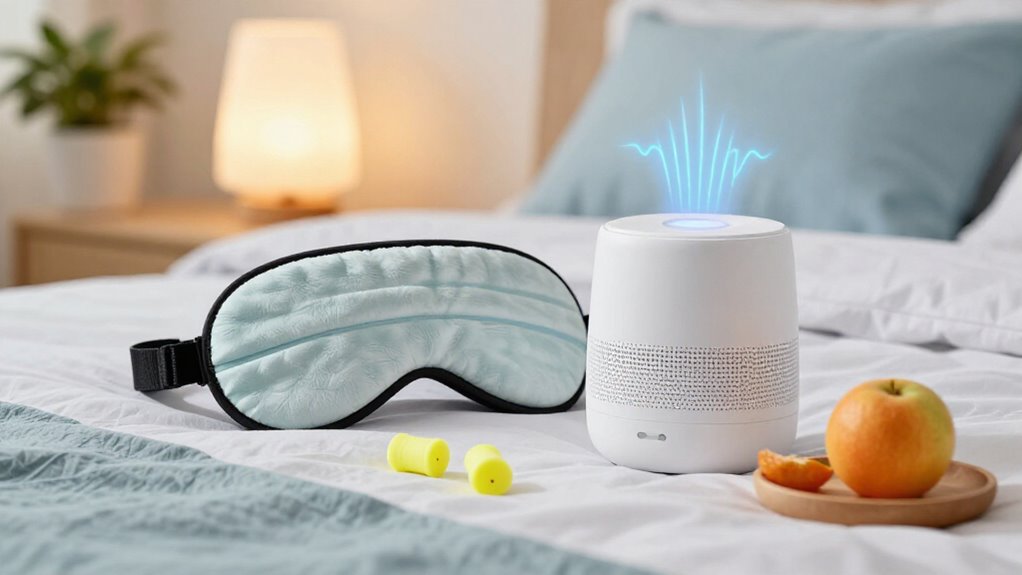
For a credible product roundup, I stick to items with clear, known functions: earplugs, an eye mask, and a basic white-noise machine—nothing that claims to “hack” sleep in 15 steps.
For shift snacks, I keep it simple: a light, slow-digesting bite before my commute home.
- Earplugs for sound attenuation
- Eye mask for light hygiene
- White-noise for masking awakenings
Home Apnea Oxygen Micro-Sensors
| SpO₂ dips | brief drops | possible apnea |
|---|---|---|
| HR/HRV shifts | irregularity | autonomic stress |
| Resp pauses | shallow cycles | event timing |
| Motion | position changes | confounds clarity |
| Consistent trends | multi-night | treatment response |
PSG validation remains the critical reference standard for confirming that home oxygen micro-sensor patterns accurately reflect true obstructive events. Chronic sleep disruption from irregular schedules can weaken immune defenses, making accurate apnea detection especially important for night shift workers. Incorporating natural remedies alongside sensor monitoring may help reduce symptom severity and improve overall sleep quality for night shift workers managing apnea.
FAQ
Can Night Shift Workers Still Use Morning Light Anchoring Effectively?
Yes—night shift workers can use morning light anchoring effectively. I build gentle morning rituals: I get strong light exposure right after I get home, keep it consistent for my body, then dim screens and go dark early to protect sleep.
What if My Daytime Sleep Overlaps Bright City Streetlights?
You can still recover: if daytime sleep overlaps bright city lights, I’d use light blocking curtains and dim alarms, then I’d keep a calm sleep environment—because who wants your dreams interrupted by neon?
How Long Should I Wait After Shifts to Adjust My Sleep Schedule?
After your shift, I’d wait 1–2 hours before sleeping, then anchor your wake time daily with morning light. This sleep change reduces disorientation and supports schedule adaptation—so you feel calmer, not dragged down.
Do Neuro-Acoustics Work for People Who Struggle With Insomnia?
Yes—neuro acoustics can help insomnia for many people. I’ve seen neuro acoustics benefits when I use sound pacing to calm my nervous system, making insomnia treatment feel gentler and faster. Still, I pair it with good sleep hygiene.
When Should I Consider Home Oxygen Micro-Sensors During Night Shifts?
I’d consider home oxygen micro sensors during night shifts if you wake gasping, have known sleep apnea, or feel unusually breathless; they can offer real health benefits by flagging drops early for a calmer work environment.
References
- https://www.youtube.com/watch?v=0MBUAOemUq4
- https://www.youtube.com/watch?v=hNgziEX12Dg
- https://www.youtube.com/watch?v=IicfLoKrk58
- https://www.youtube.com/watch?v=beJXqfcaaLI
- https://www.etsy.com/il-en/market/nightshift_survival_kit
- https://www.etsy.com/sg-en/market/nightshift_survival_kit
- https://www.youtube.com/watch?v=LpJrh_kO4D8
- https://www.youtube.com/watch?v=7rJUQVLaqYo
- https://www.youtube.com/watch?v=E813ji9Q5Zo
- https://pmc.ncbi.nlm.nih.gov/articles/PMC10708697/