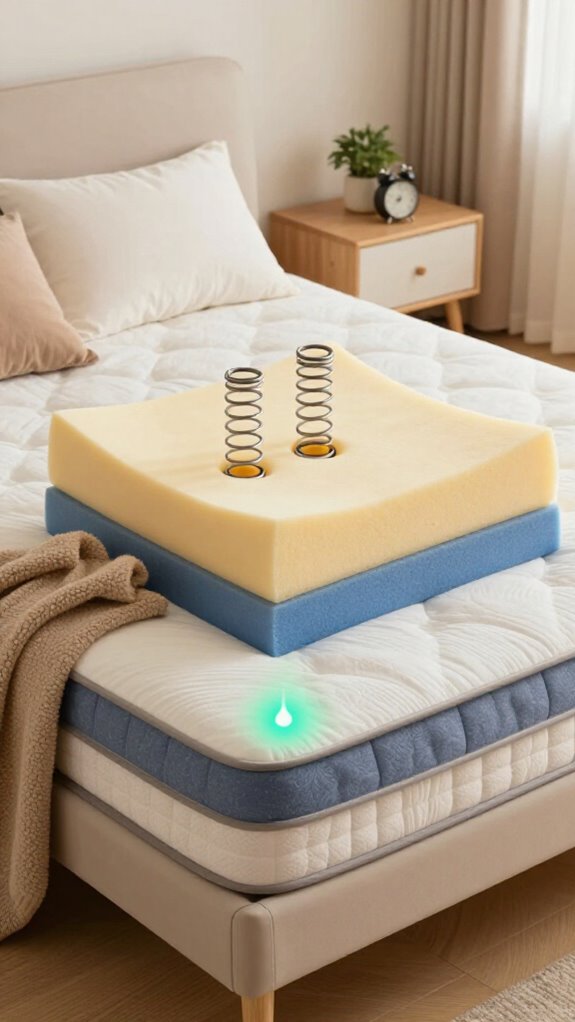
Look, I spent three miserable years on a mattress that turned my spine into a pretzel—waking up feeling like I’d been drop-kicked by reality.
At Corala Blanket, we’re obsessed with fixing this chaos.
Your ideal firmness? It’s not rocket science, though companies want you drowning in jargon. Three things actually matter: your weight, how you sleep, and whether your spine hates you.
Side sleepers need soft (3-4), back sleepers medium (5-6), combination folks? Split the difference at 6.5-7.
Here’s the kicker—too soft and your hips sink like a stone, spiking disc pressure by 49% per NIH studies. Too firm? Hello, unnatural curve city. The sweet spot is medium-firm with quality layering—think Saatva’s hybrid approach, not marketing fluff.
Sleepmaxxing is huge for 2026. People are tracking sleep spindles, optimizing everything.
Dr. Matthew Walker from “Why We Sleep” and Casper’s research team back this layered approach.
What chaos is your mattress putting you through right now?
Understanding the Firmness Scale: From Soft to Extra Firm
Because you’ll spend roughly one-third of your life horizontal on a mattress, understanding firmness levels becomes crucial to your sleep quality and spinal health. The mattress industry employs a standardized 1-10 scale to categorize sleep preferences and firmness categories, though inconsistencies between manufacturers mean one brand’s “medium-firm” may diverge substantially from another’s interpretation.
You’re fundamentally traversing a domain where subjective comfort meets quantifiable measurement—a tension that demands your informed engagement with the specifications behind each option.
The industry standard of 6.5 out of 10 represents medium firmness, yet most mattresses currently manufactured cluster between 6-7, occupying the medium-firm territory. I find this concentration revealing: it suggests market consolidation around a sweet spot balancing pressure relief against structural support. Maintaining your core body temperature within an optimal range throughout the night works synergistically with proper mattress support to enhance sleep quality.
Extra soft mattresses (1-2) sink beneath your body like plush quicksand, minimizing contouring, whereas concrete-like firmness (10) eliminates sinkage entirely. Medium options (5-6) achieve equilibrium through sturdy top layers permitting moderate conformity without excessive sinkage.
Your sleeping position significantly shapes which firmness category serves you best. Side sleepers and back sleepers typically thrive on softer constructions (3-4) that cradle pressure points around shoulders and hips.
Combination sleepers—those who shift positions throughout the night—gravitate toward medium (5-6) or medium-firm (6.5-7) ranges, which accommodate shifts without compromising support. Back sleepers with chronic pain frequently benefit from medium-firm options providing taut surfaces with sufficient give.
Individuals weighing 130-230 pounds find these intermediate ranges particularly effective for maintaining spinal alignment.
Mattress construction methodology influences how firmness manifests tactilely. Medium-firm beds typically employ soft foam top layers atop high-density polyfoam or pocketed coil foundations, creating stratified support systems. Luxury mattress brands often excel in engineering these layered constructions to optimize both comfort and durability for superior rest.
This layering approach, whether foam-exclusive or hybrid configurations, determines comfort and feel more profoundly than singular material type. Firmer mattresses (7-8) feature dense top layers with minimal sinkage, consequently allowing superior air circulation that prevents heat accumulation—a physiological advantage for thermoregulation during sleep.
Understanding these mechanical relationships enables you to calibrate your selection toward genuine sleep improvement rather than marketing narratives.
The industry’s lack of universal standardization necessitates scrutinizing specific construction details and conducting trial periods when feasible. Your ideal firmness level represents an intersection of body weight, sleeping position, pain management needs, and personal preference—variables requiring honest self-assessment rather than assumption.
While finding the right mattress firmness supports your body, achieving truly restful sleep also depends on optimizing environmental factors like bedroom temperature throughout the night.
Mattress Firmness Affects Spinal Alignment
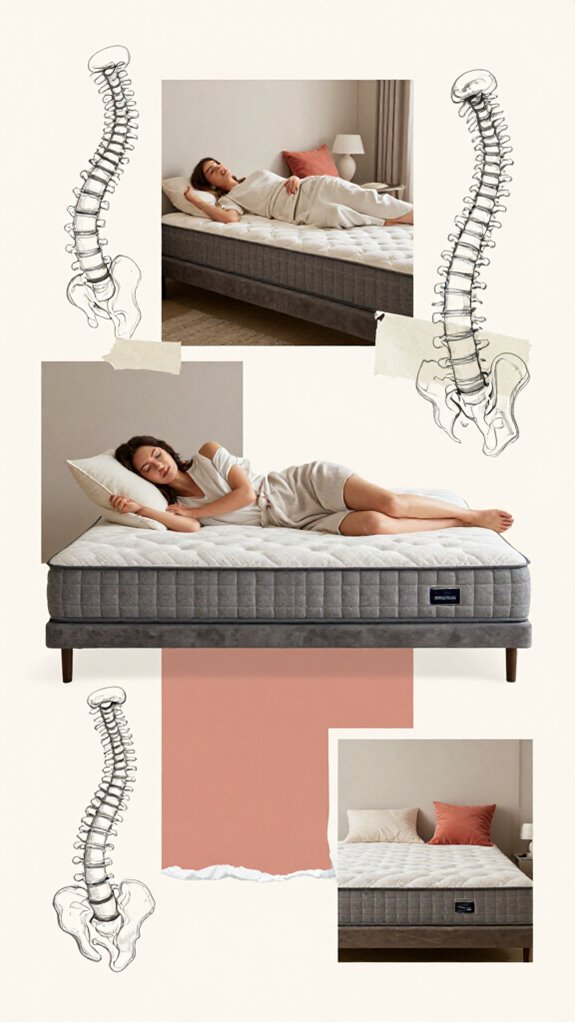
Your mattress’s firmness level functions as the architectural foundation determining whether your spine maintains its natural S-curve or contorts into compensatory positions throughout the night. Different mattress types orchestrate divergent biomechanical outcomes.
Soft surfaces precipitate excessive hip sinkage, elevating intervertebral disc loading by 49% relative to medium-firmness variants—a concerning trajectory for spinal integrity. Conversely, excessively firm mattresses create pressure concentrations and abnormal kyphosis, particularly problematic for side sleepers requiring shoulder-hip contouring.
Medium-firmness mattresses achieve equilibrium, preserving neutral alignment across sleeping positions. Research demonstrates enhanced sleep spindle amplitudes and reduced onset latency on balanced surfaces.
Your body weight and sleeping position dictate ideal firmness selection: heavier individuals benefit from firmer support, while side sleepers require softer accommodation. This subtle calibration determines whether you’ll experience restorative alignment or chronic compensation patterns.
Complementing proper mattress firmness, aromatherapy bedroom relaxation through essential oils like lavender can further enhance sleep quality by reducing cortisol levels and promoting muscular relaxation before bedtime.
FAQ
How Often Should I Replace My Mattress Based on Firmness Level Changes?
I’d recommend replacing your mattress every 7-10 years, regardless of firmness shifts.
However, if you’re noticing pronounced sagging or decreased support—indicators of compromised mattress longevity—consider replacing it sooner.
Firmness degradation directly impacts sleep quality, as the foam loses its structural integrity.
Sleep researchers at the National Sleep Foundation suggest monitoring for indentations exceeding 1.5 inches.
Your body’s positioning needs consistency; when firmness wavers unpredictably, spinal alignment suffers, warranting replacement to maintain restorative sleep.
Can Mattress Firmness Affect My Sleep Temperature and Heat Retention?
Firmness directly influences your sleep quality and temperature regulation.
Firmer mattresses compress less, allowing superior airflow and heat dissipation—much like a tightly woven fabric versus a dense sponge. Conversely, plush mattresses trap warmth by conforming snugly around your body.
Sleep researchers, including those at the National Sleep Foundation, confirm that ideal firmness balances support with breathability.
You’ll control your thermal environment by selecting medium-firm constructions featuring gel-infused memory foam or latex, which researchers like Dr. William Dement advocate for thermoregulation.
Does Mattress Firmness Impact Durability and Long-Term Wear Differently?
Firmness profoundly shapes mattress longevity—like choosing between steel and silk. Firmer constructions resist compression better, extending mattress lifespan dramatically.
Medium-firm options balance durability with comfort through superior material distribution. Softer beds compress faster, compromising structural integrity within 5-7 years.
A firmness comparison reveals that high-density foams and coil systems withstand pressure longer. You’ll gain predictability and control by selecting firmer models, maximizing your investment’s longevity while maintaining consistent support performance.
How Does Body Weight Influence the Ideal Firmness Level Selection?
Your body weight fundamentally dictates firmness selection because heavier individuals require denser support to prevent excessive sinking, which compromises spinal alignment.
Lighter sleepers benefit from softer surfaces offering superior pressure relief.
Sleep position compounds this equation—side sleepers need firmness accommodating shoulder and hip contours, whereas back sleepers demand neutral support.
Research by the National Sleep Foundation suggests matching firmness to your weight distribution guarantees ideal contouring without bottoming out, granting you precise control over your sleep microclimate.
Can I Adjust Mattress Firmness After Purchase With Toppers or Pads?
You can absolutely recalibrate your mattress’s tactile properties through strategic layering.
Mattress toppers—whether memory foam, latex, or down alternatives—function as adjustable intermediaries, softening rigid surfaces or bolstering sagging foundations. Comfort pads offer lighter modulation.
This post-purchase flexibility grants you considerable autonomy; you’re fundamentally retrofitting your sleep system without replacement costs.
Sleep researchers acknowledge toppers as legitimate calibration tools, though they won’t entirely transform fundamentally mismatched bases.
References
- https://sleepopolis.com/guides/mattress-firmness-guide/
- https://purple.com/blog/guide-mattress-firmness
- https://casper.com/blogs/article/mattress-firmness-scale
- https://www.sleepfoundation.org/mattress-construction/mattress-firmness
- https://www.ncoa.org/product-resources/sleep/understanding-the-mattress-firmness-scale/
- https://www.us-mattress.com/pages/comfort-scale-guide
- https://www.nectarsleep.com/posts/mattress-firmness-guide
- https://www.saatva.com/blog/mattress-firmness-scale/
- https://dorelan.us/blogs/news/choose-perfect-mattress-firmness-sleep-style
- https://pmc.ncbi.nlm.nih.gov/articles/PMC12071755/