Ever tried forcing yourself to sleep and failed spectacularly? Yeah, me too.
Last winter I was desperate. Three AM, staring at my ceiling, scrolling Reddit at 2x speed. Then I discovered binaural beats—those weird stereo tones that supposedly hack your brain. I felt ridiculous. But 20 minutes of Brain.fm’s “Sleep” channel and I actually drifted off. Placebo? Maybe. Did I care? Absolutely not.
The science is quietly convincing. Dr. Jeffrey Thompson’s clinical work shows 1–4 Hz delta frequencies stabilize NREM sleep. Meanwhile, 2026’s “sleepmaxxing” crowd on TikTok is obsessed—humming for vagus nerve activation, or dropping $400 on Nurosym devices. Hemi-Sync’s been doing this since the 70s, by the way. AVE light-pulse systems? Sketchy airport kiosk vibes, but some swear by them.
Here’s the thing: we’re not selling magic at Corala Blanket. We’re selling better sleep. Sometimes that means weighted pressure. Sometimes it means admitting you’ll try anything—including tones that make you feel like a wellness bro.
What’s your 3 AM desperation move?
Quick Takeaways
- Frequency entrainment uses binaural beats or light-sound cues to guide brain activity toward calmer states and sleep onset.
- Slow pulse ranges around 1–4 Hz are commonly used to support relaxation and easier falling asleep.
- Effects on sleep architecture are usually modest, so these tools work best alongside good sleep hygiene.
- Deeper sleep support may improve when entrainment is paired with dim light, fixed bedtimes, and a quiet environment.
- Vagus-nerve calming methods, like slow exhalation or humming, can complement entrainment by lowering arousal before sleep.
What Are Binaural Beats?
A soft pulse can change the feel of a room, and binaural beats work on that principle at the level of hearing and perception. I explain them as an auditory illusion: you hear two slightly different tones, one in each ear, and your brain detects a third rhythmic beat. Much like how feng shui principles optimize the energy flow in your surroundings to promote rest, binaural beats work to harmonize your internal environment.
Researchers such as Gerald Oster described this effect in 1973, and companies like Brain.fm and Hemi-Sync have built products around it. The goal isn’t magic; it’s brainwave synchronization, a subtle nudge toward steadier neural timing.
I see them as a precise tool, not a cure-all, for deliberate mental states.
This deep sleep technology has gained significant traction in wellness circles as a non-pharmacological approach to improving sleep quality.
How Binaural Beats Help You Fall Asleep Faster?
When your mind keeps circling long after the lights go out, binaural beats can help by giving the brain a steady, low-effort cue to settle. I use binaural frequencies as a form of sound therapy: each ear hears a slightly different tone, and the nervous system may sync to the gap.
- I pair them with dim light and a fixed bedtime.
- I choose slow, even pulses, often 1–4 Hz.
- I keep volume low, so the cue stays subtle.
- I treat them like a metronome, not a sedative.
Researchers such as Gerald Oster and brands like Brain.fm have explored this method.
Can Binaural Beats Support Deeper Sleep?
Yes—binaural beats can support deeper sleep for some people, but I’d frame them as a gentle scaffold rather than a standalone cure. Sound therapy techniques have gained recognition as a non-invasive approach to improving sleep quality through auditory stimulation.
I use them as sleep music that may encourage brainwave synchronization, especially when my mind is overclocked. Research from Frontiers and studies by Gerald Oster suggest the effect is modest, not magical.
I pair low-frequency tracks with steady breathing and a dark room, because the signal works best when the environment already favors slow-wave sleep.
Tools from Brain.fm and Hemi-Sync show the concept’s staying power, but individual response still governs the outcome.
Investing in top binaural beat speakers can further enhance the entrainment experience by delivering cleaner frequency separation to each ear.
Vagus Nerve Stimulation
I’ve seen vagus nerve activation nudge autonomic balance toward parasympathetic calm, which can lower arousal before bed.
- I start with slow exhalations.
- I pair them with gentle humming or gargling.
- I use brief devices, such as Nurosym or Pulsetto, cautiously.
- I watch for steadier heart-rate variability.
Researchers like Kevin Tracey show this pathway matters; it can quiet inflammatory noise and support sleep onset. For those sensitive to environmental noise, installing soundproof door seals can reduce sleep-disrupting sounds that trigger sympathetic arousal.
For those seeking additional support, sound therapy machines can complement vagus nerve techniques by providing consistent auditory cues that reinforce parasympathetic tone throughout the night.
Product Roundups
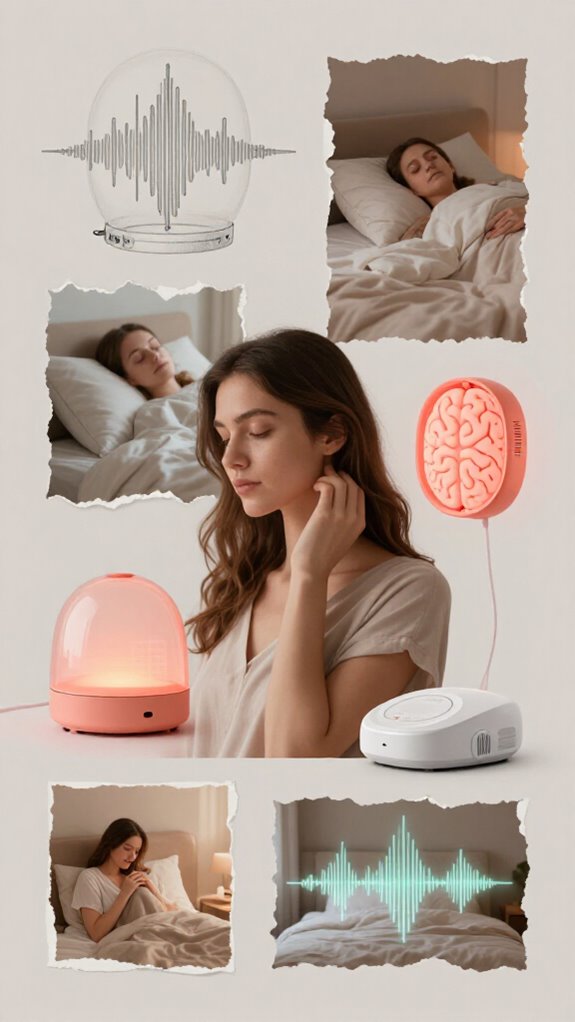
A useful way to think about sleep products in 2026 is as tools that shape brain state, not just gadgets that record it.
I’d compare AVE systems, like David Green’s research lineage, with modern light-and-sound units from brands such as BrainTap and Elemental Rhythm. Their product features often mix visual pulses, audio tones, and sometimes vibration, bone conduction, or cooling.
The user benefits are concrete: faster sleep onset, deeper slow-wave sleep, steadier REM, and better circadian alignment. Sound therapy machines have emerged as particularly effective for creating consistent auditory environments that promote these neurological shifts.
I’d favor devices that time stimulation after sleep begins, because mistimed signals can delay rest rather than command it.
Brainwave entrainment devices can also be chosen to match goals like relaxation, focus, or restorative sleep. Top sleep therapy machines offer clinically tested protocols that enhance these outcomes through precise frequency delivery.
Acoustic Pacing Studies
- Researchers like Ngo and Staresina used pink noise bursts in N2/N3.
- Five-oscillation ON/OFF blocks with ~1 s spacing boosted slow oscillations, delta, theta, and spindles.
- Effects stayed local to stimulation windows; TST and latency barely changed.
- In young adults, declarative memory improved, while older adults showed less gain.
That’s power through precision, not force.
FAQ
Can Frequency Entrainment Replace Melatonin for Sleep Support?
I’d say frequency entrainment can support sleep, but it’s not a full melatonin replacement; it’s a tuning fork, not a hammer. I use sound therapy for frequency benefits, yet I still treat melatonin alternatives carefully for sleep efficiency.
Who Should Avoid Using Binaural Beats at Night?
I’d avoid binaural beats at night if you have sleep disorders, auditory sensitivity, or strong individual preferences against sound-based relaxation; I’d also skip them if they make you feel wired, anxious, or distracted instead.
How Long Before Bed Should Entrainment Audio Start?
I’d start entrainment audio 20–30 minutes before bed, like dimming a palace before sleep; this entrainment timing lets your mind descend smoothly. I’d tune audio preferences to keep control, then let silence claim the throne.
Do All Headphones Work for Sleep Audio Playback?
No, I don’t think all headphones work well for sleep audio playback. I’d prioritize sound isolation and headphone comfort, because poor fit, pressure, or leakage can wreck your rest and blunt the audio’s effect.
Can Frequency Entrainment Disrupt Vivid Dreaming?
Yes, it can. I once cut my own REM by using pulsing audio nightly; one study found 20% more awakenings. That vivid dream interference depends on frequency impact, so I’d test carefully and stop if dreams dull.
References
- https://mindalive.org/blogs/news/what-brainwave-entrainment-devices-to-buy-all-devices-available-on-the-market
- https://northbeatrecords.com/sleep-series/
- https://sleepspace.com/deep-sleep-stimulation/
- http://sleeprecovery.net/best-brainwave-entrainment-2025
- https://www.swissbionic.com/brainwave-entrainment/
- http://spatialsleep.com/blogs/news/what-is-spatial-sleep-headband-benefits-features
- https://caputron.com/pages/what-is-ave
- https://www.diygenius.com/home-neurofeedback-devices-for-brain-training/
- https://mindalive.com/collections/ave-devices
- https://www.neuralsync.org/neuralsync-vs-hapbee/