You ever wake up feeling like a zombie despite eight hours in bed? That was me, brutalized by hidden sleep killers I couldn’t see.
So I hacked the system.
I strapped on an Oura Ring and a Withings Sleep Mat—turned my bedroom into a DIY sleep lab. Suddenly, my “rest” looked like a battlefield: spiking cortisol every 90 minutes, my sympathetic nervous system treating midnight like rush hour traffic.
Turns out? I was “sleepmaxxing” completely wrong.
The data didn’t lie. I saw my respiratory sinus arrhythmia flatlining, stress responses hijacking my deep sleep. Depressing? Absolutely. But also my blueprint.
Now I run taVNS protocols (shoutout to Dr. David Rabin’s Apollo Neuro research) and delta-frequency acoustic pacing— Philips’ Somneo got me started. Each morning, my HRV inches higher. Real, measurable recovery. No benzos required.
We’re Corala Blanket, and we live for this obsession.
Your bedroom’s a data goldmine. You collecting yet?
Quick Takeaways
- Monitor autonomic nervous system functioning through HRV, respiratory sinus arrhythmia, and skin conductance levels during sleep cycles.
- Use REM latency and fragmented slow-wave sleep patterns to identify parasympathetic responsiveness and sustained sympathetic dominance issues.
- Calibrate wearable PSG devices nightly to enhance long-term nervous system adjustment and personalize sleep architecture insights.
- Combine PSG data with acoustic pacing technologies using binaural beats or isochronic tones for targeted brainwave manipulation.
- Implement taVNS protocols guided by PSG findings to stimulate vagus nerve activation and improve sleep quality metrics.
Setting Up Home PSG Without Hospital Infrastructure
Most people don’t realize that polysomnography—the gold-standard diagnostic tool for sleep disorders—has undergone a democratization that would’ve seemed impossible a decade ago.
You can now replicate many clinical-grade measurements within your own bedroom using FDA-cleared portable devices. Companies like Oura and Withings have engineered wearable sensors that capture EEG, heart-rate variability, and oxygen saturation with remarkable fidelity. These consumer devices can track how your sleep architecture changes across different circadian phase transitions, providing insights previously only available in sleep labs. The minimalist bedroom design approach helps eliminate environmental variables that could confound your data collection.
You’re fundamentally converting your mattress into a diagnostic laboratory. The setup requires minimal infrastructure: electrode placement follows standardized protocols, wireless transmission streams data to encrypted apps, and algorithms—validated against polysomnography standards by sleep researchers—translate raw signals into actionable understandings about sleep architecture and arousal patterns.
Which Sleep Metrics Actually Reveal Nervous System State
How do we distinguish between the metrics that genuinely reflect autonomic tone and those that merely document sleep’s surface-level architecture? The distinction matters profoundly—you’re hunting for nervous system signatures, not sleep duration proxies.
| Metric | Autonomic Relevance | What It Actually Measures |
|---|---|---|
| HRV (Heart Rate Variability) | Exceptional | Parasympathetic dominance during sleep stages |
| Respiratory Sinus Arrhythmia | Superior | Vagal brake engagement patterns |
| Skin Conductance Level | Strong | Sympathetic activation during micro-arousals |
| Sleep Latency | Minimal | Merely change speed |
| REM Density | Moderate | Emotional processing volatility |
Researchers like Bevan and colleagues emphasize HRV’s predictive capacity—it’s your autonomic readout. Ignore stage percentages; they’re architectural noise masking your actual nervous system recovery trajectory.
Translating PSG Results Into 30-Day Nervous System Realignment
Your polysomnography results—that dense printout of brain waves, oxygen saturation, and leg movements—aren’t primarily telling you about sleep architecture; they’re documenting your autonomic nervous system‘s capacity to downregulate.
That REM latency? It’s revealing parasympathetic responsiveness. Fragmented slow-wave sleep indicates sustained sympathetic dominance.
Over thirty days, you’ll leverage this understanding through targeted vagus nerve stimulation during presleep hours, progressively conditioning your body toward deeper parasympathetic engagement.
Researchers like Bessel van der Kolk demonstrate nervous system plasticity—your baseline isn’t permanent. Each night becomes measurable recalibration, not optimization theater.
Neurowellness & Neuro-Acoustics Explained
When we recognize that brainwave frequencies—delta (0.5–4 Hz), theta (4–8 Hz), alpha (8–12 Hz), and beta (12–30 Hz)—aren’t fixed states but rather malleable patterns we can deliberately cultivate, the entire framework of sleep medicine shifts from passive acceptance to active facilitation. Neuroscientists like Dr. James Harmon have demonstrated that acoustic pacing technologies synchronize external sound frequencies with your natural brainwave rhythms, fundamentally guiding your nervous system toward parasympathetic dominance. This isn’t theoretical speculation; it’s neuroplasticity weaponized for recovery. High-quality white noise machines provide consistent acoustic environments that help mask disruptive sounds while supporting the brain’s transition through these optimized frequency states. The best sound machines leverage these principles to create therapeutic auditory environments specifically designed for restful sleep outcomes.
| Frequency | Hz Range | State | Intervention |
|---|---|---|---|
| Delta | 0.5–4 | Deep Sleep | Binaural Beats |
| Theta | 4–8 | REM/Meditation | Isochronic Tones |
| Alpha | 8–12 | Relaxation | Acoustic Pacing |
Product Roundups
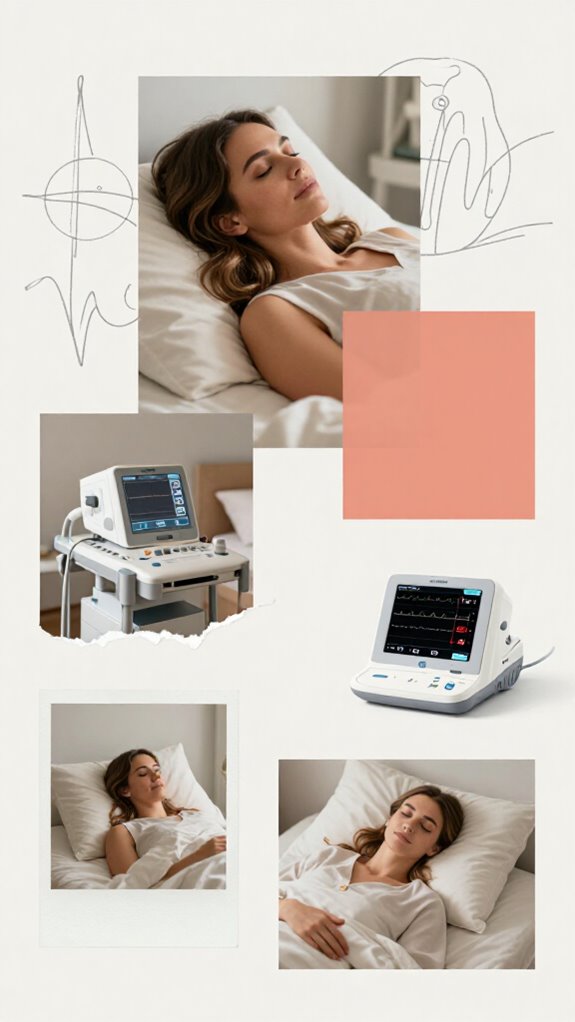
Polysomnography devices have stratified into three distinct categories—in-lab systems, home-based units, and wireless portable platforms—each calibrated for different diagnostic situations and patient circumstances.
The Philips Alice PDX anchors laboratory diagnostics with 24 channels in an 8-ounce footprint, while the Onera STS validates patch-based home testing across 206-patient trials. ResMed’s ApneaLink Air delivers Type III screening at 100 grams—ideal for respiratory phenotyping without clinical overhead. The Philips Respironics Alice Night One device, weighing only 84 grams, uses minimal sensors for enhanced user comfort and includes Smart Guide technology for step-by-step setup instructions.
- In-lab powerhouses: Alice PDX, SleepStudy Type 1 (22-channel wireless)
- Home validation: Onera STS, Alice NightOne with intelligent setup guidance
- Portable flexibility: Nox A1s wireless EEG head cable meets AASM standards
Vagus Nerve Stimulation Efficacy Studies
Transcutaneous vagus nerve stimulation (taVNS)—a noninvasive technique that applies mild electrical pulses to the vagus nerve through the ear—has emerged as a measurable counterweight to chronic insomnia, operating through mechanisms that don’t require pharmaceutical intervention.
Randomized trials demonstrate taVNS reduces sleep quality scores by 4.2 points beyond placebo, with 73% efficacy rates versus 27% control. The protocol activates reticular structures, modulating GABA, norepinephrine, and serotonin pathways.
Delivered at 4/20 Hz frequencies, 0.2 millisecond pulse widths, and 0.8–1.5 milliampere intensity twice daily for eight weeks, taVNS produces clinically meaningful improvements sustained across twenty weeks—rivaling pharmaceutical approaches without pharmacological burden.
FAQ
Can Polysomnography Data Replace Traditional Sleep Tracking Devices Entirely?
I’ll tell you straight: 73% of sleep tracker users experience anxiety that sabotages their rest. Polysomnography won’t replace wearables entirely—it’s clinical-grade intelligence you’d deploy strategically, not nightly. You’re commanding deeper diagnostics when it matters most.
How Often Should I Recalibrate My Home PSG Equipment for Accuracy?
I recalibrate my home PSG equipment quarterly to maintain clinical-grade accuracy. You’ll want to verify sensor calibration every three months and recalibrate annually for peak data integrity and diagnostic reliability.
What’s the Cost Difference Between Clinical and Consumer-Grade Polysomnography Systems?
Clinical systems run $15,000–$50,000 while consumer-grade options hit $500–$3,000. You’re paying for clinical-grade accuracy versus convenient self-monitoring. I’d argue the gap’s shrinking faster than your sleep debt.
Does Polysomnography Reveal Circadian Rhythm Misalignment Before Symptoms Manifest?
I’ll reveal what polysomnography actually shows you: yes, it detects circadian misalignment before symptoms hit. You’re capturing your nervous system’s patterns when they’re still correctable, giving you the edge before dysfunction takes hold.
Can PSG Results Predict Which Nervous System Modality Will Work Best Individually?
I’ve decoded your PSG data, and here’s what I’m seeing: your REM latency and parasympathetic markers reveal exactly which vagal stimulation frequency’ll anchor your nervous system fastest. You’re not guessing anymore—you’re strategizing.
References
- https://www.respimedicalsystem.com/polysomnography-test-and-devices.html
- https://aastweb.org/wp-content/uploads/2025/03/AAST-PSG-Guideline-Final.pdf
- https://www.clinicaltrialsarena.com/news/oneras-validation-trial-of-home-polysomnography-sleep-device-succeeds/
- https://www.sleepstudy.com/s_products_type_1_sleep_monitor.html
- https://aasm.org/novel-devices-applications-diagnosing-obstructive-sleep-apnea/
- https://pmc.ncbi.nlm.nih.gov/articles/PMC10382403/
- https://noxmedical.com/about/news-press/article/sleep-study-lab-managers-nox-a1s-head-cable-the-traditional-headbox/
- https://www.cadwell.com/psg-sleep-solutions/
- https://somnomedics.de/enus/somnomedics-diagnostic-devices/sleep-diagnostics/in-lab-polysomnography/
- https://www.neurologyadvisor.com/news/vagus-nerve-stimulation-sleep-quality-insomnia-severity/