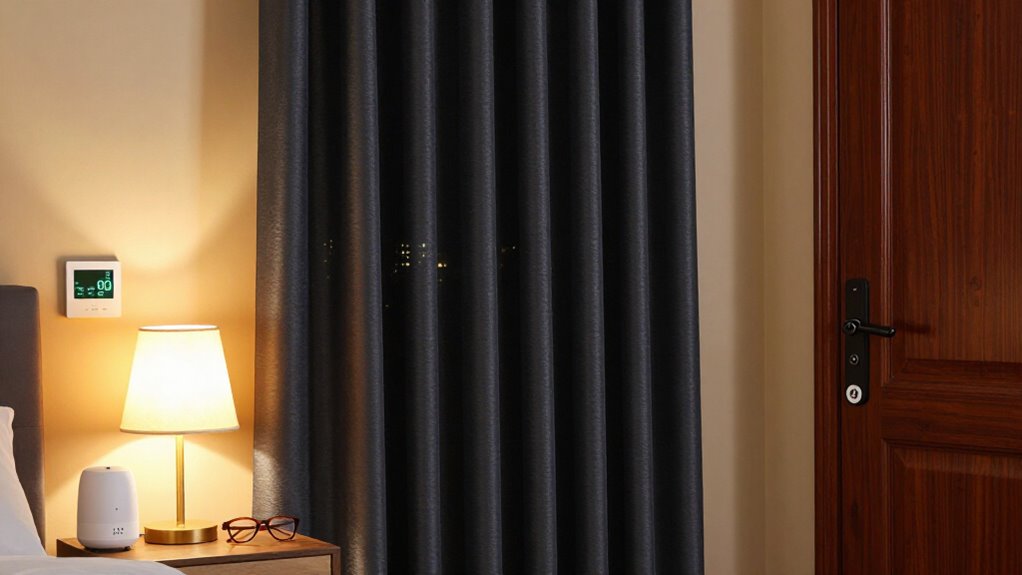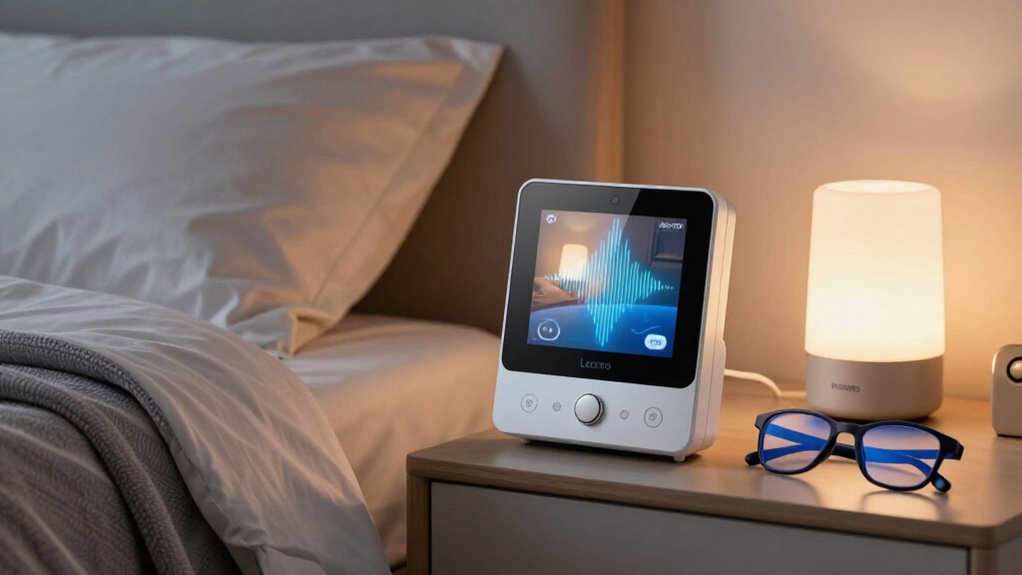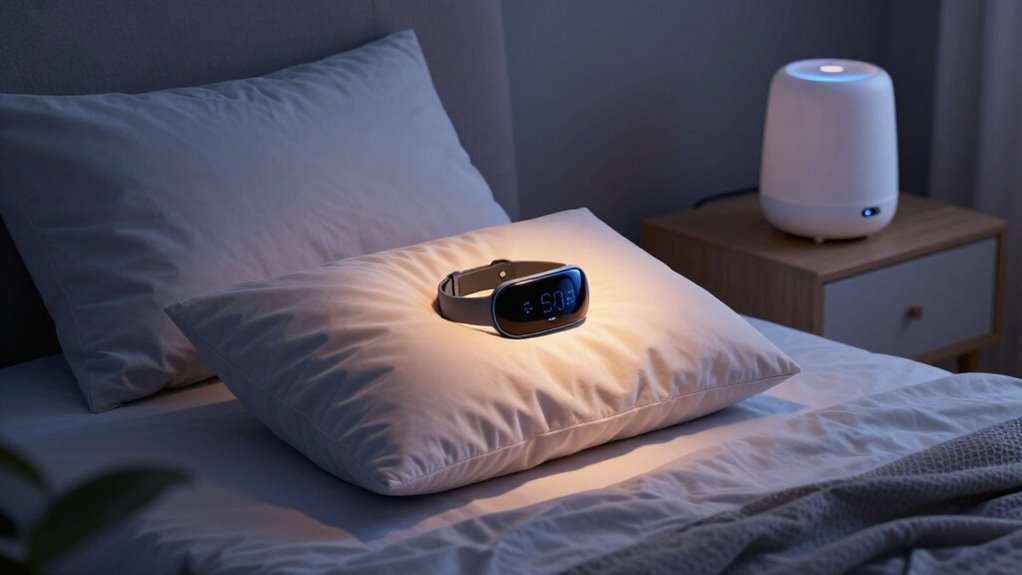
My circadian rhythm used to be a disaster—I’d lie awake at 2 AM wondering why my brain thought it was noon in Tokyo. Ever feel like your body’s clock is just punking you?
Then I discovered my SCN was the culprit. That tiny brain region was basically screaming “EMERGENCY!” every time I checked my phone at midnight.
Now? I’m ruthless. First 30 minutes of morning? Outside. No exceptions. Ten minutes of real sunlight, even gloomy British-grade stuff, starts the phase shift. Harvard’s Dr. Andrew Huberman backs this—circadian stakes are real.
Evenings get the reverse treatment. Red bulbs only. Overheads murdered at dusk. I’m basically a vampire, but make it wellness.
Travel wrecks me still, honestly. But morning re-anchors and tactical sub-20-minute naps save the trip. Some biohackers I follow swear by Apollo Neuro’s vibration tech or taVNS devices—20 Hz, concha-placement, twice daily. Clinical trials from University hospitals support the mechanism.
At Corala Blanket, we’re obviously obsessed with this stuff. Our weighted designs complement these protocols.
Sleepmaxxing 2026? It’s about stacking evidence, not guesswork.
Quick Takeaways
- Get bright outdoor light within 30 minutes of waking for 10–20 minutes to phase-shift the SCN and stabilize morning cortisol.
- Manage evening light by dimming overheads soon after sunset and using red light to reduce melanopsin-driven circadian disruption.
- Keep screen exposure and blue light low for 60–90 minutes before bed; use blue-blocking glasses and low, face-avoiding task lights.
- During travel or shift work, use consistent meal timing and maintain local-night dimness; track sleep data to gauge SCN readaptation.
- Consider adjuncts like VNS (e.g., auricular stimulation) using insomnia-trial parameters, such as 20 Hz for 20 minutes twice daily.
How to Reset the SCN With Morning Light
To reset your SCN, I start by giving it a clean “morning cue”—light. Your suprachiasmatic nucleus is the brain’s master clock, and it listens through retinal input.
When I build my morning ritual, I aim for bright light exposure within 30 minutes of waking—ideally outdoors. Ten to twenty minutes of sunlight reliably shifts phase timing in humans, as corroborated by circadian researchers like Till Roenneberg. Early morning sunlight plays a critical role in circadian realignment, helping synchronize your internal clock with the natural day-night cycle. Proper morning light exposure also helps regulate cortisol awakening response, ensuring your stress hormone peaks at the right time to promote alertness and stable energy throughout the day.
If weather blocks you, a 10,000-lux light box works; sit at proper distance, eyes open, no sunglasses. Consistency matters more than intensity.
This quiet reset helps your body anticipate sleep.
Use Evening Red Light to Lock in Circadian Timing
Evening red light helps me “lock in” the circadian timing my morning light started, by nudging melatonin release and the SCN’s phase toward night mode. After sunset, I dim bright overheads and switch to 90–660nm red (ideally ~1–2 hours). This supports red light benefits: lower melanopsin activation, steadier circadian rhythm signaling, and an earlier “lights-out” cue. Think of the SCN as a conductor—red light helps the orchestra relax into the evening tempo. Sleep architecture changes across circadian phases make evening red light particularly effective for phase anchoring. Evening screen time delays melatonin onset more than other evening light sources, making the transition to red light even more critical for protecting circadian timing.
| Cue | SCN impact |
|---|---|
| Dark blue | Delays night phase |
| Amber/red | Promotes night phase |
| Short exposures | Fine-tunes timing |
Fix Your Light Hygiene With Darkness and Screen Curfews
Once you’ve used red light after sunset to help “lock in” your circadian timing, you can make the SCN’s job even easier by tightening the darkness signal and cutting late screens.
I dim my lighting the moment evening starts—overhead bulbs down, lamp shades up—because stray light exposure tells melanopsin cells it’s still daytime.
Then I set a screen curfew: I use screen dimming 60–90 minutes before bed, and I push Night Shift or f.lux to the warmest, lowest-brightness setting.
If I must work late, I keep a task light low and aimed, not face-forward.
Your clock learns from consistency.
Wearing blue light blocking glasses in the evening adds another layer of protection by filtering the wavelengths that most strongly activate melanopsin.
This matters because blue light suppresses melatonin, the hormone your SCN signals your pineal gland to release for sleep onset.
Troubleshoot SCN Drift: Travel, Naps, and Shift Work
When your schedule changes—traveling across time zones, taking naps late, or working rotating shifts—your suprachiasmatic nucleus (SCN) can start behaving like a mis-calibrated conductor: the signals still come in, but the timing drifts relative to local clock time.
When schedules shift—time zones, late naps, rotating shifts—your SCN timing can drift, misaligning your body’s internal clock.
I troubleshoot this with three SCN disruption strategies.
First, I use travel sleep tips: anchor your wake time to the destination, and get bright morning light fast. Reviewing your sleep tracking data after travel can reveal exactly how many days your SCN needs to fully adapt.
Second, I practice nap management techniques: keep naps under 20 minutes and before mid-afternoon, or you’ll steal the evening melatonin rise.
Third, I apply shift work solutions: consistent meal timing and dim lights at your “local night.”
Resetting your circadian clock requires aligning all external time cues to your target schedule, not just one or two.
Neurowellness and Neuro-Acoustics

To help your sleep reset faster, I focus on neurowellness and neuro-acoustics, because your brain doesn’t just “receive” darkness—it interprets sound and rhythm as part of a broader safety signal. When I use brainwave entrainment, I treat audio like a metronome for neural timing, nudging alpha-to-theta patterns that correlate with drowsiness. Meanwhile, acoustic resonance steadies your body’s “alarm loop,” reducing micro-startles. White noise masks disruptive sounds and creates a consistent auditory environment that supports uninterrupted sleep cycles. Choosing from the best white noise machines for bedroom use ensures you get quality acoustic masking without distracting interruptions.
| Cue | Target state | Example |
|---|---|---|
| Slow pulse | alpha | 60–70 BPM pad |
| Low noise floor | downshift | fan at 35 dB |
| Soft decay | parasympathetic | brown-noise fade |
| Rhythmic breath | entrain | 4-6 breath pacing |
| Consistent cue | SCN anchor | same pattern nightly |
I prefer validated tones and gentle vagus support, not gimmicks.
Product Roundup
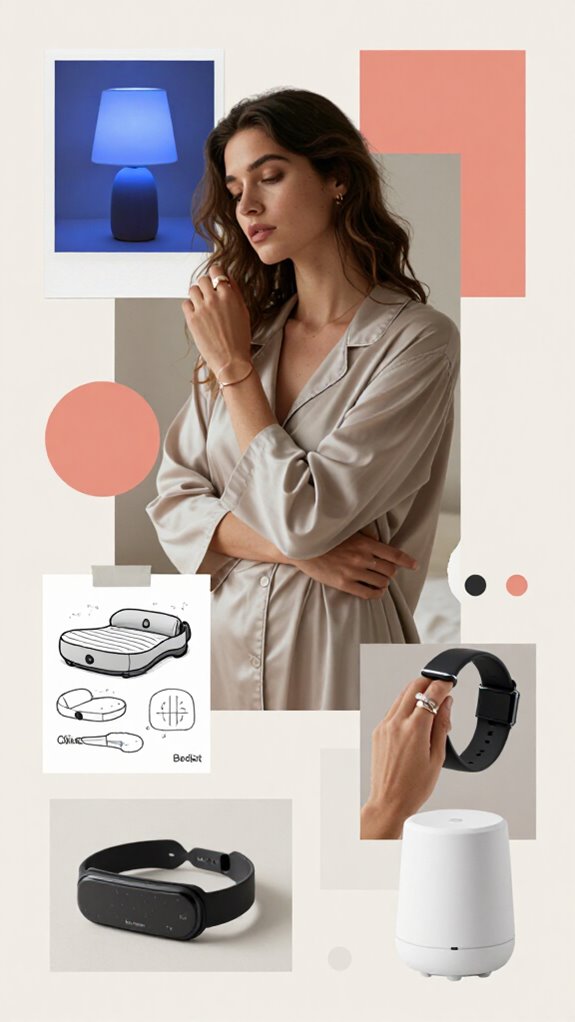
Here’s a practical product roundup that matches the “reset” goal with real-world mechanisms, not marketing theater.
I start with sleep wearables—watches, rings, actigraphy socks, and even skin patches—to map timing, stages, and awakenings. Two main issues are that wearables often rely on For nervous-system-friendly feedback, I lean on CBT-I via Full Sleep by Koko Labs, where a therapist guides adjustments to bedtime routines and relaxation patterns.
For the bedroom’s microclimate, I’ve seen BedJet, Chilipad, Eightsleep pods, and Rezet toppers use active temperature control to blunt thermal arousals. Blue light blocking lamps can also support the SCN reset by reducing melanopic stimulation during evening wind-down. For auditory masking, white noise machines provide consistent sound that can stabilize sleep architecture against environmental disruptions.
For data-backed apnea screening, FDA-cleared home tests and board-certified physician analysis complete the loop.
Vagus Nerve Stimulation Protocols
If you want to “reset” sleep without chasing more gadgets, vagus nerve stimulation (VNS)—specifically transcutaneous auricular VNS (taVNS) and t-VNS—offers a clinically studied way to nudge your autonomic nervous system toward parasympathetic dominance.
Vagus nerve stimulation—especially taVNS or t-VNS—may help shift toward parasympathetic dominance to “reset” sleep, without more gadgets.
In stimulation research, I follow protocols from insomnia trials: 20 Hz taVNS to the auricular concha, twice daily for 20 minutes over one month, or 30 minutes twice daily, 5 days/week for 8 weeks in the TASC-I study.
Intensity ran up to maximum tolerable (active 0.8–1.5 mA; sham 0.1 mA).
Mechanistically, VNS routes through the solitary tract to VLPO and slow-wave sleep.
FAQ
Can You Reset the SCN Without Sunlight if You Live in Low-Lux Regions?
Yes, you can reset your SCN without sunlight: I anchor my nighttime routines with red light in the evening, keep melatonin supplementation low and timed, and use indoor bright light early during the day—then dim everything at night.
How Long Does SCN Re-Entrainment Take After Inconsistent Sleep Schedules?
After inconsistent schedules, I’d expect SCN re-entrainment in 3–10 days if you practice sleep training gently; full steadiness often takes 2–4 weeks. Don’t panic—I ride circadian alignment like slow, intimate tides.
What’s the Best Bedtime for SCN Resetting When You Can’T Control Wake Time?
If I can’t control wake time, I pick a consistent bedtime inside my ideal sleep window and anchor evening routines. I dim lights, quiet sound, and breathe slowly for 30 minutes so my SCN resets calmly each night.
Does Caffeine Affect SCN Resetting, and When Should You Stop It?
Caffeine takes about 5–7 hours to halve in your body, so yes—it can hinder SCN resetting and lower sleep quality. I stop caffeine 8–10 hours before bed, and track how my jitters fade.
Are White Noise or Acoustic Pacing Better for SCN Rhythm Consolidation?
I’d choose white noise or acoustic pacing based on your nervous system: white noise masks disruptions gently, while acoustic pacing actively guides timing. If you want deeper rhythm consolidation, I’d start acoustic pacing, then keep white noise as a fallback.
References
- https://aasm.org/staying-current-with-insomnia-related-technologies/
- https://www.delveinsight.com/blog/rise-of-sleep-tech-devices
- https://www.thesleepreset.com/home-sleep-study
- https://lifestyle.sustainability-directory.com/learn/how-does-the-suprachiasmatic-nucleus-scn-regulate-the-sleep-wake-cycle/
- https://www.greatlakesdentaltech.com/appliances/sleep-airway.html
- https://pmc.ncbi.nlm.nih.gov/articles/PMC5204321/
- https://pmc.ncbi.nlm.nih.gov/articles/PMC9599790/
- https://www.theeducatedpatient.com/view/vagus-nerve-stimulation-enhances-sleep-quality
- https://www.charliehealth.com/areas-of-care/anxiety/vagus-nerve-exercises-for-sleep
- https://jamanetwork.com/journals/jamanetworkopen/fullarticle/2828072