My brain used to feel like foggy soup until 11am. No kidding.
Then I learned the SCN—that tiny master clock in your skull—desperately craves morning light. Skip it? You’re basically telling your cortisol to play guessing games all day.
Now I stumble outside within 30 minutes of waking, no sunglasses, just me and the sky. Game changer. Till Roenneberg’s Munich studies back this: precise light timing compresses cortisol’s curve so you peak hard, crash clean.
I ditched the phone doom-scroll. Replaced it with actual dawn. Revolutionary, I know.
Notice how “Sleepmaxxing” blew up in 2026? Your algorithm is already judging your 2am reel habit. Oura Ring users obsess over this data. Huberman Lab preached it for years.
We at Corala Blanket exist because quality sleep culture shouldn’t gatekeep. Even Casper pivoted toward circadian tools recently.
Your cortisol is begging for a reset. When did morning stop feeling like morning to you?
Quick Takeaways
- Morning outdoor light cues your brain’s circadian system, aligning cortisol release for better daytime energy and focus.
- Light within 30–45 minutes of waking stabilizes the cortisol feedback loop and reduces nighttime alertness.
- Longer or brighter morning exposure strengthens the reset—about 5–15 minutes outdoors on overcast days.
- Avoid doom-scrolling and very dim mornings; bright light intensity should rise gradually to prevent sharp melanopsin activation.
- Consistent sleep timing and optional morning light boxes help maintain cortisol rhythm when outdoor light isn’t available.
Morning Light Resets Your Cortisol Rhythm
When you step into the first light of the day, you’re not just “waking up”—you’re steering your cortisol rhythm, the body’s built-in morning signal that helps you mobilize energy and focus.
I think of it like opening the blinds on a control panel: receptors in your retina relay timing cues to your suprachiasmatic nucleus, which coordinates cortisol regulation across the day.
With bright light exposure soon after waking, cortisol typically rises more predictably, supporting alertness without overshooting later.
If you’ve ever felt wired at night, consistent morning light can steady the feedback loop—no magic, just biology, as echoed in work by researchers like Till Roenneberg.
Time Your Light Exposure to Smooth Your Cortisol Rhythm
Rather than blasting your eyes with light at random, I time my exposure so my cortisol curve rises on schedule and then tapers smoothly—think of it as “dialing in” your internal alarm, not flicking a switch. Within 30–45 minutes of waking, I step outside and let sunlight duration do its job, minimizing cortisol fluctuations. My rule: 5–15 minutes for overcast, 2–5 for bright days, then dim indoors. Just as optimal bedroom temperature supports your circadian rhythm for restful nights, strategic light exposure anchors your cortisol rhythm for energized mornings. Research consistently shows that consistent sleep timing plays a crucial role in regulating mood and cognitive function.
| Cue | Clock signal | Outcome |
|---|---|---|
| Dawn walk | CSO activation | Crisp wake |
| Short dose | Threshold lift | Stable rise |
| Indoor dim | Melanopsin downshift | Gentle taper |
| Midday | Reset buffer | Less drift |
| Evening shield | Low melanopic light | Smoother night |
I treat it like Andrew Huberman’s protocol: precise timing, not hype.
Avoid Common Morning Light Mistakes That Spike Cortisol
Even with Morning Light Anchoring, a few common habits can spike cortisol instead of smoothing it, because they jolt your melanopsin system faster than your brain can “lock on” to the new day.
I’ve learned to watch my morning routines: first, I don’t blast bright indoor lights through blinds right away—light intensity should rise gradually. A cool bedroom temperature overnight primes your system to respond more calmly to morning light transitions.
I ease into morning light—no sudden bright blasts through blinds, letting intensity rise gradually for a calmer cortisol rhythm.
Second, I avoid doom-scrolling on my phone in the doorway; the sudden blue plus cognitive stress can override the light signal.
Third, I skip caffeine before I’ve taken my first real, outdoor exposure.
Researchers on intrinsically photosensitive retinal ganglion cells back this nervous-system sensitivity.
Building these gradual transitions into your evening wind-down routine can make mornings feel less jarring, since stress-free evenings set the stage for smoother cortisol rhythms when you wake.
Morning Light Anchoring Within 30 Minutes
Within 30 minutes of waking, I step into outdoor daylight—because that short window strongly nudges the circadian timing system and helps prevent a cortisol “jump” that can feel like an invisible alarm. I treat it as quiet calibrating, not motivation. My goal is stable circadian biology: earlier light exposure reduces phase delay and lowers the daybreak stress surge by signaling the suprachiasmatic nucleus.
- Aim for open-sky sun when possible, not window glare
- Stay outside 5–20 minutes, then resume normal indoor light
- If cloudy, brightness still helps; consistency beats intensity
I learned this from timing research and chronobiologists like Russell Foster.
Product Roundup
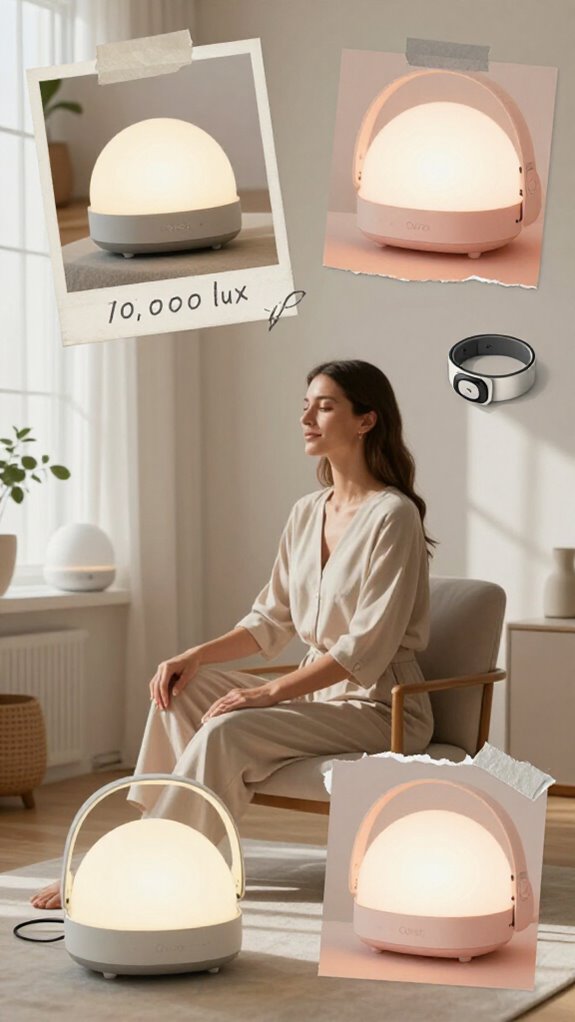
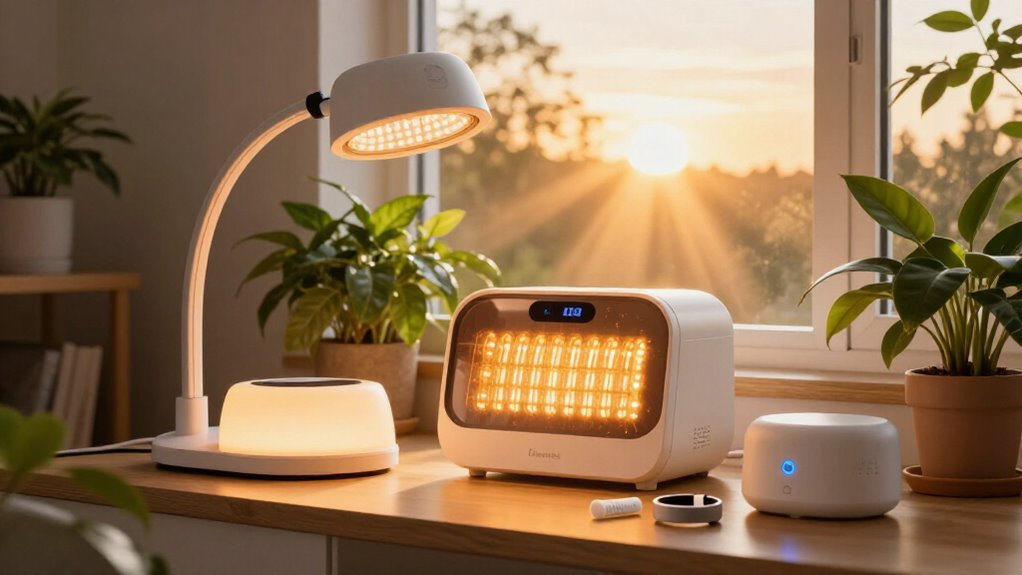
After I anchor morning light in the first 30–60 minutes, I use a simple “toolkit” to hit the lux targets that matter for cortisol timing: around 2,500–10,000 lux for a robust cortisol awakening response and about 10,000 lux delivered for ~30 minutes (often in the 9:00–10:00 a.m. window) to reshape cortisol mesor and amplitude over time. Bright light enhances the cortisol awakening response compared with dim light, improving the stress-hormone rhythm. For cortisol regulation, I pick light therapy boxes rated 10,000 lux at distance, like Carex models, and calibrate placement like a mini radiometer check.
| Option | What I look for |
|---|---|
| 10,000 lux box | 30 min, 9–10 a.m. |
| 2,500–8,000 lux lamp | 2–3 hour window |
| 800 lux portable | controlled 20–40 min study |
| Oura Ring | readiness + sunlight effect |
| Salivary kits | pre/post cortisol tracking |
Home Apnea Screening Devices
- ApneaTrak records up to 3 nights; effort, snoring, position, oximetry
- WatchPAT uses finger probe PAT + pulse oximetry; sensitivity 95.8% (AHI≥5)
- FDA-cleared options include Nox T3s, Sleep Profiler PSG2, Wesper Lab
Nox T3s also supports raw-data scoring with AI, while Suprasternal sensors help sort central vs obstructive patterns.
FAQ
How Long After Morning Light Will Cortisol Rhythms Normalize?
You’ll usually see cortisol rhythms settle within 3–7 days after consistent light exposure within 30 minutes of waking. The cortisol spike often drops the first day, but your body refines timing over a week or two. I’ll help you stay steady.
Does Cloudy Weather Still Provide Enough Light to Reset Cortisol?
Yes—cloudy weather can still reset cortisol, as long as you get enough cloud exposure and light intensity. I step outside for 10–30 minutes, letting brightness reach my eyes; even diffuse light can cue your body’s rhythm.
Can Caffeine Before Light Exposure Blunt Cortisol Reduction?
Yes—caffeine can blunt cortisol reduction from morning light. When you drink coffee before light exposure, your caffeine impact can keep cortisol levels higher and delay the calm your nervous system would’ve felt. Try waiting 30–60 minutes if you can.
What if I Wake Before Sunrise—What Light Works Best?
If you wake before sunrise, I still use light: open curtains and step into the brightest nearby area for feathered greetings—dawn activities—using a high-lux daylight lamp if needed. I keep it close to waking, dim screens, and avoid harsh blue at night.
Are There Cortisol-Reset Benefits From Brief Light Through Windows?
Yes—brief window light can nudge cortisol down on your behalf. I notice calmer mornings from gentle light exposure, especially if it’s cool, steady, and close to waking; it helps your brain read “daytime” softly.
References
- https://drkumardiscovery.com/posts/light-affects-morning-salivary-cortisol-humans/
- https://pmc.ncbi.nlm.nih.gov/articles/PMC12932458/
- https://pubmed.ncbi.nlm.nih.gov/10487717/
- https://www.frontiersin.org/journals/psychiatry/articles/10.3389/fpsyt.2026.1743465/full
- https://ouraring.com/blog/benefits-of-morning-sunlight/
- https://www.youtube.com/shorts/bmFw2kQ9pRs
- https://www.cadwell.com/apneatrak/
- https://sleepreviewmag.com/sleep-diagnostics/home-testing/home-apnea-testing/hst-devices-guide/
- https://aasm.org/novel-devices-applications-diagnosing-obstructive-sleep-apnea/
- https://wellnessandpain.com/comfort-and-convenience-of-home-sleep-test-devices/