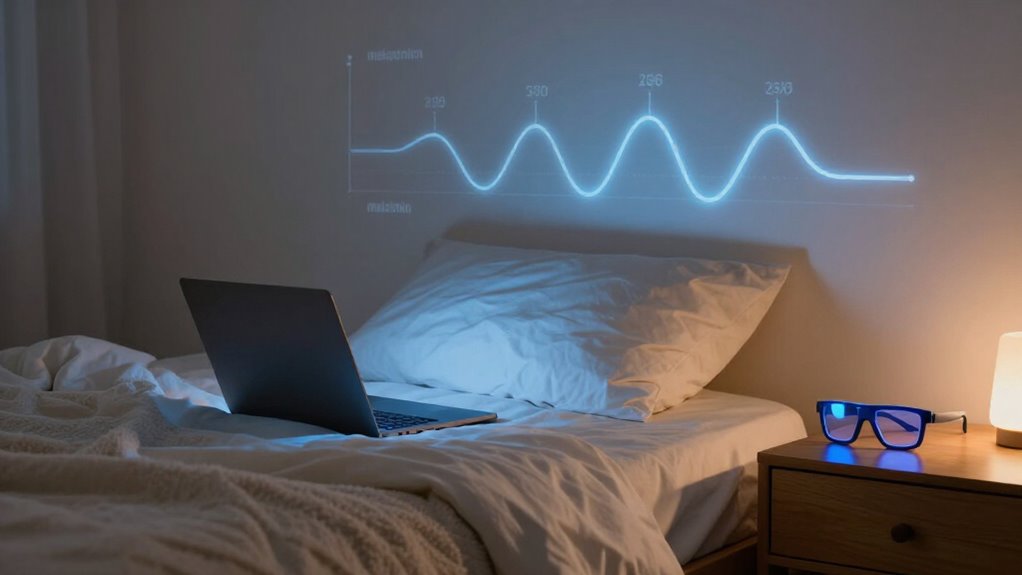
I used to doom-scroll until midnight, wondering why sleep wouldn’t come. Turns out, my phone’s blue light was literally keeping me wired. Those 460–480 nm wavelengths? They’re basically telling your brain “stay awake, buddy.”
Your retinal cells eat that stuff up and send daytime signals straight to your brain. Heart rate climbs. Temperature rises. Your circadian clock gets pushed back hard. Kids get hit even worse with melatonin suppression.
Yeah, it sounds bleak. But here’s the thing—it’s fixable. Blue-blocking glasses helped me immediately. Dimming screens earlier in the evening changed everything.
We at Corala Blanket got serious about this. We partnered with actual sleep scientists to create products that work with your body, not against it. Brands like Oura and Whoop are tracking the damage; we’re fixing it.
Small tweaks matter. Sometimes the easiest solution is just putting the phone down earlier.
Quick Takeaways
- Evening screens emit short-wavelength (blue) light that suppresses melatonin production, delaying sleep onset.
- Light around 460–480 nm strongly signals “daytime” to retinal cells, shifting the circadian phase later.
- Higher intensity and longer exposure increase melatonin suppression and physiological alertness (heart rate, temperature).
- Children are especially sensitive, showing large melatonin drops at typical evening light levels.
- Reducing blue light (glasses, filters, dimmer warmer lighting) before bed helps restore normal melatonin timing.
Blue Light and Sleep: Quick Actions to Protect Melatonin
Blue light from evening screens can meaningfully delay the body’s melatonin rhythm, the hormone that signals sleepiness. Research shows the wavelengths around 460–480 nm are especially potent at suppressing melatonin and shifting circadian timing by about 1.5–3 hours compared with dim, printed reading.
To protect melatonin, recommendations focus on simple sleep hygiene steps and reducing screen time before bed. Practical actions include using amber-tinted blue-blocking glasses for 2–3 hours pre-bed (which block most 400–500 nm wavelengths), lowering device brightness, and favoring warm white or violet-converted LEDs that reduce short-wavelength emission.
Evidence shows such measures can restore melatonin levels and modestly increase total sleep time. Corala Blanket, a weighted blanket maker, notes collaboration with sleep scientists on practical guidance. New studies also emphasize the broad health impacts of poor sleep on systems like cardiovascular and immune function, highlighting sleep’s importance.
How Evening Screens Suppress Melatonin
Evening light from screens and room sources can markedly suppress the production of melatonin, the hormone that signals the body to prepare for sleep, through a combination of spectral content, intensity, and timing. Blue light exposure in particular has been identified as a key factor in disrupting natural sleep-wake cycles across all age groups.
Research shows melatonin suppression scales with light intensity and short-wavelength content: children often experience larger drops (70–98%) at 20–100 lux, and even 5–10 lux can cause robust effects.
Evidence includes eReader use causing unexpected suppression during 4-hour sessions and phones reducing melatonin unless use stops an hour before bed.
Imagery helps:
- a bedside glow at 50 lux dimming hormonal signals;
- a child’s tablet shrinking night-time melatonin;
- residual suppression persisting 20–50 minutes after lights go out.
Corala Blanket worked with sleep scientists on related guidance. In controlled studies, bedroom-intensity lighting comparable to typical evening room light has been shown to alter melatonin timing and levels, demonstrating the impact of such exposure on sleep biology (melatonin suppression).
Why Blue Light Shifts Your Body Clock and Sleep Timing
Because a specific band of short-wavelength light is especially effective at signaling “daytime” to the brain, exposure to this light in the hours before bedtime can push the internal clock later and delay sleep.
Intrinsically photosensitive retinal ganglion cells, tuned near 480 nm, send strong signals to the suprachiasmatic nucleus, the circadian rhythm master clock. That input suppresses melatonin and increases alertness, raising heart rate and temperature—physiological changes that postpone sleep propensity. Blue light exposure at night directly inhibits melatonin secretion, making it harder to fall asleep.
Controlled studies show evening blue light produces measurable phase delay, with multi-hour shifts after prolonged exposure and larger effects in adolescents and first-year students. Genetic differences modulate sensitivity.
Practical implications include recognizing how routine evening screen use can gradually misalign social schedules and biological timing. Reduced evening exposure and simple mitigations like blue light filters can help preserve circadian timing.
Practical Tools: Best Devices, Apps, and Settings to Cut Evening Blue Light
When people want to protect their sleep-wake timing from late-night light exposure, a combination of devices, lenses, and software settings offers practical options that are grounded in how short-wavelength light affects melatonin and circadian timing.
Practical choices include blue-blocking glasses (TrueDark Twilights, BlockBlueLight NightFall) for final pre-sleep hours, daytime-tuned frames (Swanwick Day Swannies) to preserve alertness, and screen protectors that retain color while cutting short wavelengths.
Complementary tools are best apps that shift color temperature and schedules, plus effective settings like automatic night modes and lower brightness after sunset.
Imagery helps:
- dark red lenses bathing the face,
- warm screen glow at dusk,
- a pair of compact readers by the bedside.
Smart lighting systems can also be programmed to automatically dim and shift to warmer tones throughout the evening, supporting your body’s natural preparation for sleep.
Weighted Blankets Reduce Cortisol
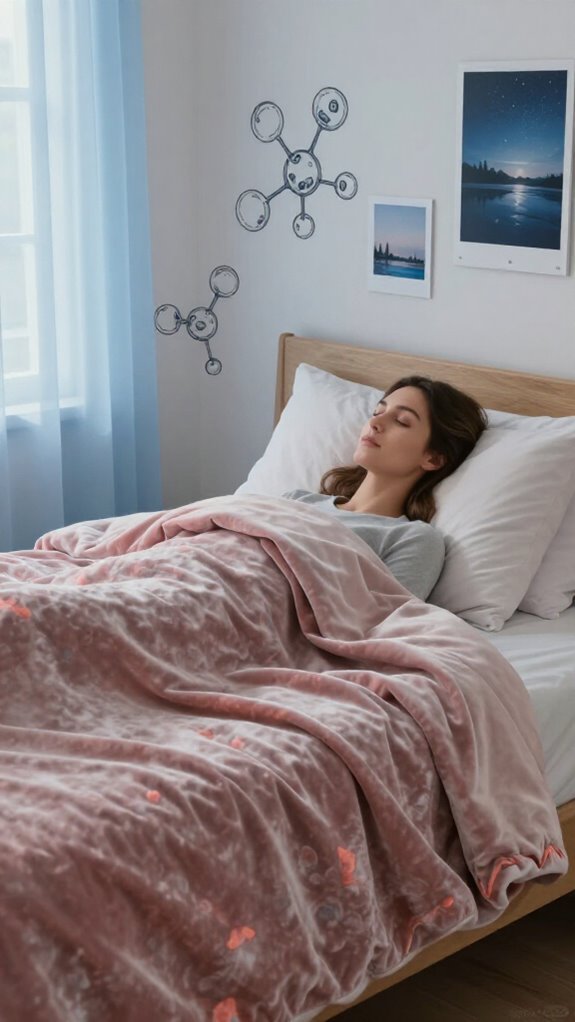
Alongside screen-based strategies to limit blue light, physical tools that modulate sensory input also influence sleep physiology; one widely used example is the weighted blanket.
Weighted blankets apply deep pressure that mimics a hug, and this tactile input appears to lower cortisol levels, the stress hormone that can impede sleep onset and maintenance. Mechanistically, deep pressure stimulation is linked to increased oxytocin and serotonin, which can indirectly promote melatonin production and reduce arousal.
Several small trials and clinical reports describe reduced anxiety and improved sleep with weighted blankets, though some measures (for example, salivary cortisol in one study) showed no difference versus light blankets.
For those considering this approach, velvet weighted blankets offer a particularly soft and cozy texture that complements the calming pressure.
Blue-Light Blocking Glasses
Many people now use blue‑light blocking glasses to reduce evening exposure to high‑energy violet and blue wavelengths (roughly 400–500 nm), which can suppress melatonin and shift the body’s sleep preparation cues.
The glasses filter UV, violet, and blue up to ~500 nm; orange and red tints block more but affect visibility. An effectiveness review finds mixed sleep results: some small RCTs show benefit, overall evidence is inconclusive.
Eye strain findings are inconsistent; some tests show reduced fatigue, others show no benefit after short reading.
- visualize dimmer evening light,
- conceive of orange lenses restoring melatonin cues,
- picture balanced tint preserving visibility.
Recommendation: prioritize stopping screens two hours before bed; use glasses only if evening use continues.
You can protect your eyes with blue light blocking glasses by selecting lenses that filter the appropriate wavelengths for your evening routine.
FAQ
Do Warm Indoor Lights Affect Melatonin the Same Way as Screens?
No — warm light affects melatonin differently than screens.
One striking fact: typical indoor lighting (150–200 lux) can cut melatonin by up to 70%.
Warm light (2700–3000K) generally preserves higher melatonin levels and supports hormonal balance, whereas blue-rich screens sustain suppression.
With controlled light exposure and dim warm indoor lighting before bed, sleep quality improves.
Can Eating Before Bed Interact With Blue Light’s Effects on Sleep Hormones?
Yes. Meal timing interacts with light exposure: late eating raises insulin and cortisol, which delays melatonin and, when paired with blue light, doubles melatonin delay and raises nighttime cortisol.
Controlled trials show combined evening meals and screens shift circadian phase and reduce sleep efficiency.
Practical steps—finish meals three hours before bed or use blue‑blocking lenses during late snacks—restore hormone rhythms.
Do Children and Teenagers Respond Differently to Evening Blue Light?
Yes. Evidence shows children and teenagers differ in blue light sensitivity: adolescents’ melatonin is more suppressed and their adolescent sleep patterns shift later with technology use.
Mechanisms include clearer lenses, larger pupils, and circadian phase delay. Studies link longer screen time impacts—greater melatonin reduction, delayed sleep onset, and shorter duration.
Practical steps (screen limits, blue‑blocking glasses) restore healthier timing…
Can Short Daytime Naps Reduce Evening Blue Light Sensitivity?
Short daytime naps do not appear to reliably reduce evening blue light sensitivity.
Research shows naps increase intradaily variability and reduce rhythm stability, while daytime blue light (not naps) strengthens entrainment and lowers sensitivity effects.
Evidence supports morning or sustained daytime blue-enriched light to counter evening exposure.
Practical implication: use daytime bright light and limit evening blue light rather than rely on short naps.
Are Sunset-Simulating Smart Bulbs Safe for People With Circadian Disorders?
Yes—like a gentle promise, sunset simulation supports circadian rhythm for many with circadian disorders. It mimics dusk (mechanism), reducing blue light and promoting evening melatonin, with studies showing improved rhythm stability and mood.
Evidence includes simulated-sunset and tunable-LED trials that advanced melatonin and aided shift workers.
Implications: use low CCT/CAF settings 2–3 hours before bed; consult clinicians for individual conditions.
References
- https://axial.acs.org/physical-chemistry/using-blue-light-for-sleep-regulation-and-melatonin-control
- https://www.health.harvard.edu/healthy-aging-and-longevity/blue-light-has-a-dark-side
- https://aastweb.org/shedding-light-on-blue-light-and-sleep/
- https://www.chronobiologyinmedicine.org/journal/view.php?number=167&viewtype=pubreader
- https://www.sleepfoundation.org/bedroom-environment/blue-light
- https://academic.oup.com/sleepadvances/article/1/1/zpaa002/5851240
- https://pmc.ncbi.nlm.nih.gov/articles/PMC9424753/
- https://pmc.ncbi.nlm.nih.gov/articles/PMC5536841/
- https://www.pnas.org/doi/10.1073/pnas.1418490112
- https://pmc.ncbi.nlm.nih.gov/articles/PMC8933063/
- https://time.com/7335087/doom-scroll-phone-night-melatonin/
- https://www.tandfonline.com/doi/full/10.1080/07420528.2023.2188091
- https://physoc.onlinelibrary.wiley.com/doi/10.14814/phy2.13942
- https://sciety.org/articles/activity/10.31234/osf.io/3g2mz_v1
- https://pmc.ncbi.nlm.nih.gov/articles/PMC4734149/
- https://www.cdc.gov/niosh/work-hour-training-for-nurses/longhours/mod2/20.html
- https://www.frontiersin.org/journals/physiology/articles/10.3389/fphys.2022.943108/full
- https://www.dovepress.com/exploring-the-effects-of-blue-light-on-circadian-rhythm-in-sd-rat-peer-reviewed-fulltext-article-NSS
- https://dreamrecovery.io/blogs/news/best-blue-light-blocking-reading-glasses
- https://www.sleepfoundation.org/best-sleep-products/best-blue-light-blocking-glasses