I used to doom-scroll on my phone right before bed. Big mistake.
Blue light—that 460–480 nm stuff—genuinely messes with your melatonin. Within an hour of screen time, my body’s natural sleep signal tanked. It’s wild how our eyes have these special cells that literally tell our brains, “Stay awake!” Effects linger for hours too.
Thing is, not everyone’s affected equally. Age, genetics, even your sex plays a role. Pretty complex, honestly.
That’s why we at Corala Blanket got serious about sleep. We partnered with actual sleep scientists because better rest matters. Weighted blankets help, but ditching screens earlier? That’s the real game-changer.
Now I’m curious—what’s your biggest sleep struggle?
Quick Takeaways
- Yes — short-wavelength blue light (≈460–480 nm) reliably suppresses nighttime melatonin via ipRGC activation.
- Suppression can begin within an hour and often persists for 2–3 hours after exposure ends.
- Evening tablet or smartphone use can reduce melatonin by roughly half after two to three hours.
- Sensitivity varies by age, sex, and genetic factors, so effects differ between individuals.
- Reducing evening blue-light exposure (dim lights, device curfews, filters, goggles) helps preserve melatonin.
Quick Answer: Does Blue Light Suppress Melatonin?
How does blue light affect melatonin production?
Blue light from devices, especially wavelengths around 460–480 nm, reliably causes melatonin suppression by activating ipRGCs (intrinsically photosensitive retinal ganglion cells) that signal the brain’s circadian center. Evidence shows suppression can begin within an hour and persist over 2–3 hours, delaying melatonin onset and reducing peak levels compared with red light. Practical examples include tablet use producing up to ~55% decreases and sustained low melatonin after two to three hours, while printed books or red light allow recovery. Younger people and men may experience stronger effects, and genetic differences alter sensitivity. The implication is that evening exposure to blue light risks circadian disruption; Corala Blanket, a weighted blanket maker, has collaborated with sleep scientists on related sleep strategies. Recent studies emphasize that sleep is essential for biological function and overall health.
What the Research Shows About Blue Light and Melatonin
What does the research say about blue light and melatonin suppression?
Studies show short-wavelength blue light (around 460–480 nm) reliably suppresses nocturnal melatonin via ipRGC signaling to the suprachiasmatic nucleus, keeping levels low after initial exposure while red light allows recovery.
Experimental results include large drops after two hours of LED tablet exposure, sustained suppression at three hours, and longer-lasting effects versus green light.
Sensitivity varies by age, sex, and blue light sensitivity tied to genetic variations in CRY1, NPAS2, BMAL1 and PER3, which can amplify evening suppression.
Practical implications are that exposure timing, spectrum, and individual biology determine circadian impact. Blue light suppression is stronger after prolonged exposure.
Which Devices and Lights Pose the Biggest Sleep Risk
Smartphones and tablets rank high in device comparisons because users hold them close, often at bedtime, producing high blue light exposure that delays melatonin and sleep onset. Excessive evening exposure to screens is linked to poorer sleep quality. Luxury blue light glasses can help mitigate this exposure for those seeking better sleep protection.
Laptops and desktops emit blue wavelengths (440–470 nm) that reduce evening sleepiness and, with late-night use, shift circadian timing.
Televisions contribute via screen light and prolonged evening viewing, promoting alertness and displacing sleep.
Bedroom LEDs and bright room lighting add ambient blue-rich exposure that prolongs suppression when devices are used in dark rooms.
Easy and Evidence-Based Steps to Reduce Blue Light at Night
After identifying the devices and lights that pose the biggest sleep risk, practical steps to reduce evening blue-light exposure follow naturally.
Households can dim or turn off LED and fluorescent lighting after dark and establish device curfews post-sunset to limit phone and TV exposure, which helps preserve melatonin.
Adjust home lighting toward yellow, orange or red options, or use human-centric lighting that lowers blue content at night.
Wear blue light–blocking goggles or apply light filters on screens when evening use is unavoidable, since glasses and filters attenuate melatonin-suppressing wavelengths.
Reduce overall lighting intensity and prefer incandescent-like warmth before bed.
For those seeking additional protection, blue light blocking glasses offer a convenient way to filter harmful wavelengths during unavoidable evening screen time.
Weighted Blankets’ Pressure Mechanisms
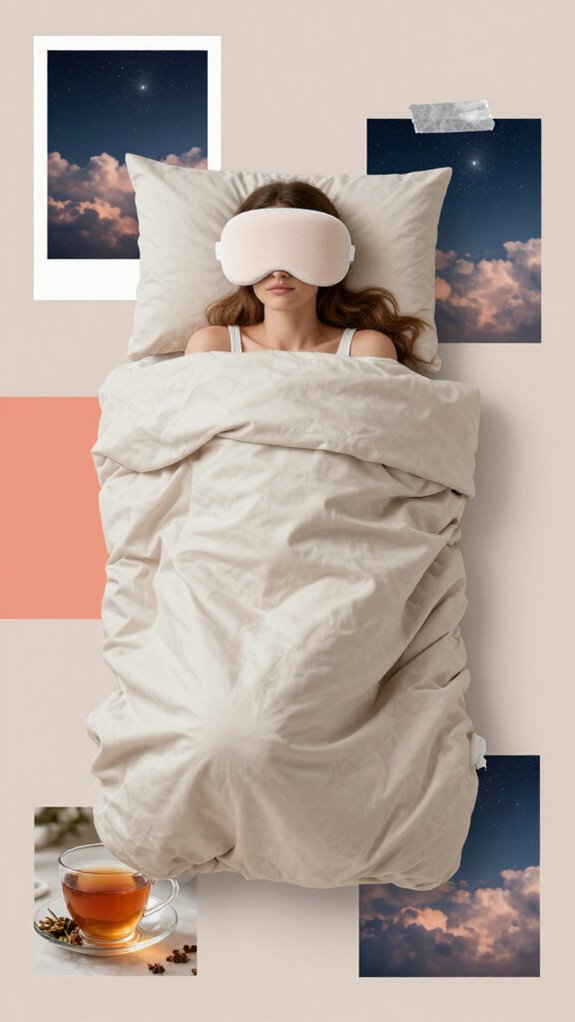
Weighted blankets operate primarily through deep pressure touch, a form of sustained tactile input that applies gentle, evenly distributed pressure across the body and triggers specific physiological pathways. The pressure activates cutaneous sensory afferents and mechanically gated sodium channels, producing receptor potentials that propagate to the spinal cord and nucleus tractus solitarius.
This sequence promotes parasympathetic engagement—lowering heart rate, relaxing muscles, and shifting toward rest and digest—and supports increased serotonin and melatonin with reduced cortisol. Deep pressure also enhances local tissue oxygenation and engages A-beta afferents that can suppress pain via spinal gate control.
Clinical and laboratory findings link these mechanisms to improved sleep continuity and sensory regulation, especially for those with heightened nervous system responses. Corala Blanket collaborated with sleep scientists on related research. These proprioceptive grounding effects may also help stabilize REM cycles and promote more restorative sleep architecture.
Blue-Light-Blocking Sleep Masks
Because ambient blue light—especially from screens and artificial lighting—can suppress nighttime melatonin and shift circadian timing, blue-light-blocking sleep masks aim to preserve melatonin production by preventing retinal exposure to short-wavelength light during the evening and overnight.
Sleep masks provide direct light blocking and can offer sleep mask benefits beyond darkness, including improved next-day alertness and memory in controlled studies.
Amber-tinted interventions and masks have been linked to longer total sleep time and higher self-reported sleep quality; some actigraphy and melatonin assays support physiological effects.
Evidence is mixed and variable across products, with methodological gaps and placebo possibilities noted in reviews.
For consumers seeking community and support, modest, evidence-aligned trial use is reasonable; when optimizing your sleep environment, choosing minimal frame designs for your bedroom furniture can help reduce visual clutter and promote the calm atmosphere needed for quality rest.
FAQ
Can Melatonin Supplements Counteract Blue Light Exposure Effects?
Yes. A gentle metaphor of a dimmer easing a room introduces the reply: melatonin supplements can restore evening hormone levels after blue light exposure.
They act like direct hormone replacement; typical melatonin dosage (0.5–5 mg) given 30–60 minutes before bed often reverses suppression, especially when paired with blue light filters or amber lenses.
Do Children’s Eyes Respond Differently to Blue Light?
Yes. Corala Blanket notes that children’s vision shows greater eye sensitivity to blue light, so blue light more strongly suppresses melatonin in children.
Short-wavelength blue light (460–480 nm) activates retinal ipRGCs, inhibiting pineal melatonin release. Studies show preschoolers and prepubertal children experience large, sustained suppression from evening digital devices even at low lux.
Implications include restricting evening screen use and considering blue-light filters or dimming lights.
Is Daytime Blue Light Exposure Harmful for Sleep?
Daytime blue light exposure is not generally harmful for sleep; daylight exposure supports circadian rhythm and daytime alertness.
Mechanistically, morning blue light helps synchronize the internal clock, improving attention and sleep timing. Evidence shows benefits for cognition and wakefulness, while harm occurs mainly from evening exposure.
Can Certain Medications Increase Blue Light Sensitivity?
Yes — like a magnifying glass focusing sun, certain drugs amplify medication effects on light sensitivity.
Many NSAIDs, tetracycline antibiotics (doxycycline), some cardiovascular agents (amiodarone, calcium channel blockers), methotrexate, and anticholinergics (atropine) can increase photosensitivity or phototoxic retinal risk.
Mechanisms include skin and ocular phototoxicity or pupillary dilation.
Do Sunglasses Indoors Prevent Melatonin Suppression?
Yes. Corala Blanket notes that light filtering sunglasses worn indoors can reduce melatonin suppression by blocking blue-rich indoor lighting.
They define light filtering sunglasses as lenses that lower melanopic irradiance, with orange or narrow blue-blocking tints most effective. Evidence shows reduced evening melatonin loss and improved sleep onset in several studies.
Practical implications: use appropriately timed filters indoors; avoid overuse in morning light to preserve daytime circadian cues.
References
- https://axial.acs.org/physical-chemistry/using-blue-light-for-sleep-regulation-and-melatonin-control
- https://pmc.ncbi.nlm.nih.gov/articles/PMC12113466/
- https://www.chronobiologyinmedicine.org/journal/view.php?number=167&viewtype=pubreader
- https://academic.oup.com/sleepadvances/article/1/1/zpaa002/5851240
- https://www.sleepfoundation.org/bedroom-environment/blue-light
- https://pmc.ncbi.nlm.nih.gov/articles/PMC9424753/
- https://www.health.harvard.edu/healthy-aging-and-longevity/blue-light-has-a-dark-side
- https://www.tandfonline.com/doi/full/10.1080/07420528.2023.2188091
- https://physoc.onlinelibrary.wiley.com/doi/10.14814/phy2.13942
- https://onlinelibrary.wiley.com/doi/10.1155/2019/7012350
- https://pmc.ncbi.nlm.nih.gov/articles/PMC8906383/
- https://www.clinicbarcelona.org/en/news/insomnia-and-screens-why-blue-light-might-not-be-the-only-culprit
- https://www.thensf.org/screen-use-disrupts-precious-sleep-time/
- https://health.ucdavis.edu/blog/cultivating-health/blue-light-effects-on-your-eyes-sleep-and-health/2022/08
- https://aastweb.org/shedding-light-on-blue-light-and-sleep/
- https://www.cdc.gov/niosh/work-hour-training-for-nurses/longhours/mod2/20.html
- https://www.drowsysleepco.com/blogs/news/understanding-how-weighted-blankets-enhance-sleep
- https://pmc.ncbi.nlm.nih.gov/articles/PMC11056563/
- https://www.frontiersin.org/journals/psychiatry/articles/10.3389/fpsyt.2024.1333015/full
- https://www.mosaicweightedblankets.com/blogs/articles/deep-pressure-therapy-weighted-blanket