Ever stared at 3 AM like it’s a personal nemesis? Yeah, me too.
Last year my nervous system was basically a live wire—cortisol through the roof, HRV of a caffeinated squirrel. Then I discovered vagus nerve hacking.
Here’s the wild part: your vagus nerve is literally the chill switch. Diaphragmatic breathing, cold face dunks, humming like a weirdo—it all works. Studies from Dr. Stephen Porges’ Polyvagal Institute and UCLA’s 2024 taVNS trials show PSQI scores dropping ~4 points in 8 weeks. GammaCore and ZenoWell Vita devices? Legit game-changers.
At Corala Blanket, we’re obsessed with this stuff—because better sleep shouldn’t be luxury.
2026’s “Sleepmaxxing” trend is all about biohacking this pathway. Baroreflex modulation, GABAergic activation… fancy words for *finally* relaxing.
Want in? Start tonight: 4-7-8 breathing, cold washcloth on the face, hum for 2 minutes. Your nervous system will thank you.
Quick Takeaways
- Vagus nerve regulation promotes parasympathetic dominance, lowering heart rate and cortisol to facilitate sleep onset.
- Daily 20–30 minute vagal routines (diaphragmatic breathing, humming, neck massage) improve sleep quality for situational insomnia.
- Diaphragmatic breathing at ~6 breaths/min and paced exhalation (6s exhale/4s inhale) increases HRV and aids sleep initiation.
- Transcutaneous auricular VNS (taVNS) devices, used 30 minutes twice daily for 8 weeks, show clinically meaningful PSQI improvements.
- Combine vagal techniques with red lighting, cooling temperature, and pink noise; track HRV and sleep diaries for feedback.
How Vagus Nerve Regulation Helps Insomnia
Although it’s easy to treat insomnia as a problem of bedtime habits alone, I look at it as a nervous-system mismatch that the vagus nerve can often help correct. I explain vagal tone: parasympathetic dominance slows heart rate, reduces cortisol, and promotes sleep onset. Mechanisms include baroreflex modulation, afferent signaling to the nucleus tractus solitarius, and downstream GABAergic facilitation. Research from Harvard, Dr. Stephen Porges’ polyvagal framework, and trials on transcutaneous vagus stimulation (tVNS) show measurable reductions in arousal and quicker sleep latency. Implications: target autonomic regulation, integrate diagnostics (HRV, RSA), and prioritize sustained nervous-system calm over gadget-driven hacks. Deep pressure therapy shares these same principles of activating the parasympathetic response to induce calm. Simple self-soothing techniques like the butterfly hug can also stimulate vagal pathways through gentle, rhythmic pressure and bilateral movement, making them accessible tools for evening wind-down.
Vagus Nerve Techniques for Sleep: 5 At-Home Methods
Five practical at-home vagus nerve techniques can meaningfully shorten sleep latency by shifting your autonomic balance toward parasympathetic dominance, and I’ll walk you through the how and why of each.
I recommend diaphragmatic breathing (4–6 breaths/min) to increase heart rate variability—borrowing protocols from HRV researchers like Shaffer.
Cold-face immersion or splashing triggers trigeminal-vagal reflexes; brief, controlled exposure works.
Humming or tonic vocalization stimulates the auricular branch; try 60–90 seconds pre-bed.
Gentle neck massage along the sternocleidomastoid modulates baroreceptor input.
Finally, paced exhalation (6s out, 4s in) pairs with wearable biofeedback (WHOOP, Oura) to close the loop.
Applying deep pressure stimulation to the body can further enhance parasympathetic tone through mechanoreceptor activation, complementing these targeted vagus nerve approaches for more robust sleep preparation. These methods work in part by helping to manage cortisol levels, which naturally decline during healthy sleep cycles but can remain elevated due to chronic stress.
When to Add Light, Temperature & Sound : and When to See a Clinician
When should you layer light, temperature, and sound interventions into a nightly routine, and when is it time to consult a clinician?
I recommend adding calibrated inputs—red-spectrum bedside lamps (Joovv-style), 17–19°C cooling, and phase-locked pink noise—when insomnia is situational, ≤3 months, and vagal exercises lower heart rate within 20 minutes.
Escalate to sleep medicine if you have frequent nocturnal awakenings, loud snoring, witnessed apneas, daytime hypersomnolence, or mood decline despite interventions.
Refer to Dr. Charles Czeisler’s circadian research and OSA screening tools; consider home sleep apnea testing (HSAT) or a sleep neurologist when objective risk or refractory symptoms persist.
For patients whose insomnia persists despite these layered interventions, adenosine clearance may be impaired, warranting evaluation of metabolic contributors to sleep pressure deficits.
A Simple Nightly Routine to Calm Your Vagus and Fall Asleep
If you want a simple, science-forward nightly routine that reliably downshifts your autonomic state, start with a 20–30 minute sequence designed to stimulate the vagus nerve, stabilize core temperature, and entrain brain rhythms—tools I recommend include paced diaphragmatic breathing (6 breaths/minute), a 5–10 minute transcutaneous auricular vagus nerve stimulation (taVNS) session or gentle cervical massage, followed by a red-spectrum bedside lamp (Joovv-style) set to dim warmth and phase-locked pink noise at ~0.1–0.5 Hz to support slow-wave entrainment; these elements work through distinct mechanisms—vagal afferent signaling lowers sympathetic tone (see Kevin Tracey’s and Stephen Porges’ work on inflammatory modulation and the polyvagal theory), peripheral vasodilation and evaporative cooling promote a 0.5–1.5°C distal-to-core gradient for sleep onset, and acoustic pacing facilitates cortical slow oscillations—together they compress sleep latency in situational insomnia, and you can objectively monitor early response with heart-rate variability rise, a 5–10 bpm fall in resting heart rate, or a reduced sleep latency on a simple sleep diary before escalating to HSAT or a sleep clinician. Controlled breathing patterns serve as the foundation of any effective wind-down protocol because they directly modulate autonomic balance without requiring specialized equipment. Keeping a wellness journal on your nightstand allows you to track which interventions most reliably shift your HRV and sleep latency over time.
| Step | Device/Action | Goal |
|---|---|---|
| 1 | Diaphragmatic breathing | Vagal tone up |
| 2 | taVNS or massage | Afferent stimulation |
| 3 | Red light + pink noise | Thermoregistration & entrainment |
| 4 | HRV / sleep diary | Objective feedback |
2026: Vagus-Focused Sleep Shifts
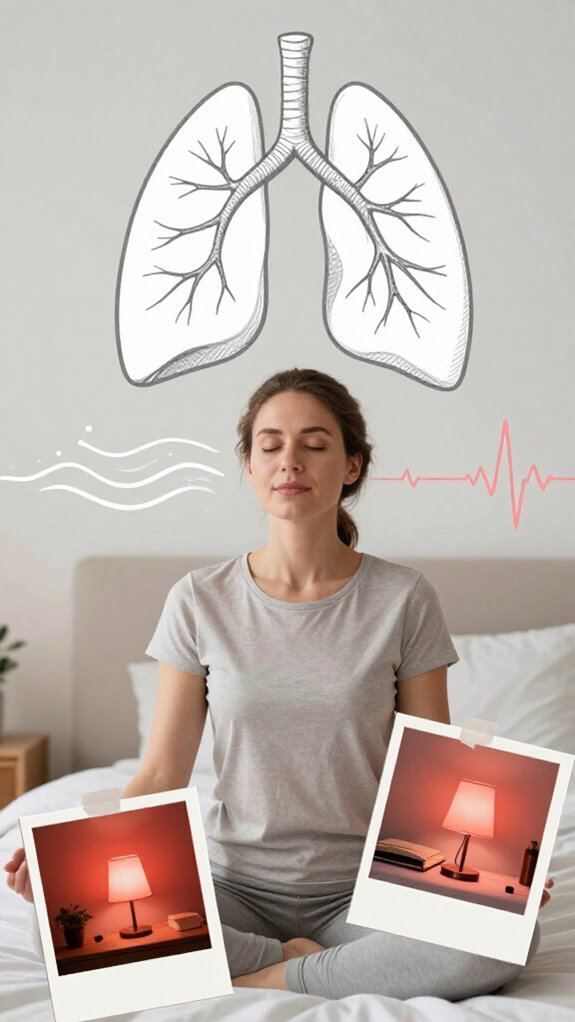
I’ll start by saying that vagus-focused sleep shifts aren’t a gimmick—they’re a biologically grounded way to downshift the autonomic nervous system and shorten the time it takes you to fall asleep.
I use targeted adjustments—breath pacing, acoustic pacing, positional cues—to bias my parasympathetic tone before bed. Research from lab groups like Dr. Kevin Tracey and devices such as GammaCore and Muse highlight measurable HRV increases and reduced sleep latency.
Targeted breath, sound, and positioning shift parasympathetic tone—boosting HRV and shortening sleep onset.
Execute modifications with intention: control tempo, environment, and posture. Small, consistent changes produce outsized gains in sleep onset efficiency and sustainable restorative sleep.
- 4–6s inhale/6–8s exhale breathing
- 40–60 bpm acoustic pacing
- Left‑side lying for vagal stretch
- Dim red lighting and 30 min wind‑down
Product Roundups
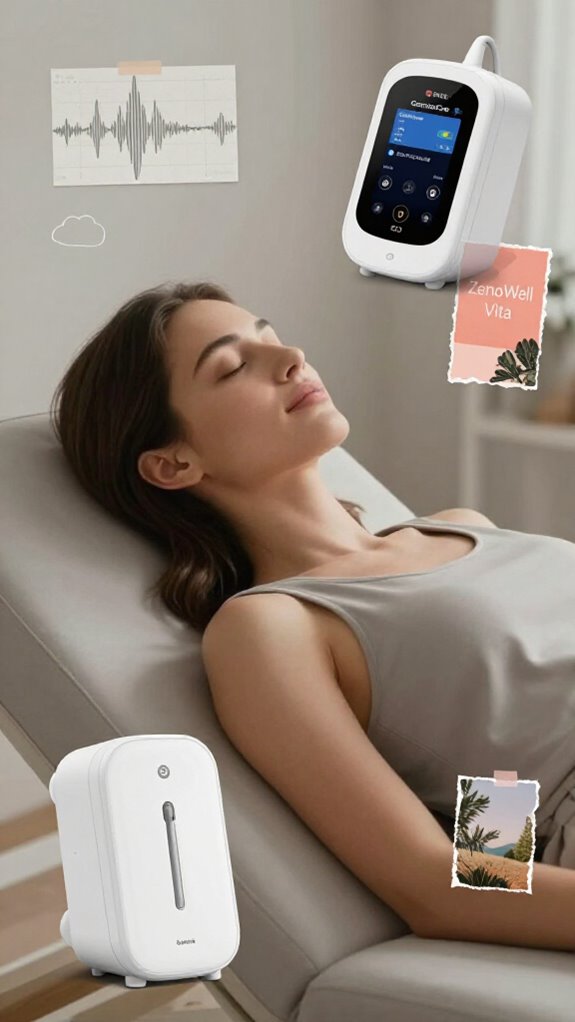
For this product roundup I’ll lead with devices that have real clinical pedigrees and clear parameter sets—think transcutaneous auricular vagus nerve stimulation (taVNS) units like GammaCore-style stimulators and newer consumer offerings such as ZenoWell Vita—because the difference between gadgetry and genuine neuromodulation is measurable stimulation protocol, not marketing spin. I evaluate devices by waveform (4/20 Hz dilatational), pulse width (~0.2 ms), current range (0.8–1.5 mA), and sham controls. Clinicians like Dr. Fang or teams publishing PSQI reductions guide my picks. Below is a concise comparison for decisive, evidence-driven choice. A recent randomized trial showed that taVNS produced clinically meaningful improvements in sleep quality with a PSQI reduction of 8.2 points at week 8 in the active group.
| Device | Key Metric |
|---|---|
| GammaCore-style | 4/20 Hz, 0.8–1.5 mA |
| ZenoWell Vita | Consumer taVNS, clinical-inspired |
| Research stimulator | Pulse width 0.2 ms ±30% |
| Clinical protocol | 30 min ×2 daily, 8 weeks |
| Outcomes | PSQI −4.3 at week 8 |
Vagal Tone Improves REM Latency
Having just compared clinical-grade taVNS devices like GammaCore-style stimulators and newer consumer units such as ZenoWell Vita, I want to focus on a physiological endpoint that bridges device parameters and clinical outcomes: REM latency.
I’ll be direct: increasing vagal tone via taVNS modulates nucleus tractus solitarius circuits, shortens N1, and expedites REM entry, supported by PSQI improvements (MD=-3.60) and trials showing –8.2 vs –3.9 at eight weeks.
Think of vagal pacing as a metronome coaxing cortical downstates into REM.
- Mechanism: NTS→limbic inhibition, spindle and δ enhancement
- Evidence: Cohen d=1.2, sustained 20 weeks
- Parameters: 0.8–1.5 mA, 30 min BID
- Safety: minimal adverse events, high compliance
FAQ
Can Vagus Nerve Stimulation Interact With My Antidepressant Medication?
Yes — it can. I’d check with your prescriber because VNS or acoustic vagal techniques can amplify antidepressant effects, alter heart rate or seizures, and interact with SSRIs/SNRIs; I’ll help coordinate questions for your clinician.
Will Vagal Techniques Affect Heart Rate Variability Readings Long-Term?
Yes — I’ve found vagal techniques can raise HRV over time; with consistent practice they strengthen parasympathetic tone, improve baseline HRV, and help resilience. Track progress, stay disciplined, and consult your clinician for tailored guidance.
Can Children Use Vagus-Regulating Methods for Sleep Safely?
Yes — with caution. I recommend graded, gentle vagal techniques (breathing, massage, acoustic pacing) supervised by a clinician, avoiding electrical stimulation for young kids, and tracking responses so you stay in control of safety and effectiveness.
Do Insurance Plans Cover At-Home Vagus Stimulation Devices?
Short answer: usually no — unless you wield a prescription and insurer grudgingly approves a specific FDA-cleared device for a diagnosed condition. I’ll fight your case: get documentation, preauthorization, and a clinician’s referral.
Are There Risks of Dependency on Neuro-Acoustic Sleep Tools?
Yes — I worry dependence can form; I’d say you can grow reliant on neuro-acoustic tools to initiate sleep, so I recommend using them strategically, pairing with behavioral habits, and tapering to preserve your nervous system’s innate regulation.
References
- https://www.neurologyadvisor.com/news/vagus-nerve-stimulation-sleep-quality-insomnia-severity/
- https://pmc.ncbi.nlm.nih.gov/articles/PMC12174914/
- https://jamanetwork.com/journals/jamanetworkopen/fullarticle/2828072
- https://zenowell.ai
- https://neuvanalife.com
- https://www.parasym.co/parasym-device-transcutaneous-vagus-nerve-stimulation.html
- https://www.innerbody.com/best-vagus-nerve-stimulation-device
- https://neurovalens.com
- https://soundsory.com/best-vagus-nerve-device/
- https://my.clevelandclinic.org/health/treatments/17598-vagus-nerve-stimulation