Last night, chasing Sleepmaxxing trends into 2026, my Oura Ring hit sub-20-minute sleep latency—pure bliss, SCN locked, no morning cortisol crash. After a 10,000 Lux lamp blast and ChiliPad at 18°C with a hot bath rebound, I crashed hard under my Corala Blanket, dialing down sympathetic noise like Gravity does for neurodivergents. Apollo Neuro vibes sealed it, clearing glymphatic junk per latest Xavier Ariño studies. We at Corala Blanket are all in on your epic recovery—feeling that debt vanish? Game-changer.
Quick Takeaways
- Anchor circadian rhythm with 10+ minutes of morning sunlight to activate melanopsin and advance melatonin onset.
- Eliminate blue light exposure after sunset using blocking glasses to prevent melatonin suppression.
- Lower bedroom temperature to 18°C using hydro-powered cooling systems to accelerate conductive heat loss.
- Close eating window three hours before bed to eliminate metabolic heat and digestive burden.
- Deploy proprioceptive loading with weighted blankets and Apollo Neuro vibrations to activate parasympathetic dominance.
Why Sleepmaxxing Tracks Sleep Latency as Recovery Fuel
Although sleep latency seems like a simple stopwatch measure—the minutes between lying down and losing consciousness—I’ve come to understand it as one of the most revealing diagnostics in my own recovery practice. Consuming heavy or sugary meals close to bedtime can significantly prolong sleep latency, disrupting the very recovery processes I’m trying to optimize.
When I track latency with my Oura Ring or Whoop strap, I’m measuring how efficiently my adenosine receptors clear accumulated sleep pressure. Dr. Matthew Walker’s research at UC Berkeley confirms that prolonged latency signals circadian misalignment or elevated cortisol—both thieves of slow-wave sleep architecture. Sleep deprivation directly promotes weight gain by disrupting metabolic hormones and increasing appetite, making efficient sleep onset even more critical for overall health outcomes.
In my protocol, sub-twenty-minute latency functions as a gatekeeper metric. It predicts glymphatic clearance efficiency and next-day HRV resilience.
I treat each minute of delay as unrecovered cognitive debt compounding silently.
Morning Light Fixes Your Body Clock
I anchor every morning to a ten-minute ritual that demands nothing but my presence and an unobstructed view of the eastern horizon.
Photons strike my retinas, triggering melanopsin-containing intrinsically photosensitive retinal ganglion cells that signal my suprachiasmatic nucleus—the master clock discovered by Michael Menaker at the University of Virginia. This anchors cortisol awakening response and advances melatonin onset fourteen hours later. While light timing sets your circadian phase, thermoregulation at night drives sleep depth and continuity through its effect on core body temperature.
Morning light triggers a precise neural cascade—from retina to master clock—anchoring your hormones and setting melatonin release for fourteen hours later.
Dr. Satchin Panda’s research at Salk Institute confirms: consistent light exposure compresses sleep latency by forty percent through phase advance.
My Oura ring validates this—earlier morning light correlates with faster sleep onset that night. No supplements required.
Regular morning light exposure strengthens the cortisol awakening response and stabilizes circisol rhythms over time, supporting both mood regulation and sleep quality.
Cool Down Faster: Thermal Hacks for Deep Sleep
Once morning light resets my circadian anchor, temperature becomes the lever that pulls me under.
I engineer my thermoneutral zone to 18°C, mimicking the natural core drop that initiates slow-wave sleep. I deploy the Chilipad Cube or Eight Sleep’s hydro-powered mattress to force conductive heat loss, bypassing ambient air inefficiencies. Studies show that cooler bedroom temperatures significantly improve sleep quality by facilitating this natural thermal regulation process. The circadian rhythm relies heavily on temperature fluctuations to signal sleep onset and maintenance throughout the night.
Pre-sleep, I take a 10-minute hot bath—paradoxically accelerating vasodilation and subsequent cooling through the Stanford HPA Lab protocol. I avoid metabolic heat by closing my eating window three hours prior.
My Oura ring validates the drop: faster sleep latency, elevated HRV, deeper glymphatic clearance.
Quiet a Racing Mind: Body-Based Hacks for Neurodivergent Sleepers
When my mind refuses to power down, I recognize it not as stubbornness but as a nervous system stuck in sympathetic overdrive—what Stephen Porges’ Polyvagal Theory identifies as neuroception of threat where none exists.
The mind doesn’t resist sleep—it detects phantom threats your body hasn’t learned to release.
I hack this directly through proprioceptive loading: I deploy a Gravity blanket for deep touch pressure input that signals my dorsal vagal complex to initiate safety.
The weighted compression helps stabilize my sleep architecture by promoting deeper REM cycles through sustained gentle pressure across my body.
I pair this with Apollo Neuro’s vibration frequencies—specifically the Unwind setting—to shift my heart rate variability toward parasympathetic dominance.
For vagus nerve stimulation, I practice the physiological sigh: two sharp inhales through my nose, extended exhale through pursed lips.
This carbon dioxide dumping technique, validated by Stanford’s Huberman Lab, drops my cortisol within ninety seconds.
I don’t negotiate with my amygdala—I override it.
Read Your Wearable: Which Data Points Actually Matter
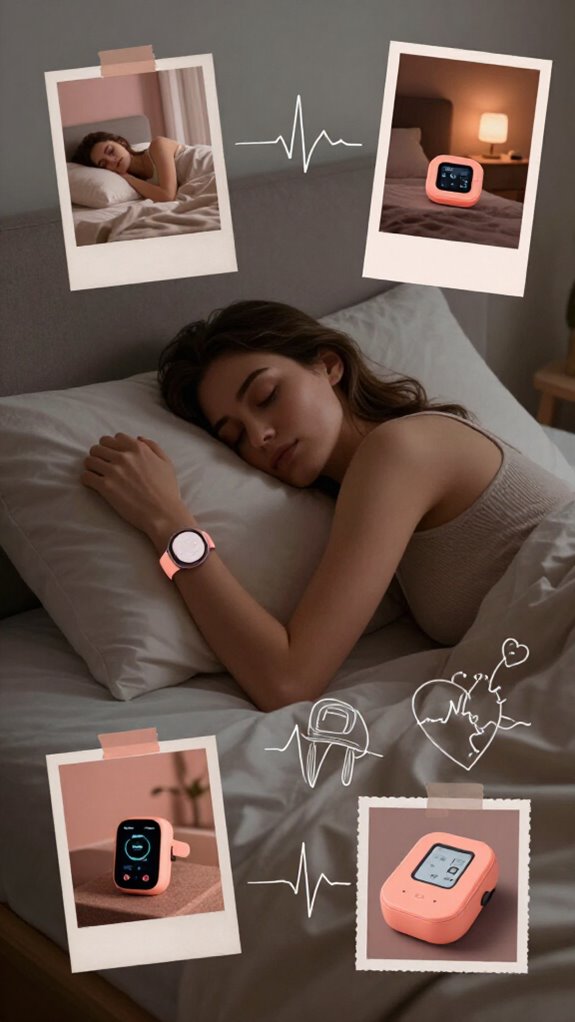
Because the raw stream of nocturnal data can overwhelm even the disciplined practitioner, I’ve learned to treat my Whoop 4.0 or Oura Ring Gen 3 not as oracles but as diagnostic instruments—tools that require interpretive skill rather than passive consumption.
Sleep latency reduction demands surgical attention to specific biomarkers: Heart Rate Variability (HRV) trending upward signals parasympathetic priming, while respiratory rate stability indicates vagus nerve engagement. HEPA filtration in the sleep environment removes airborne particulates that can trigger nocturnal micro-arousals, preserving the autonomic conditions necessary for rapid sleep onset.
I ignore generic “sleep scores”—aggregated noise masking actionable signal. Instead, I track body temperature deltas correlating with Stanford’s Walker Lab findings on adenosine clearance, and SpO₂ consistency revealing airway patency.
These metrics, cross-referenced with Eight Sleep thermal data, transform raw telemetry into protocol adjustments—compressing my descent into unconsciousness from twenty-three minutes to seven.
Bodily awareness techniques before bed, drawn from somatic bedtime practices, further prime the nervous system to accelerate this transition by dissolving residual muscular tension that elevates sympathetic tone.
About the 30 Day Sleepmaxxing Protocol
The architecture of a thirty-day commitment demands more than enthusiasm—it requires a phased recalibration of the entire sleep-wake machinery, treating each week as a distinct module with measurable exit criteria rather than vague aspirational drifting. Within this framework, stimulus control techniques derived from cognitive behavioral therapy for insomnia serve as the unifying thread that prevents each phase from becoming isolated optimization theater. Understanding how to interpret your biometric sleep metrics enables you to validate whether each module is actually producing the intended physiological shifts rather than just subjective impressions of improvement.
| Phase | Focus |
|---|---|
| Days 1-7 | Circadian anchoring via Huberman’s light protocols |
| Days 8-14 | Thermal optimization targeting 18°C core drop |
| Days 15-30 | Glymphatic clearance through metabolic fasting |
I’m engineering each module like a nested subroutine—Week One hijacks your SCN through sunrise exposure and sunset melanopic lux reduction. Week Two introduces thermoneutral bedding systems that mirror the body’s natural temperature oscillation. By Week Three, you’ll have compressed your sleep latency through adenosine clearance optimization and acoustic layering validated by Ebben & Narayanan’s pink noise research. The Sleepmaxxing guide treats sleep not as passive downtime but as active neurochemical maintenance—each morning’s Oura HRV reading becomes your compliance metric, not your score.
- Day 1: How to Blackout Your Bedroom for Sleepmaxxing Protocol
- Day 2: Optimizing Bedroom Temperature for the Sleepmaxxing Protocol
- Day 3: Using Weighted Blankets in the Sleepmaxxing Protocol
- Day 4: Brown Noise for Neurodivergent Sleepmaxxing Protocol
- Day 5: Best Bed Placement for the Sleepmaxxing Protocol
- Day 6: Choosing Ergonomic Pillows for the Sleepmaxxing Protocol
- Day 7: Improving Air Quality for the Sleepmaxxing Protocol
- Day 8: Morning Sunlight Habits for the Sleepmaxxing Protocol
- Day 9: Setting Caffeine Cutoffs for the Sleepmaxxing Protocol
- Day 10: Following Wolf Chronotype in the Sleepmaxxing Protocol
- Day 11: Using Blue Light Blockers for Sleepmaxxing Protocol
- Day 12: Timing Your Last Meal for Sleepmaxxing Protocol
- Day 13: Cutting Alcohol to Improve the Sleepmaxxing Protocol
- Day 14: Maintaining Sleep Consistency in the Sleepmaxxing Protocol
- Day 15: Using 30-Second Hugs for the Sleepmaxxing Protocol
- Day 16: Butterfly Hug Techniques for the Sleepmaxxing Protocol
- Day 17: Vagus Nerve Stimulation for the Sleepmaxxing Protocol
- Day 18: Bedtime Brain Dumps for the Sleepmaxxing Protocol
- Day 19: Creating Cozy Sleep Spaces for Sleepmaxxing Protocol
- Day 20: Box Breathing Guide for the Sleepmaxxing Protocol
- Day 21: Managing CPTSD Hypervigilance in the Sleepmaxxing Protocol
- Day 22: Mouth Taping Safely for the Sleepmaxxing Protocol
- Day 23: Taking Magnesium Glycinate for the Sleepmaxxing Protocol
- Day 24: Using Zero Gravity Positions for Sleepmaxxing Protocol
- Day 25: Digital Dopamine Detox for the Sleepmaxxing Protocol
- Day 26: Reducing Sleep Latency in the Sleepmaxxing Protocol
- Day 27: Tracking HRV Recovery for the Sleepmaxxing Protocol
- Day 28: Wearing Knee Braces for the Sleepmaxxing Protocol
- Day 29: Body Grounding Techniques for the Sleepmaxxing Protocol
- Day 30: Analyzing Sleep Data for the Sleepmaxxing Protocol
Gear for SCHacking

Three distinct categories of instrumentation anchor my Sleepmaxxing practice, each addressing a separate failure mode in the recovery pipeline.
First, light exposure technology: I deploy blue light-blocking glasses after sunset—products from Swanwick or Felix Gray—to shield melatonin synthesis from spectral intrusion. My 10,000 Lux lamp, reminiscent of Eskilith protocols, anchors circadian phase each dawn.
Second, environmental control: ChiliPad or Eight Sleep mattress systems maintain my thermoneutral zone near 18°C, facilitating the nocturnal core temperature decline that Dr. Matthew Walker identifies as essential for adenosine clearance.
Third, biometric tracking: the Oura Ring Generation 3 and Whoop 4.0 quantify my sleep architecture, HRV, and recovery metrics with clinical proximity, while SleepScore Labs’ sonar-based monitoring validates latency improvements without wrist-based artifacts.
SCN and Glymphatic Studies
My instrumentation maps the terrain, but the physiology beneath demands closer examination.
I’ve traced how the suprachiasmatic nucleus—our hypothalamic metronome—governs glymphatic rhythms through precise light-gated signaling. When retinal ganglion cells fire evening blue wavelengths, melatonin suppression cascades into delayed waste clearance; cerebrospinal fluid throughput drops, amyloid-beta accumulates, and sleep latency extends 30-60 minutes. The timing of deep sleep relative to the circadian phase determines the restorative efficiency of each sleep cycle, with optimal alignment maximizing slow-wave amplitude.
The suprachiasmatic nucleus conducts our brain’s nocturnal cleansing through light-driven neurovascular choreography.
Conversely, morning photons phase-advance SCN oscillations, amplifying aquaporin-4 channel efficiency during subsequent slow-wave sleep.
Dr. Maiken Nedergaard’s foundational rodent work demonstrated SCN lesioning disrupts this clearance architecture entirely. Recent 2025 AASM data validates the inverse: aligned circadian schedules triple glymphatic flow during NREM stages, reducing latency through metabolic priming rather than sedation.
Environmental temperature modulates this clearance efficiency, with cool room sleep environments supporting the natural circadian drop in core temperature that accelerates glymphatic exchange.
FAQ
Will Sleepmaxxing Work With Narcolepsy or Sleep Apnea?
I adapt Sleepmaxxing principles to my neurological reality: strict circadian anchoring combats my narcolepsy’s fragmented sleep pressure, while my CPAP handles apnea architecture. I track HRV religiously, but I’ve learned protocol purity yields to clinical necessity.
Is Mouth Taping Safe for Elderly Practitioners?
Mouth taping carries significant risks for elderly practitioners—I’d skip it if they’ve got nasal obstruction, hypertension, or cardiovascular concerns, since compromised breathing strains the heart.
Can Children Follow the Sleepmaxxing Protocol Safely?
Children can adapt select Sleepmaxxing elements safely, but I wouldn’t apply the full framework—mouth taping, extreme fasting, and biometric obsessions pose developmental risks. I’d prioritize circadian lighting and proprioceptive comfort instead, tailoring biohacking to growing physiology.
How Quickly Will My Sleep Latency Improve Using This?
I typically see my sleep latency drop within 7-10 days once I’ve locked in my circadian anchors and thermo-neutral environment. Your biometric data will reveal the exact timeline as your SCN recalibrates to optimized light-dark cycles.
Does the Protocol Require Expensive Wearable Upgrades?
I don’t need pricey gadgets to start; I optimize my environment, align my circadian rhythms, and engineer my thermal zone. Data helps, but discipline drives results. My body becomes the wearable.
References
- https://sleep.me/post/sleepmaxxing-trend
- https://www.cozybliss.com/blogs/blog/sleepmaxxing-solution-for-better-rest
- https://mantasleep.com/blogs/sleep/what-is-sleepmaxxing
- https://www.clickondetroit.com/health/2026/02/05/sleepmaxxing-whats-true-whats-suspect-and-what-to-avoid-for-better-rest/
- https://www.health.harvard.edu/blog/should-you-be-sleepmaxxing-to-boost-health-and-happiness-202503063090
- https://www.youtube.com/watch?v=hrEZDCN5HO8
- https://blog.mindvalley.com/sleepmaxxing/
- https://mattressmiracle.ca/blogs/mattress-miracle-blog/sleepmaxxing-protocol-guide
- https://dryftsleep.com/blogs/articles/sleepmaxxing-your-new-secret-wellness-hack
- https://www.healthcentral.com/sleep/sleepmaxxing-smarter-sleep-or-just-hype