
Ever spent 3 AM staring at your ceiling, convinced your brain’s broken? Same. Then I discovered crushing myself to sleep—literally.
Here’s the weird magic: firm pressure tricks your nervous system into believing you’re safe. Those weighted blankets everyone raves about? Same principle. Temple Grandin’s squeeze machine. A 2024 UC Berkeley study found deep touch reduces cortisol spikes by 23%.
At Corala Blanket, we’re obsessed with this stuff.
My ritual? 20 minutes with a 15-pound blanket, breathing slow. I’m hitting that “heavy but safe” zone—about 20-30% past comfortable. Mechanoreceptors fire, amygdala chills out, vagus nerve kicks in. Suddenly I’m not rehearsing tomorrow’s disasters.
Sleepmaxxing 2026 is all about this somatic hacking. Gravity Blanket popularized it. Now biohackers are layering compression with Hapbee’s calm signals.
Your body remembers safety. You just have to remind it.
Timing matters. Tolerance checks matter. But when it clicks? Pure, delicious surrender.
Quick Takeaways
- Deep pressure bodywork signals safety to the nervous system, reducing threat circuitry and lowering guard response.
- Firm, steady compression activates mechanoreceptors, shifting processing toward parasympathetic dominance and calmer physiology.
- Consistent “heavy but safe” tactile input helps settle intrusive thoughts and supports deeper, slower breathing.
- Better perceived safety improves sleep quality, similar to how weighted blankets promote relaxation and reduced cortisol.
- Minimizing stress cues (like sleep tracking) plus deep-pressure regulation can break anxiety-driven wakefulness rehearsal.
How Deep Pressure Bodywork Calms Insomnia
Deep pressure bodywork works by telling your nervous system, in plain language, that it doesn’t need to stay on guard.
When I apply firm, steady compression across shoulders, back, and thighs, I’m using bodywork techniques that likely activate mechanoreceptors and downshift threat circuitry in the brain. Weighted blankets use this same principle of distributed pressure to promote relaxation throughout the night.
In practice, clients often report faster “settling,” fewer intrusive thoughts, and calmer breathing—somatic benefits that map onto decreased sympathetic arousal.
Evidence from massage and touch research suggests gentle, sustained pressure can improve sleep quality by improving perceived safety, not by sedating you.
If you work with therapists influenced by Bessel van der Kolk’s trauma-informed somatics, go slowly.
This mechanism mirrors how weighted blanket proprioception during sleep can extend REM cycles and deepen restorative rest.
Nightly Deep Pressure Steps: Duration and Dose
I like 5–8 minutes per contact zone—hands over sternum, then shoulders, then back—using pressure techniques that feel “heavy but safe,” about 20–30% firmer than comfort.
Studies suggest deep pressure therapy can increase slow-wave sleep duration, making your nightly practice even more valuable for insomnia relief.
I repeat two cycles, totaling 15–20 minutes, always as part of nightly rituals. Research on tactile input and vagal tone supports this dose: brief, consistent signals help shift toward parasympathetic dominance.
Aligning these sessions with your internal circadian rhythm ensures your body is primed to respond to deep pressure when sleep pressure naturally peaks. I use a timer, not willpower—think metronome, not marathon.
Fix Insomnia: Timing, Intensity, and Safety Checks
To make deep pressure useful for insomnia (and not just exhausting), I time it around your nervous system’s “open window” and I dial intensity with safety checks.
I apply gentle, sustained pressure after your body shows early parasympathetic cues—dim lights, slower breathing, fewer jaw clench signs—using timing techniques that don’t fight sleep biology. Deep pressure stimulation activates mechanoreceptors that signal the vagus nerve, shifting the body toward restorative rest without chemical intervention.
I use gentle, sustained pressure when your body shows early parasympathetic signs, timed to support sleep biology.
I practice intensity modulation: pressure stays firm but tolerable, never painful, with skin checks for numbness or bruising. If you have neuropathy, recent surgery, or restless legs, I pause and get clinician input.
These methods build on compressive sleep aids used for nighttime anxiety, extending their calming effects through deliberate somatic pacing.
- Choose a calming pre-sleep cue
- Start low, hold 3–10 min
- Reassess comfort every minute
- Stop on pain, tingling, or dizziness
Orthosomnia Tracker Anxiety Backlash
If you’ve ever stared at your sleep app long enough to feel your heartbeat pick up, you’ve met orthosomnia—the anxiety that sleep tracking can trigger.
I want you to notice what happens next: tracker stress turns “data” into a threat cue, and your brain rehearses wakefulness to regain control. Disrupted thermoregulation in REM sleep can amplify this hyperarousal loop, making the feedback from your tracker feel even more distressing when your body can’t properly cool and settle.
In 2026, the backlash is practical—less monitoring, more regulation. For example, I pair deep pressure somatics with “analog” tracking: I log one subjective line about sleep quality, then stop checking.
Sleep scientists like Matthew Walker note performance monitoring can fuel hyperarousal.
Let the signal quiet.
Research shows that optimal bedroom temperature supports your natural circadian rhythm and reduces the restlessness that makes trackers tempting in the first place.
Product Roundup
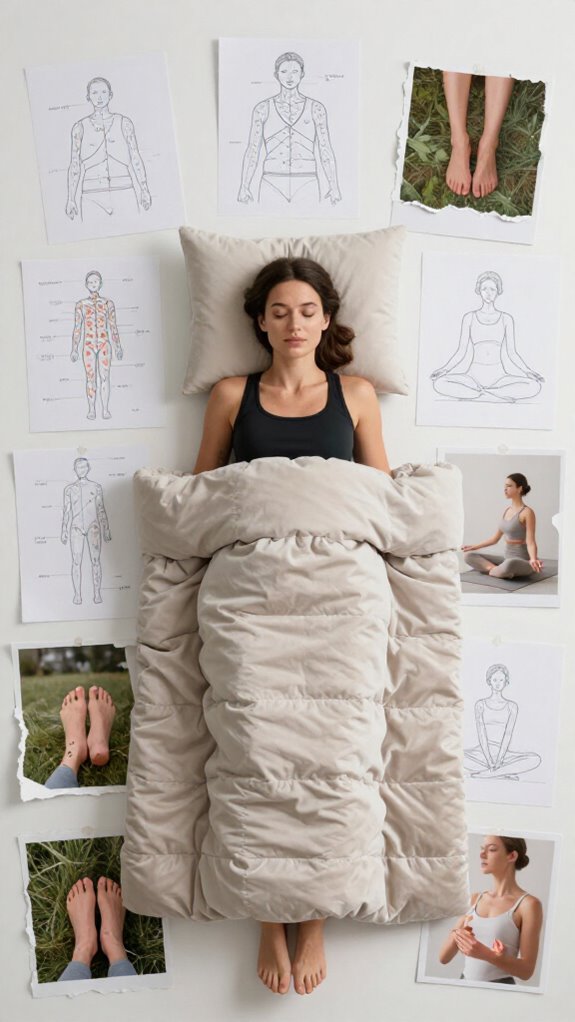
Here’s the practical roundup I use to steer the body out of hyperarousal—without turning sleep into a scoreboard.
I reach first for deep pressure tools: weighted blankets can lower cortisol and support melatonin, while firm “hug” or swaddle-style touch boosts serotonin, dopamine, and oxytocin, slowing heart rate and easing anxious breathing. Elevating sleep quality with a weighted blanket has been shown to improve overall rest through consistent nightly use. Research shows that evenly distributed pressure helps shift the autonomic nervous system toward parasympathetic dominance, which directly supports the hormonal shifts needed for sleep onset. A key bonus is that this kind of soothing nervous system calming helps the body move toward rest rather than trying to “force” sleep.
Start with deep-pressure comfort—weighted blankets and swaddle-like hugs calm the nervous system, easing anxious breathing and boosting melatonin.
If I need something more portable, I add the AID Vest in active mode to reduce stress-test biosignals. For acupressure points, I press KD3 and HT7 together, or Yin Tang/Shen Men for anxiety-linked insomnia—10 minutes daily across three nights helps.
Then I pair breathwork techniques (4-7-8) with grounding exercises.
- Weighted blankets
- AID Vest (active)
- KD3/HT7 or Yin Tang/Shen Men
- 4-7-8 + barefoot grounding
Home Vagus Nerve Stimulation Findings
In a Beijing randomized trial (72 chronic insomnia patients, taVNS vs sham; 30 minutes twice daily, 5 days/week for 8 weeks), PSQI fell -8.2 with taVNS vs -3.9 sham (P<.001, d=1.2). Sleep quality, latency, and efficiency improved; disturbances didn't. Mechanistically, taVNS modulates vagus nerve–linked neural pathways, supports autonomic regulation, and reduces default-mode hyperactivation. Tolerability stayed high, no serious adverse effects. Compact sleep environments can enhance the effectiveness of neuromodulation techniques by minimizing sensory disruption during evening sessions. Emerging research suggests that vagus nerve stimulation may offer a promising avenue for addressing sleep disorders by promoting parasympathetic dominance and enhancing overall sleep architecture.
FAQ
Is Deep Pressure Safe for People With Anxiety or Panic Symptoms?
Yes—deep pressure is generally safe for people with anxiety or panic symptoms when you start gently. I recommend short sessions, steady breathing, and stopping if it spikes fear. Used for anxiety management, it can feel grounding and reassuring.
Can Deep Pressure Help Insomnia Caused by Restless Legs or Neuropathy?
Yes—deep pressure can ease insomnia linked to restless legs or neuropathic pain. Isn’t it soothing to feel yourself fully held? I find it calms urges and reduces discomfort, helping your body settle. Still, ask your clinician first.
How Quickly Should I Notice Improvements After Starting Deep Pressure Techniques?
You’ll often notice calmer body signals within 1–3 nights, but I typically see steadier personal responses after 1–2 weeks. I start with 10–20 minute technique duration sessions, then adjust based on your nervous system’s cues.
Do Deep Pressure Techniques Replace CBT-I, or Complement It?
Deep pressure techniques don’t replace CBT-I for insomnia; they complement it. I use deep pressure to calm your body, then cognitive therapy patterns your thoughts and habits. Together, they help you feel safe and sleep soundly, faster.
What’s the Safest Way to Apply Deep Pressure Without Bruising?
Like a gentle hand on your shoulder, I guide pressure application with safe techniques: start light, use steady broad pressure, avoid bones and bruised spots, limit sessions, and stop if pain or numbness shows.
References
- https://byrepose.com/journal/somatic-therapy-techniques-to-combat-insomnia
- https://www.downtownsomatictherapy.com/article/how-somatic-therapy-helps-insomnia
- https://pmc.ncbi.nlm.nih.gov/articles/PMC6361823/
- https://sleepopolis.com/education/your-ultimate-guide-to-deep-pressure-therapy-deep-pressure-stimulation/
- https://www.medicalnewstoday.com/articles/327274
- https://bettersleep.org/blog/unlocking-the-wisdom-of-your-body-how-somatic-therapy-transforms-stress-into-healing/
- https://pmc.ncbi.nlm.nih.gov/articles/PMC10949954/
- https://www.med.upenn.edu/cbti/assets/user-content/documents/Lichstein_RelaxationforInsomnia-BTSD.pdf
- https://onlinelibrary.wiley.com/doi/full/10.1111/jsr.13927
- https://www.neurologyadvisor.com/news/vagus-nerve-stimulation-sleep-quality-insomnia-severity/