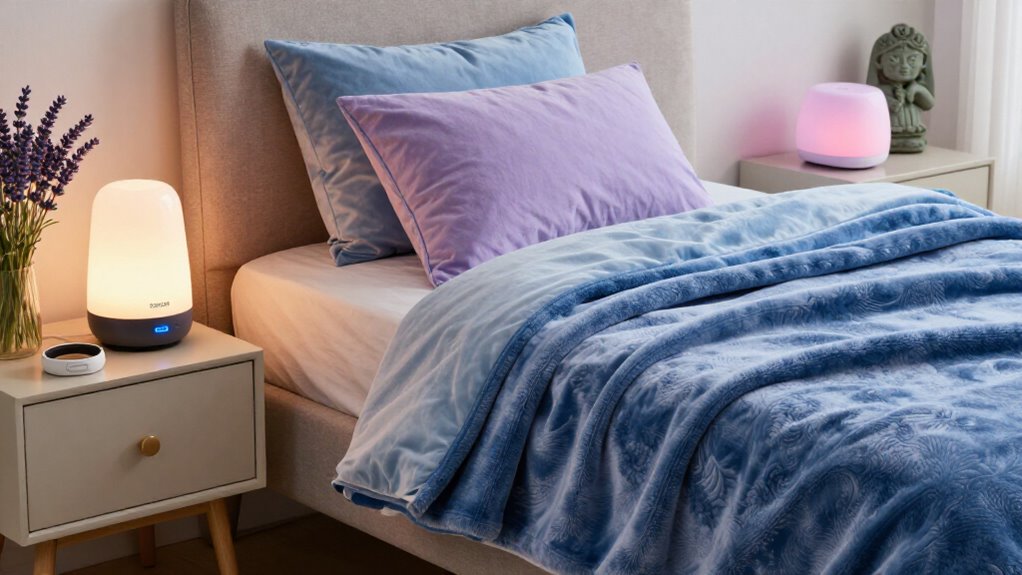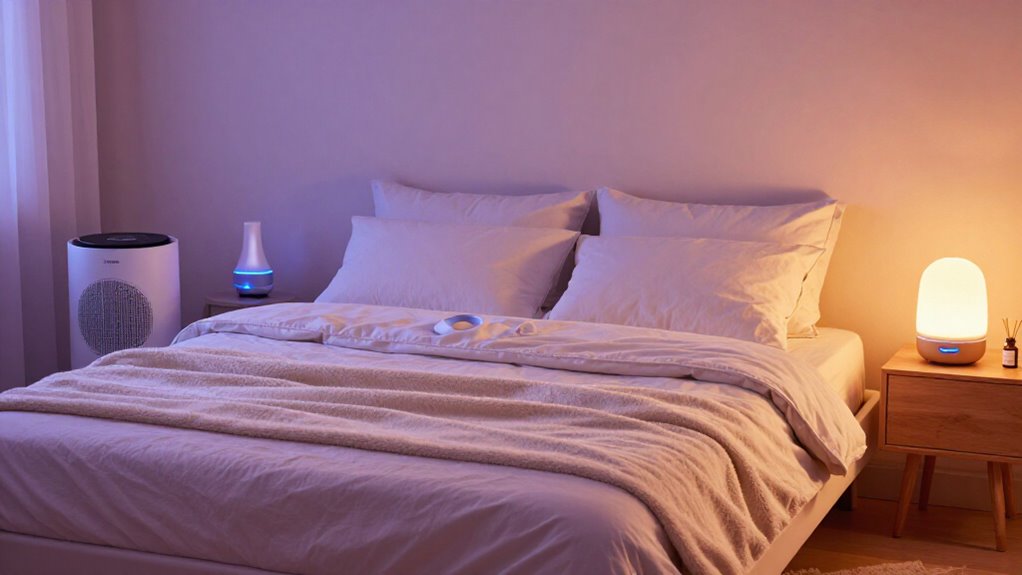
I used to crash every afternoon until I learned my REM was wrecked—I was ignoring my body’s clock completely. The SCN runs this show, syncing your brainstem so dreams hit when your temperature drops. Huberman’s research and Oura’s data helped me nail my timing. At Corala Blanket, we’re obsessed with getting this right—our temperature-regulating layers hit that 18-20°C sweet spot. Sleepmaxxing in 2026? It’s not just vibes, it’s science. Are you actually resting, or just lying there?
Quick Takeaways
- The Suprachiasmatic Nucleus (SCN) regulates REM sleep timing by aligning REM phases with the body’s circadian readiness and core temperature nadirs.
- Exposure to blue light around 480 nm affects the SCN, suppressing melatonin and altering REM onset and duration.
- Consistent sleep-wake routines synchronized with natural light cues enhance REM sleep efficiency by harmonizing circadian rhythms.
- Individual chronotypes shape the timing and quality of REM cycles, necessitating personalized sleep schedules for optimal cognitive function.
- Circadian disruptions or misalignment trigger compensatory homeostatic responses, impacting REM sleep patterns and mood regulation.
What Is REM Sleep and Why It Matters?

Rapid Eye Movement (REM) sleep, first characterized by researchers Nathaniel Kleitman and Eugene Aserinsky in the 1950s, represents a distinct phase within the sleep cycle marked by rapid, darting eye movements and heightened brain activity resembling wakefulness.
REM functions are essential for neural plasticity and emotional regulation, directly underpinning cognitive benefits such as memory consolidation and creative problem-solving. Optimal bedroom temperature supports the natural progression through sleep stages, allowing REM cycles to occur without disruption caused by thermal discomfort.
Studies by Stanford’s Matthew Walker emphasize REM’s role in optimizing synaptic connections, enhancing alertness and decision-making.
Understanding this phase offers actionable understanding into improving performance—making REM not just a sleep stage, but a cornerstone for cognitive supremacy and resilience.
During REM sleep, the brain actively processes and stabilizes newly acquired information through memory consolidation mechanisms that strengthen neural pathways essential for long-term retention.
How Do Circadian Rhythms Control Your REM Sleep Timing?
Although many factors influence sleep architecture, circadian rhythms serve as the internal timekeepers that orchestrate the precise timing of REM sleep within the 24-hour cycle.
The SCN function, acting as the master pacemaker, channels circadian signaling to regulate REM onset, ensuring it aligns with ideal physiological readiness.
The SCN masterfully orchestrates circadian signals to time REM onset for optimal physiological readiness.
Research from institutions like the Harvard Medical School underscores how SCN-driven neurotransmitter cascades influence cholinergic activation, which initiates REM phases.
This coordination guarantees REM cycles emerge during the latter part of the night, maximizing cognitive functions tied to memory consolidation and emotional regulation, granting you control over your sleep’s restorative power.
When circadian timing is disrupted, the resulting sleep disruption frequently co-occurs with mood disorders like anxiety and depression, highlighting why maintaining robust SCN function remains critical for both sleep quality and emotional health.
cortisol and circadian disruption can further destabilize this delicate system, as elevated evening cortisol levels interfere with melatonin production and delay REM onset.
How Does Light Exposure Regulate REM Sleep Cycles?
When the eye detects light, specialized retinal ganglion cells send signals directly to the Suprachiasmatic Nucleus (SCN), triggering a cascade of neurochemical events that govern REM sleep timing.
Light intensity and the blue spectrum—peaking around 480 nm—exert the strongest influence, suppressing melatonin release and shifting the circadian phase.
Researchers like Dr. Russell Foster emphasize that precise modulation of blue light exposure, especially in evening hours, can recalibrate REM onset and duration.
Brands such as Philips Hue leverage this science by adjusting spectra dynamically.
Mastering light’s role enables control over REM cycles, optimizing cognitive restoration and aligning sleep architecture with circadian biology.
Luxury smart lighting systems demonstrate how sophisticated spectral control can transform bedroom environments into circadian-optimized sanctuaries for deeper sleep.
Wearing blue light blockers in the evening hours represents a practical intervention to filter disruptive wavelengths and preserve melatonin secretion for improved REM sleep quality.
Why Temperature and Bedroom Environment Affect REM Sleep Quality
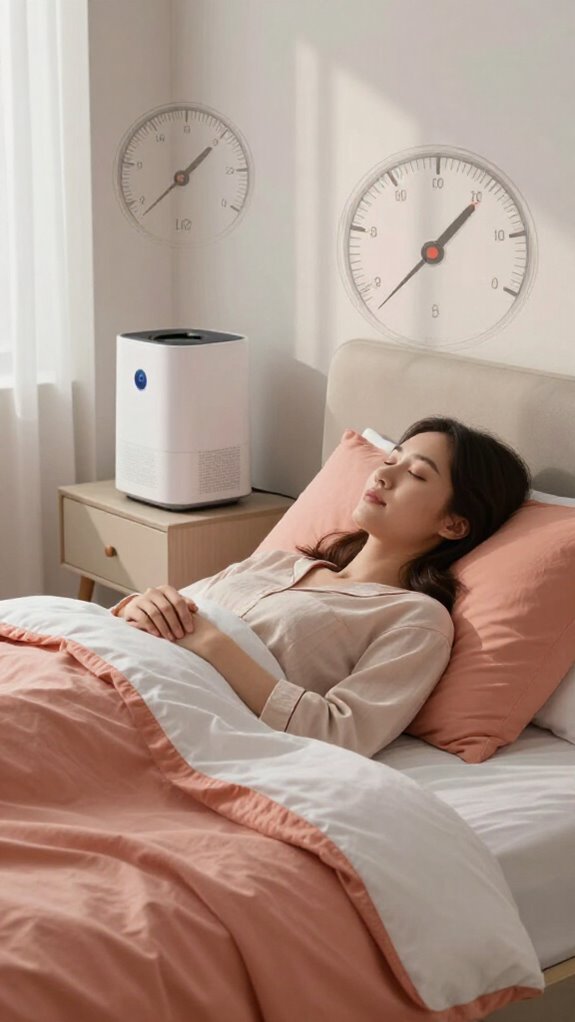
Because core body temperature undergoes a critical decline during the shift into REM sleep, maintaining the bedroom within a Thermo-neutral Zone—typically around 18°C—directly influences REM sleep quality and duration. Research suggests that cooler environments between 18-20°C best support the body’s natural thermoregulation during sleep stages.
Maintaining bedroom temperature near 18°C supports the essential core body temperature drop for optimal REM sleep quality.
Precise temperature settings optimize adenosine clearance, essential for neural restoration. Equally, controlling humidity levels and air quality mitigates respiratory disruptions, enhancing parasympathetic dominance.
Noise control and minimizing visual distractions reduce cortical arousal, fostering uninterrupted REM cycles. Consider these three factors:
- Bedding types and sleep positioning to facilitate thermal regulation.
- Bedroom aesthetics that promote calm, reducing sensory overload.
- Advanced air purifiers ensuring pollutant-free atmospheres.
When environmental stressors disrupt these optimal conditions, the resulting elevated cortisol levels can delay REM onset and fragment sleep architecture throughout the night.
Experts like Dr. Matthew Walker emphasize these environmental variables for maximizing REM efficacy.
How Can Adjusting Your Schedule Improve REM Sleep Efficiency?
Since REM sleep operates within the broader framework of the circadian rhythm governed chiefly by the Suprachiasmatic Nucleus (SCN), adjusting your daily schedule to support this internal clock profoundly influences REM efficiency.
I use schedule optimization, aligning consistent sleep-wake cycles with natural light cues, to amplify REM phases.
Sleep journaling, a tactic championed by researchers like Dr. Matthew Walker, offers quantifiable observations to refine timing and habits.
Collecting data on sleep stages reveals patterns I adjust to reduce circadian misalignment, enhancing SCN-driven melatonin release.
This scientifically grounded approach converts raw rest into a performance upgrade, maximizing cognitive restoration.
For those with a later natural sleep tendency, adopting a wolf chronotype schedule can further synchronize your REM phases with your body’s delayed circadian preferences.
Recommended Products to Use

Five essential categories of products underpin a rigorous approach to Sleepmaxxing, each targeting a distinct lever of sleep biology and environmental optimization.
To harness your REM cycles, prioritize:
- Wearable trackers like Oura ring for biometric data, and smart alarms that align wake times with circadian peaks. Sleep tracking clips offer a comfortable alternative for those who prefer non-ring wearable options.
- Blackout curtains paired with sleep masks to eliminate light-induced SCN disruption, complemented by essential oils such as lavender to induce parasympathetic activation.
- Relaxation apps and meditation tools, alongside sleep journals, empower cognitive offloading, reducing hypervigilance and pre-sleep arousal.
Together, these create an environment engineered for optimized sleep architecture, supported by leading chronobiology research. Implementing these products can help you reduce sleep latency and achieve faster, more restorative sleep.
Circadian Rhythm Impact Studies

While the suprachiasmatic nucleus (SCN) orchestrates the body’s central circadian timing system, it plays an essential role in modulating REM sleep propensity, particularly during the rest phase.
Circadian variations dictate REM occurrence, peaking near core temperature nadirs. Research demonstrates that REM deprivation triggers a compensatory homeostatic process, independent of circadian timing, underscoring interaction between intrinsic clocks and sleep drive.
Sleep architecture aligns with this dual regulation, optimizing restorative phases. Pioneering studies by experts like Mistlberger reveal that SCN-lesioned subjects lack normal REM modulation, affirming the SCN’s pivotal influence in synchronizing REM cycles within circadian frameworks. The SCN actively promotes REM sleep at specific times, facilitating transitions during the rest phase through its circadian pacemaker.
Sleepmaxxing for couples
A foundational challenge in Sleepmaxxing for couples lies in harmonizing dual circadian rhythms and sleep architectures within a shared environment. Just as one might chunky knit throws for physical comfort, achieving effective sleep synchronization demands deliberate couple communication to align schedules and enhance sleep environments.
I prioritize:
- Environmental calibration—temperature near 18°C, lighting to support melatonin production.
- Chronotype mapping, referencing Kronauer’s SCN models for ideal timing.
- Wearable biometrics for individualized REM and Slow-Wave Sleep balance.
Brands like Oura and researchers like Dr. Till Roenneberg provide frameworks to quantify and refine these elements.
Mastery here facilitates compounded cognitive restoration, transcending isolated sleep enhancement toward synergistic recovery.
For partners navigating mismatched schedules, rotating shift schedules require additional adaptive strategies to maintain sleep quality without compromising relationship cohesion.
FAQ
Can Diet Influence the Duration of REM Sleep Cycles?
Think of your REM sleep as a symphony; carbohydrate intake and protein sources set its tempo, while meal timing, caffeine, and alcohol effects can disrupt harmony. Balanced nutrients, hydration, and avoiding vitamin deficiency empower your deepest cycles.
How Do Medications Alter REM Sleep Architecture?
Medications can dramatically shift sleep architecture by suppressing or enhancing REM stages, directly impacting recovery intensity. I harness this knowledge to control medication effects, optimizing my REM cycles for powerful cognitive restoration and peak mental performance.
What Role Does Genetic Variability Play in REM Sleep Quality?
Genetic mutations in sleep genes directly influence REM sleep quality, giving me understanding into my unique sleep architecture. Understanding these variations lets me harness my biology’s power, optimizing REM cycles for peak cognitive function and recovery.
Are There Differences in REM Sleep Patterns Across Age Groups?
Yes, infant patterns show more REM sleep, adolescents experience shifts due to circadian adjustments, and elderly variations include reduced REM duration. Mastering these changes lets you optimize sleep for peak cognitive performance at every age.
How Does Stress Specifically Impact REM Sleep Stages?
Stress hormones spike, disrupting REM by increasing anxiety levels and insomnia effects. I’ve learned relaxation techniques counter sleep deprivation’s blow, restoring emotional regulation—power moves anyone serious about dominating their sleep and waking sharper every day.
References
- https://pmc.ncbi.nlm.nih.gov/articles/PMC6772655/
- https://academic.oup.com/sleep/article/4/3/319/2750186
- https://pmc.ncbi.nlm.nih.gov/articles/PMC8051942/
- https://pmc.ncbi.nlm.nih.gov/articles/PMC11221196/
- https://www.frontiersin.org/journals/neuroscience/articles/10.3389/fnins.2025.1727683/full
- https://www.cureus.com/articles/258897-exploring-the-role-of-circadian-rhythms-in-sleep-and-recovery-a-review-article