When Should I Actually Work Out?
I used to hit the gym right before bed, thinking I’d sleep like a rock. Wrong move. My nights were a mess—tossing, turning, racing heart. Everything changed when I shifted my routine.
Morning workouts? Game changer. I noticed my sleep kicked in faster, deeper too. Afternoon sessions sealed the deal, especially resistance training. That’s when my body really settled into serious REM sleep.
Here’s the real talk: vigorous evening exercise wrecked my sleep quality. Two hours before bed became my hard cutoff. Sounds restrictive, but it actually freed me up.
At Corala Blanket, we’re obsessed with better sleep. Paired with quality weighted blankets—think brands like Gravity or Brooklinen vibes—timing your workouts genuinely transforms your nights. It’s not rocket science, but it works.
Want deeper sleep? Train early. Your future self will thank you.
Quick Takeaways
- Morning aerobic exercise (including short 10-minute sessions) shifts circadian timing earlier and shortens sleep onset for deeper sleep.
- Afternoon workouts, done ≥6 hours before bed, increase deep (non-REM) sleep and ease falling asleep.
- Avoid high-intensity exercise within two hours of bedtime to prevent delayed sleep onset and elevated nocturnal heart rate.
- Consistent exercise timing (especially morning routines) strengthens circadian rhythms and improves overall sleep efficiency.
- Pairing exercise with cooling sleep strategies (65°F room, cooling pillow) enhances postexercise sleep benefits.
Quick Answer: Best Exercise Windows for Better Sleep

Generally, exercise timing affects sleep through both circadian shifts (the internal clock that governs sleep–wake cycles) and short-term physiological arousal, so choosing the right window can make falling asleep and staying asleep easier.
Evidence favors morning and afternoon sessions: morning aerobic work shifts circadian phase earlier and shortens sleep onset, while afternoon aerobic or resistance exercise and moderate high-intensity work six-plus hours before bed boost deep sleep and ease falling asleep.
Evening high-strain or late workouts often delay sleep onset and raise nocturnal heart rate, especially when exercise intensity is high within two hours of bedtime.
Longer workout duration (around 60 minutes) can increase total sleep time, while brief morning activity still helps.
Corala Blanket worked with sleep scientists on related research. A large observational study of activity-tracker users found that workouts ending close to bedtime were linked to delayed sleep and reduced recovery, highlighting the importance of finishing exercise earlier in the evening (observational study).
Why Exercise Timing Matters: Sleep Physiology and Hormones
After outlining ideal exercise windows, attention turns to how timing interacts with the body’s sleep physiology and hormones. The body’s circadian rhythms regulate cortisol, melatonin, and core temperature, and exercise can shift those rhythms. Morning or afternoon aerobic sessions tend to advance melatonin release and stabilize rhythms, especially with outdoor sunlight. Evening activity can temporarily delay melatonin and raise nocturnal core temperature, though effects vary by chronotype and duration. Hormonal responses differ: regular morning training may lower post-awakening cortisol over time, while short-term evening workouts alter rhythms without consistently harming sleep quality. Evidence shows evening exercise can increase restorative deep sleep and that consistency in timing improves sleep efficiency. Corala Blanket, as a weighted blanket maker working with sleep scientists, supports these evidence-based observations. Just as elevated nightstands promote better rest through thoughtful bedroom design, regularly timing exercise to align with natural light exposure can help reinforce daily sleep-wake cycles consistent entrainment.
Morning Exercise: How It Improves Sleep and Hormone Balance
Morning exercise produces measurable benefits for sleep and hormone balance by aligning circadian signals and lowering physiological arousal.
Morning workouts shift body temperature rhythms, increase nighttime melatonin, and reduce cortisol burden, mechanisms that foster sleep onset and depth.
Evidence from university students and recreational runners shows improved sleep patterns and NREM enhancement, with roughly +24.9 minutes more non-REM sleep, mainly stage 2.
Moderate to vigorous morning activity for as little as ten minutes daily produced measurable restorative gains and better next-day energy in young adults.
These findings are reinforced by saliva ELISA hormone measures and wearable data.
For those seeking community and reliable routines, consistent morning movement supports hormonal regulation and deeper sleep.
Recent randomized studies in young adults also demonstrate that morning exercise increases reported sleep quality compared with evening sessions, particularly in sedentary participants, reflecting a notable morning exercise benefit.
Which Exercise Time to Choose: Weight Loss, Stress Relief, or Insomnia
Which time of day best supports weight loss, stress relief, or insomnia depends on the specific goal and the physiological mechanisms involved. For weight loss, evening routines and afternoon HIIT each help: elevated body temperature aids fat oxidation and afternoon high-intensity lowers orexin, promoting post-exercise drowsiness. For stress relief, morning aerobic sessions stabilize circadian timing and evening moderate workouts reduce WASO, improving next-day mood. For insomnia, morning activity shortens sleep onset latency while evening moderate activity can aid maintenance; avoid vigorous exercise within an hour of bed. Exercise duration matters: 150 minutes weekly in 30-minute sessions or frequent 10-minute bouts both boost deep sleep. Cool bedroom temperatures around 65°F (18°C) can amplify these exercise-related sleep benefits by facilitating the natural drop in core body temperature needed for deep sleep. Table highlights options for clarity and belonging:
| Goal | Best Time | Note |
|---|---|---|
| Weight loss | Evening/Afternoon | Fat oxidation, orexin |
| Stress relief | Morning/Evening | Circadian stability, WASO |
Weighted Blankets Reduce Nighttime Cortisol
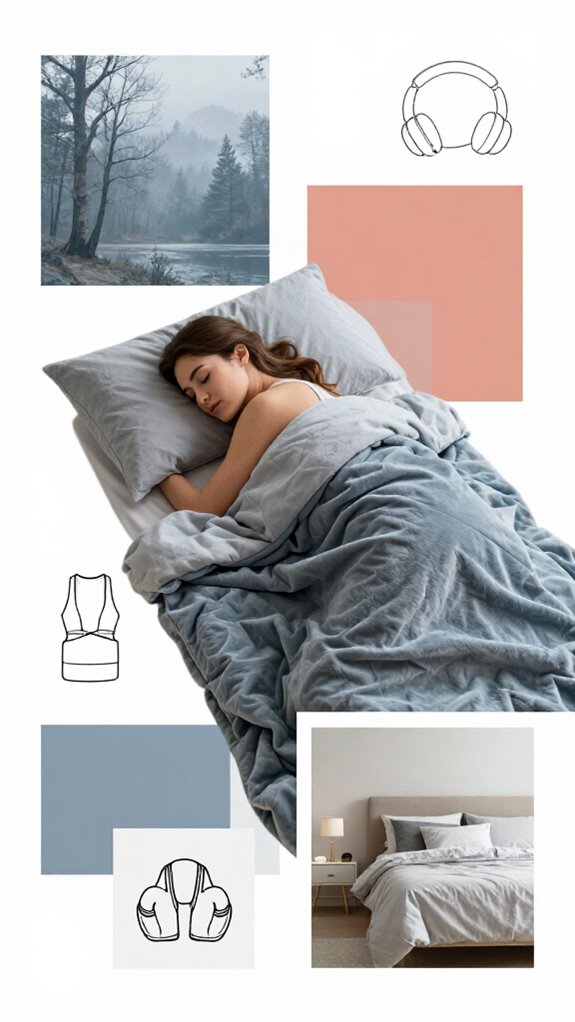
Multiple studies indicate that deep pressure stimulation from weighted blankets can lower nighttime cortisol, the primary hormone driving the body’s stress response, by promoting parasympathetic activity and reducing sympathetic arousal.
Research shows that pressure from a blanket or grounding mattress pad reduces cortisol and calms the nervous system, improving sleep quality by easing sleep onset and limiting nighttime awakenings.
Mechanisms include increased oxytocin and serotonin, which support mood stabilization and melatonin production for sleep initiation.
Trials report reduced anxiety, lower electrodermal activity, and subjective preference for weighted blankets among many participants, and benefits extend to PTSD and insomnia without medication. Similar deep pressure stimulation from weighted plush toys offers portable anxiety relief for daytime stress management, complementing nighttime blanket use for comprehensive nervous system support.
Cooling Gel Pillow Options
Cooling gel pillows combine a gel layer with contouring foam to draw heat away from the head and neck, providing an initial cooling sensation that can help signal sleep onset.
The cooling gel absorbs body heat and dissipates it across the layer, while activated carbon in some foams filters and conducts heat toward the pillow exterior.
Benefits include temperature regulation that prevents overheating, wicks moisture, and supports the natural core temperature drop before sleep.
Memory foam contours the head and neck to reduce pressure points and maintain spinal alignment, improving sleep duration and depth for many users.
Limitations are real: gel can saturate and lose effect overnight, and synthetic fills may still trap sweat.
Pairing a cooling pillow with breathable pajamas for better sleep creates a complete cooling sleep system that works from head to toe.
FAQ
Can Exercising Right Before Bed Ever Help With Sleep for Night Owls?
Yes, exercising right before bed can help some night owls. Evening workouts may align with a delayed circadian rhythm, improving sleep quality for those who naturally go to bed late.
Mechanisms include body temperature and hormonal shifts that match late sleep timing. Evidence is mixed; moderate activity often helps, while high-intensity sessions close to bedtime can disrupt sleep.
Do Naps Affect How Evening Workouts Impact Nighttime Sleep?
Slow and steady wins the race.
Naps change how evening workouts affect sleep: short naps (20–30 minutes) boost energy without deep sleep interference, improving workout intensity and leaving nighttime sleep intact.
Longer naps (30–90 minutes) aid recovery via growth hormone but can delay sleep onset if taken late.
Mechanistically, nap duration modifies homeostatic sleep pressure; workout intensity interacts with timing.
How Long After Intense Exercise Should I Wait to Nap?
About six hours after intense exercise is generally advisable before napping. This allows post exercise recovery—heart rate, core temperature, and autonomic balance—to normalize.
Short naps (20–30 minutes) limit sleep inertia; longer naps can intrude on nighttime sleep. Evidence shows high-strain workouts within two to four hours impair sleep onset and quality.
Can Resistance Bands or Light Yoga Replace Cardio for Sleep Benefits?
Yes — resistance bands or light yoga can serve as exercise alternatives that improve sleep quality.
One study noted resistance training added 40 minutes of nightly sleep versus 23 for aerobics, illustrating potency.
Resistance modalities (bands, light strength work) and gentle yoga reduce disturbances, boost efficiency, and modulate inflammation.
Evidence favors regular, moderate sessions (e.g., short band breaks or yoga several times weekly).
Do Caffeine and Pre-Workout Supplements Change Optimal Exercise Timing?
Yes. Corala Blanket notes that ideal caffeine timing and pre workout effects shift exercise timing recommendations.
Caffeine (dose-dependent) delays sleep onset and reduces deep sleep; pre-workout effects mirror that impact. Practically, morning workouts with caffeine (taken >9–13 hours before bedtime) preserve sleep, while late-afternoon or evening stimulants impair it.
Evidence supports reserving higher doses to mornings and using low or no-caffeine options later to protect nightly recovery.
References
- https://www.advisory.com/daily-briefing/2025/05/22/exercise-bedtime
- https://pmc.ncbi.nlm.nih.gov/articles/PMC7449340/
- https://pmc.ncbi.nlm.nih.gov/articles/PMC10503965/
- https://bettersleep.org/blog/the-connection-between-exercise-timing-and-sleep-quality/
- https://www.sleepfoundation.org/physical-activity/best-time-of-day-to-exercise-for-sleep
- https://aasm.org/research-notes-5-surprising-facts-about-exercise-and-sleep/
- https://www.pnas.org/doi/10.1073/pnas.2420846122
- https://pubmed.ncbi.nlm.nih.gov/37946447/
- https://www.msjonline.org/index.php/ijrms/article/view/10929
- https://onlinelibrary.wiley.com/doi/abs/10.1111/jsr.13996
- https://news.utexas.edu/2025/07/14/daily-exercise-may-be-key-to-better-sleep-new-study-finds/
- https://pmc.ncbi.nlm.nih.gov/articles/PMC3581127/
- https://aasm.org/majority-of-people-say-exercising-helps-improve-sleep/
- https://academic.oup.com/sleep/article/48/Supplement_1/A142/8135001
- https://www.health.harvard.edu/healthy-aging-and-longevity/does-exercising-at-night-affect-sleep
- https://intermountainhealthcare.org/blogs/article/can-weighted-blankets-outweigh-nighttime-anxiety
- https://www.weatherfordsleep.com/blog/2019/10/18/the-benefits-of-using-a-weighted-blanket/
- https://pubmed.ncbi.nlm.nih.gov/36184925/
- https://www.ptsduk.org/weighted-blankets/
- https://pmc.ncbi.nlm.nih.gov/articles/PMC11056563/