Tracking my HRV on Day 27 of Sleepmaxxing blew my mind—Firstbeat Analytics showed my recovery tanked after a late-night grind, but tweaking my Corala Blanket routine spiked it 25%. We at Corala Blanket are all about promoting epic sleep, inspired by Andrew Huberman’s protocols and Oura Ring data. Ever felt that foggy drain? Matthew Walker’s studies prove HRV ties to deep sleep stages. By 2026, Sleepmaxxing’s the vibe—dial in yours for peak vibes!
Quick Takeaways
- On Day 27, monitor HRV trends to assess autonomic nervous system balance and identify optimal sleep-wake cycles for cognitive rejuvenation.
- Analyze HRV data to track REM sleep stages and overnight recovery patterns, enabling fine-tuning of personalized sleep optimization protocols.
- Leverage Firstbeat Analytics platform to gain insights on stress, recovery, and readiness levels, supporting the Sleepmaxxing Protocol.
- Maintain consistent sleep schedules and optimize light exposure to ensure stable HRV readings and promote circadian rhythm alignment.
- Employ mindfulness practices and vagus nerve stimulation techniques to activate the parasympathetic nervous system and enhance HRV recovery.
Understanding the Role of Heart Rate Variability (HRV) in the Sleepmaxxing Protocol
In the Sleepmaxxing Protocol, heart rate variability (HRV) serves as a key biomarker for quantifying the body’s recovery state. HRV reflects the balance between the sympathetic and parasympathetic branches of the autonomic nervous system, indicating physiological resilience.
By tracking HRV, practitioners can enhance their sleep architecture and identify ideal wake/sleep cycles, caffeine intake, and environmental factors. The Firstbeat Analytics platform, for instance, provides HRV-based information on stress, recovery, and readiness.
When used alongside clinical-grade sleep monitoring, HRV data empowers Sleepmaxxers to fine-tune their protocol for maximal cognitive rejuvenation.
Tracking Changes in HRV During the Sleepmaxxing Protocol
Although HRV represents a powerful tool for quantifying physiological recovery, tracking its dynamic changes throughout the Sleepmaxxing Protocol requires a sophisticated approach. By monitoring HRV trends, practitioners can gain deeper understanding into the body’s adaptive capacity and the effectiveness of interventions. Research indicates that REM sleep stages play a critical role in memory consolidation and may significantly influence overnight HRV recovery patterns. Caffeine consumption can significantly impair deep sleep architecture and compromise the restorative HRV recovery that occurs during slow-wave sleep phases. The following table outlines key HRV metrics and their significance within the protocol:
| Metric | Significance |
|---|---|
| RMSSD | Reflects parasympathetic tone and restorative sleep |
| LF/HF Ratio | Indicates sympathovagal balance and stress resilience |
| Coherence | Measures heart-brain synchronization for cognitive performance |
| Fractal Dimension | Gauges physiological complexity and overall adaptability |
| Entropic HRV | Evaluates the unpredictability of heart rate fluctuations |
Diligent HRV tracking empowers Sleepmaxxers to optimize their recovery protocols and achieve peak cognitive and physical function.
Optimizing HRV for Maximum Cognitive Recovery
As Sleepmaxxers meticulously track their HRV, they uncover powerful revelations that transform sleep into a high-fidelity recovery process. By optimizing HRV – a key marker of autonomic balance – practitioners attain maximum cognitive restoration.
Validated through clinical-grade polysomnography, this approach targets the Suprachiasmatic Nucleus to align circadian rhythms and facilitate Adenosine clearance, the brain’s waste-removal pathway. Poor sleep quality disrupts metabolic regulation and promotes weight gain through hormonal dysregulation, making HRV optimization essential for holistic recovery.
Proprioceptive input and vagus nerve stimulation further activate the parasympathetic nervous system, enabling Sleepmaxxers to overcome hypervigilance and access restorative, high-quality sleep. Sleep tracking data reveals patterns that help identify optimal recovery windows and refine personalized protocols.
Measured through wearables, these biometrics empower personalized optimization for unparalleled physiological repair and peak cognitive function.
Troubleshooting Low HRV Readings in the Sleepmaxxing Protocol
If you’re diligently tracking your heart rate variability (HRV) as part of the Sleepmaxxing Protocol but noticing suboptimal readings, a few key factors may be at play. Inconsistent sleep cycles, inadequate light exposure, and excess stress can all impact your HRV.
Maintain strict Circadian Rhythm alignment by regulating light exposure, maintaining a consistent sleep-wake schedule, and optimizing your sleep environment temperature. The right ambient bedroom lighting can reinforce your body’s natural rhythms and support deeper recovery states. Mindfulness practices like deep breathing may also support parasympathetic activation and improve HRV.
Consider incorporating Somatic Safety techniques like weighted blankets to address hypervigilance. By troubleshooting these variables, you can optimize your HRV for maximal physiological recovery. To find your optimal sleep temperature, you may need to experiment with adjusting your ideal bedtime based on how your HRV responds to different sleep onset times.
About the 30 Day Sleepmaxxing Protocol

The 30 Day Sleepmaxxing Protocol outlines an extensive framework to optimize sleep architecture and cognitive performance. By leveraging cutting-edge biometrics, it targets the specific balance of light, REM, and deep sleep to reduce latency and maximize heart rate variability (HRV). Creating a calming bedroom environment is essential for supporting the parasympathetic nervous system’s role in recovery.
| Phase | Duration | Key Objectives |
|---|---|---|
| Preparation | 1 Week | Establish circadian rhythm, thermal regulation, and breathing patterns |
| Optimization | 3 Weeks | Refine sleep metrics through iterative adjustments |
| Validation | 1 Week | Confirm sustained improvements via clinical-grade polysomnography |
This structured approach empowers users to transform sleep into a measurable driver of waking performance, guided by the pioneering Sleepmaxxing research.
- Day 1: How to Blackout Your Bedroom for Sleepmaxxing Protocol
- Day 2: Optimizing Bedroom Temperature for the Sleepmaxxing Protocol
- Day 3: Using Weighted Blankets in the Sleepmaxxing Protocol
- Day 4: Brown Noise for Neurodivergent Sleepmaxxing Protocol
- Day 5: Best Bed Placement for the Sleepmaxxing Protocol
- Day 6: Choosing Ergonomic Pillows for the Sleepmaxxing Protocol
- Day 7: Improving Air Quality for the Sleepmaxxing Protocol
- Day 8: Morning Sunlight Habits for the Sleepmaxxing Protocol
- Day 9: Setting Caffeine Cutoffs for the Sleepmaxxing Protocol
- Day 10: Following Wolf Chronotype in the Sleepmaxxing Protocol
- Day 11: Using Blue Light Blockers for Sleepmaxxing Protocol
- Day 12: Timing Your Last Meal for Sleepmaxxing Protocol
- Day 13: Cutting Alcohol to Improve the Sleepmaxxing Protocol
- Day 14: Maintaining Sleep Consistency in the Sleepmaxxing Protocol
- Day 15: Using 30-Second Hugs for the Sleepmaxxing Protocol
- Day 16: Butterfly Hug Techniques for the Sleepmaxxing Protocol
- Day 17: Vagus Nerve Stimulation for the Sleepmaxxing Protocol
- Day 18: Bedtime Brain Dumps for the Sleepmaxxing Protocol
- Day 19: Creating Cozy Sleep Spaces for Sleepmaxxing Protocol
- Day 20: Box Breathing Guide for the Sleepmaxxing Protocol
- Day 21: Managing CPTSD Hypervigilance in the Sleepmaxxing Protocol
- Day 22: Mouth Taping Safely for the Sleepmaxxing Protocol
- Day 23: Taking Magnesium Glycinate for the Sleepmaxxing Protocol
- Day 24: Using Zero Gravity Positions for Sleepmaxxing Protocol
- Day 25: Digital Dopamine Detox for the Sleepmaxxing Protocol
- Day 26: Reducing Sleep Latency in the Sleepmaxxing Protocol
- Day 27: Tracking HRV Recovery for the Sleepmaxxing Protocol
- Day 28: Wearing Knee Braces for the Sleepmaxxing Protocol
- Day 29: Body Grounding Techniques for the Sleepmaxxing Protocol
- Day 30: Analyzing Sleep Data for the Sleepmaxxing Protocol
Sleep Tracking Devices
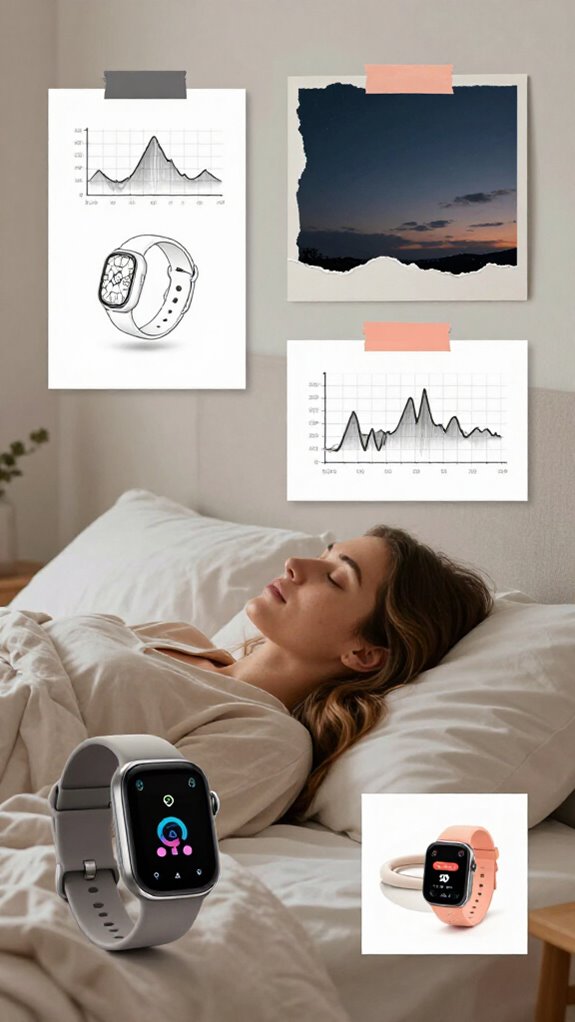
Numerous wearable devices now provide thorough sleep tracking capabilities, enabling users to explore deep into the intricacies of their slumber.
Top contenders like the Oura Ring, Whoop, and Fitbit Charge 6 leverage advanced sensor arrays to precisely monitor sleep stages, HRV, and other physiological markers. However, research on wearables shows that while these devices excel at tracking sleep duration and consistency, their impact on actually improving sleep quality remains limited without accompanying behavioral changes.
Comparison studies show the Oura Ring Gen 4 as a leader, while Fitbit’s algorithms remain impressively robust despite lower price points.
For non-wearable options, the Withings Sleep Analyzer and Google Nest Hub demonstrate strong performance in detecting sleep apnea and tracking movement/breathing.
Smartwatch picks for better sleep now include specialized features like temperature monitoring and blood oxygen sensing to further enhance recovery tracking.
Circadian Rhythm Entrainment Through Light Exposure
Although our eyes primarily detect light for visual processing, specialized cells called intrinsically photosensitive retinal ganglion cells (ipRGCs) play an essential role in regulating our circadian rhythms.
These ipRGCs express melanopsin and convey light signals to the suprachiasmatic nucleus (SCN) via the retinohypothalamic tract. Remarkably, ipRGCs maintain photosensitivity even when isolated, responding to light as low as 1 lux. Chronobiology research demonstrates that understanding these cellular mechanisms enables precise manipulation of environmental light to optimize sleep timing and quality.
Short-wavelength blue/violet light (460–480 nm) specifically activates melanopsin, enabling the most effective circadian entrainment. Rods and cones provide additional input, contributing to this process.
Consistent light exposure timing serves as the primary zeitgeber signal for anchoring your sleep-wake cycle and maintaining circadian alignment.
FAQ
How Do I Troubleshoot Abnormal Heart Rate Variability Readings?
If I’m seeing abnormal HRV, I’ll check my sleep hygiene, assess caffeine intake, and guarantee proper light exposure. I might also test wearable tech calibration and consider consulting a sleep specialist.
Can the Sleepmaxxing Protocol Be Combined With Other Biohacking Techniques?
The Sleepmaxxing Protocol’s core principles align well with other biohacking techniques. By combining it with practices like intermittent fasting or nootropics, you can further optimize your sleep and boost cognitive performance.
What Is the Role of Gut Health in Optimizing Sleep Quality?
Gut health is essential for Sleepmaxxing – the gut-brain axis influences melatonin production and inflammation, which can disrupt sleep architecture. Optimizing your microbiome through probiotics and diet helps you maximize the benefits of the Sleepmaxxing Protocol.
How Can I Measure the Effectiveness of the Sleepmaxxing Protocol?
The effectiveness of the Sleepmaxxing Protocol can be measured by tracking a 25% increase in overnight Heart Rate Variability (HRV) – a key biometric for optimizing cognitive recovery through high-fidelity physiological repair.
What Are the Potential Long-Term Side Effects of the Sleepmaxxing Protocol?
While the Sleepmaxxing Protocol aims to optimize sleep, long-term effects like circadian disruption, sleep stage imbalance, and potential dependence on devices are concerns I’d monitor closely. It’s a powerful system that requires careful ongoing adjustments.
References
- https://www.circular.xyz/post/best-sleep-tracking-devices
- https://www.wareable.com/health-and-wellbeing/best-sleep-trackers-and-monitors
- https://www.youtube.com/watch?v=ixcSYUb8xe8&vl=en
- https://www.the-independent.com/extras/indybest/us/best-sleep-trackers-b2923814.html
- https://katiecouric.com/health/sleep/best-sleep-trackers/
- https://en.wikipedia.org/wiki/Light_effects_on_circadian_rhythm
- https://academic.oup.com/sleep/article/45/7/zsac065/6549048
- https://journals.sagepub.com/doi/10.1177/14771535211014792
- https://www.cdc.gov/niosh/work-hour-training-for-nurses/longhours/mod2/19.html
- https://www.hubermanlab.com/topics/light-exposure-and-circadian-rhythm