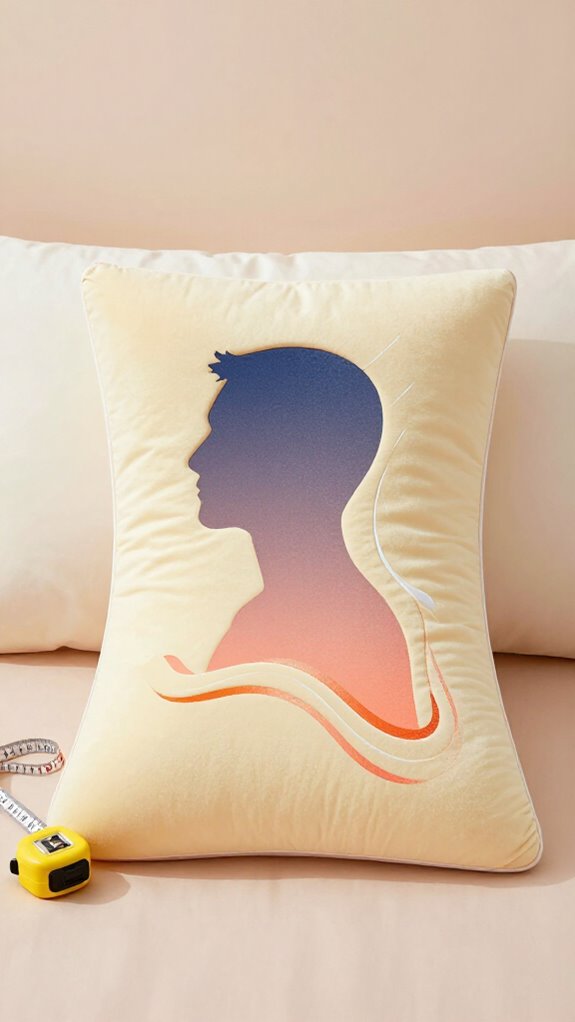
I used to wake up with a neck so stiff I couldn’t check my blind spot while driving. Turns out my “luxury” pillow was basically a brick masquerading as bedding.
Ever measured your ear-to-shoulder distance? I hadn’t. Then I learned back sleepers need 4-5 inches, side sleepers 5-7 inches—science from the *Journal of Chiropractic Medicine* showing 10cm preserves that precious C2-7 Cobb angle. Go thicker than 12 inches? Your lordosis collapses like a sad soufflé.
Contoured designs changed my life. No, seriously.
We’re Corala Blanket—obsessed with fixing sleep, one neck at a time. The 2026 “sleepmaxxing” crowd gets it: Tempur-Pedic’s ergonomic lines, Coop’s adjustable fills, even Casper’s data-backed heights. Biomechanics isn’t boring when *you’re* the one not wincing through morning coffee.
So what’s your measurement? Your spine’s already judging your answer.
The Biomechanical Science Behind Pillow Height and Cervical Alignment
Three distinct biomechanical zones—the cervical spine’s natural curvature, the shoulder-to-head gap, and the cranio-cervical pressure distribution—converge to determine whether your pillow supports or sabotages your neck’s alignment during sleep.
I’ll guide you through understanding how pillow height functions as a precision instrument for cervical positioning rather than mere comfort. Establishing consistent pre-sleep relaxation habits helps reduce muscle tension that could otherwise compromise your neck’s neutral positioning throughout the night.
Your sleep position dictates specific height requirements. Back sleepers benefit from 4-5 inch pillows that maintain your chin parallel to the mattress, creating neutral cervical alignment without the forward head positioning that triggers strain. Side sleepers require 5-7 inches to bridge the shoulder-to-ear gap—this measurement varies based on individual shoulder width and anthropometric parameters. Stomach sleepers face inherent challenges; pillows under 3-4 inches minimize the neck rotation that causes overextension, though this position remains biomechanically disadvantageous regardless of pillow selection.
When evaluating pillow materials and pillow firmness, recognize that these factors considerably influence how effectively height translates to actual support. A 10 cm pillow height demonstrates the lowest electromyographic (EMG) activity in neck muscles, representing ideal muscular efficiency during sleep. For side sleepers, placing a pillow between the knees provides added support and maintains spinal alignment throughout the night.
Research shows that individualized measurements—specifically your ear-to-shoulder distance and neck-wall length—create personalized height baselines more accurate than generic recommendations. Medium to high loft pillows generally provide superior alignment compared to flat alternatives, though firmness must complement height for effective support distribution.
Recognizing misalignment signals protects your cervical health. Neck pain emerging after 7-9 hours of sleep indicates either insufficient support or excessive height forcing cranial-cervical angle alterations. Your head shouldn’t sink excessively toward the mattress or angle upward unnaturally; proper positioning feels neutral rather than corrective.
Contoured and ergonomic pillow shapes—including U-shaped cutouts and B-shaped designs—enhance height effectiveness by conforming to your unique cervical anatomy. A rolled towel can mimic orthopaedic support if commercial options prove impractical.
The critical principle remains consistent: your pillow height must match your head-neck-shoulder dimensions precisely. This isn’t preference-based alignment; it’s biomechanical engineering applied to sleep surfaces.
Control your cervical positioning through informed height selection, and you’ll transform sleep from potential damage into restorative recovery.
Pillow Height Affects Spinal Curvature
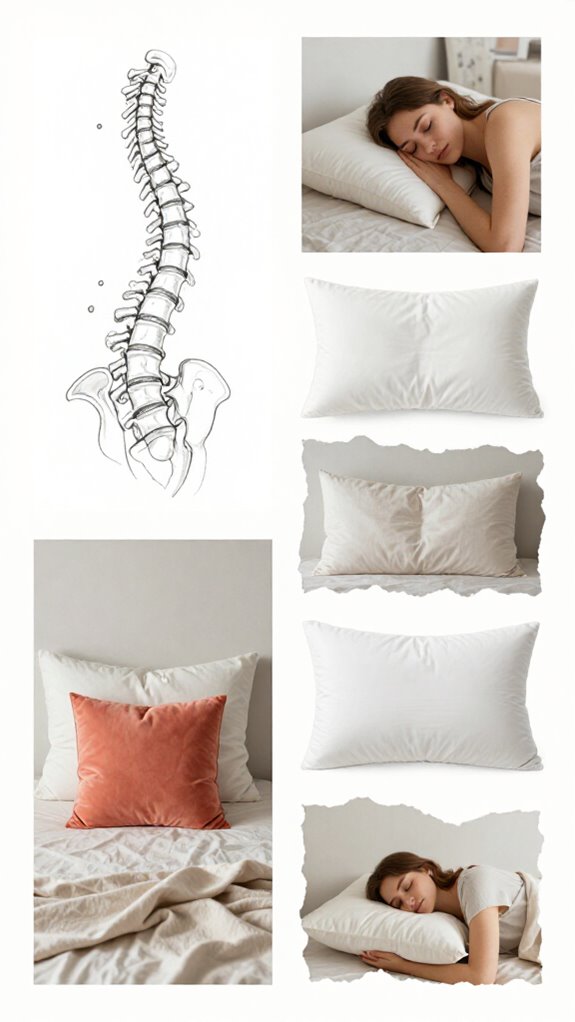
Your pillow height functions as a precision lever that either preserves or compromises your cervical lordosis—that gentle forward curve of your neck vertebrae that mirrors your upright standing posture.
When you select ideal pillow thickness around 10 cm, your cervical spine maintains its natural architecture, reducing neck strain substantially. Research demonstrates that at this height, your C2-7 Cobb’s angle increases to approximately 14.93 degrees, preserving lordotic integrity.
Conversely, excessive pillow thickness exceeding 12 cm triggers cervical flexion, collapsing your natural curve by 15-25 degrees and dramatically escalating intradiscal pressures.
Key measurement outcomes:
- T1S increases from 12.92° to 17.33° at ideal height
- Upper cervical kyphosis decreases 43.4% with elevation
- Lower cervical lordosis increases 25.1% proportionally
- Intradiscal pressure potentially rises 40-60% excessively
- Individual shoulder width determines precise requirements
FAQ
How Do I Measure My Individual Pillow Height Needs at Home?
I’d measure my pillow thickness by having someone photograph my head’s lateral profile while I’m lying in my sleeping position. The distance from mattress to ear canal approximates my ideal height.
Back sleepers typically need 7-9 cm; side sleepers require 8-11 cm depending on shoulder width. I’d cross-reference these measurements against research by cervical biomechanics specialists, then adjust incrementally until my cervical spine aligns naturally—neither flexed forward nor hyperextended backward.
Can Pillow Height Adjustments Reduce Existing Neck Pain Symptoms?
You might think neck pain requires medical intervention alone—it doesn’t. I’ve found that pillow height adjustments demonstrably reduce symptoms.
Research shows individualized height matching improved neck pain in 50% of participants within three months. By optimizing pillow height for your cervical spine alignment, you’re actively recalibrating cranio-cervical pressures.
This biomechanical correction—paired with integrated neck support—gives you tangible control over your pain trajectory without pharmaceutical dependence.
What’s the Difference Between Pillow Height and Pillow Firmness?
Pillow height determines vertical distance between your head and mattress, directly influencing cervical spine alignment and sleep posture.
Firmness, conversely, controls how much the pillow compresses under your neck’s weight, affecting pillow support density.
You’re fundamentally managing two distinct variables: height controls positioning geometry while firmness governs pressure distribution and structural integrity throughout the night.
How Often Should I Replace My Pillow for Optimal Support?
I’ll replace my pillow every 1-2 years—though apparently some folks believe pillows achieve immortality.
Your pillow’s lifespan directly impacts sleep hygiene and cervical support. Flattened pillows lose structural integrity, compromising the individualized height measurements that researchers like those studying cervical alignment emphasize.
Degraded materials harbor allergens.
I maintain control over my spinal health by rotating quarterly, inspecting for lumping, and upgrading when it no longer maintains that 8-11 cm ideal zone side sleepers require.
Do Different Pillow Materials Affect the Benefits of Proper Height?
Material properties fundamentally shape how height benefits translate into actual support.
Memory foam contours individually, adapting to cervical curves while maintaining your chosen height—research shows it reduces internal musculoskeletal forces better than static materials.
Conversely, firm polyester won’t compress, potentially negating precise height calibration.
You’re effectively controlling spinal alignment through material selection combined with height; neither factor works best independently.
Quality memory foam preserves individualized measurements longer, maximizing those documented cervical alignment advantages.
References
- https://pubmed.ncbi.nlm.nih.gov/39412632/
- https://academic.oup.com/sleep/article/48/Supplement_1/A567/8135388
- https://openpublichealthjournal.com/VOLUME/18/ELOCATOR/e18749445371712/FULLTEXT/
- https://pmc.ncbi.nlm.nih.gov/articles/PMC5012320/
- https://mattressmiracle.ca/blogs/mattress-miracle-blog/pillow-ergonomics-guide
- https://blissbury.com/blogs/news/pillow-firmness-and-spinal-support-research-insights
- https://www.reflexspinalhealth.com/2022/04/29/correct-pillow-height-sleep-position/
- https://purple.com/blog/ideal-pillow-height
- https://pmc.ncbi.nlm.nih.gov/articles/PMC8544534/
- https://coopsleepgoods.com/blogs/blog/pillow-height-how-high-should-your-pillow-be