Ever tried falling asleep in a swamp? Yeah, me too. Last July, I woke up at 3 AM stuck to my sheets like a grilled cheese, convinced I’d melt before morning.
Turns out, my body had it right all along—core temp drops ~1.3°C when sleep hits, per Dr. Matthew Walker’s research at UC Berkeley. Without that dip? No deep rest.
So I hacked it. Cracked opposing windows for cross-breeze, swapped my death-trap polyester for Buffy Breeze’s eucalyptus comforter, and aimed my Vornado at a frozen water bottle. Genius? Absolute jank? Both. Worked though.
We at Corala Blanket push this hard because sleepmaxxing—2025’s wildest wellness trend bleeding into 2026—isn’t about fancy gadgets. It’s thermal discipline. NASA’s even studying phase-change materials for astronaut shut-eye.
Your move: 60–67°F, breathable layers, actual airflow. Or keep marinating. Your call.
The Science of Sleep Temperature and Bedroom Cooling Strategies
Picture your body as a thermostat that must drop several degrees to usher you into deep sleep—a physiological requirement as essential as darkness or silence, yet one that many of us inadvertently sabotage by keeping our bedrooms too warm. Your core temperature naturally descends when you sleep, triggering the cascade of neurochemical changes that consolidate memories and restore cognitive function.
When your environment resists this cooling, you’re fighting biology itself, and the consequences accumulate: reduced slow-wave sleep, fragmented REM cycles, and the next-day fog that undermines focus and mood. Consider how modular nightstands can improve bedroom airflow by allowing flexible furniture arrangements that promote better circulation around your sleeping space.
The science is unambiguous. Research shows that sleeping in temperatures between 60–67°F enhances sleep architecture, while every 8-degree climb above 22°C triggers approximately 10% efficiency loss. Conversely, 28% of adults report heat actively disrupts their sleep, with younger demographics—36% of Gen Z—particularly vulnerable to warmth-induced restlessness. Hybrid mattresses combine breathable coil systems with cooling comfort layers to actively dissipate body heat rather than trapping it against your skin.
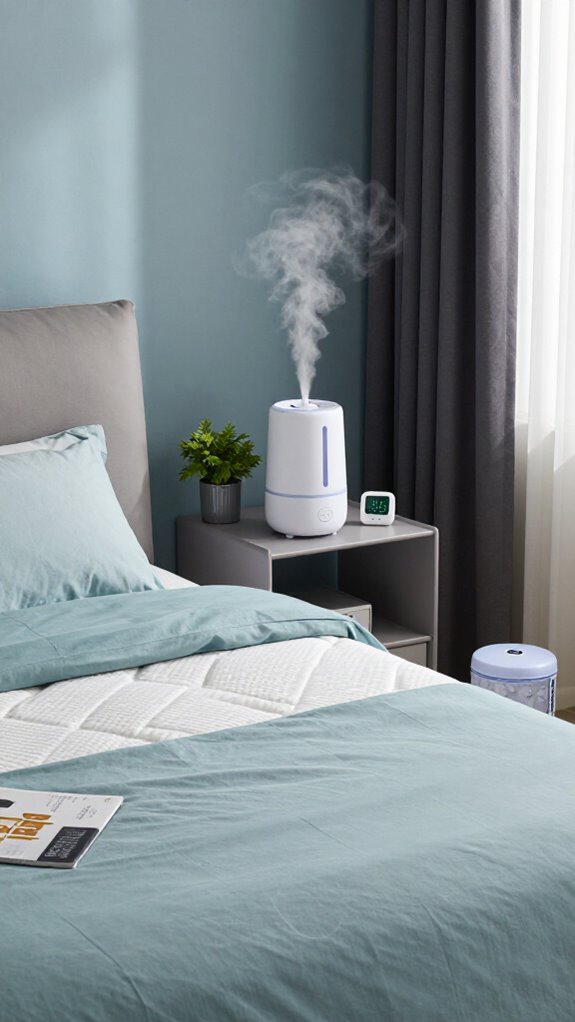
Your bedroom airflow becomes the intervention point. Strategic bedroom airflow management, achieved through cross-ventilation by opening opposite windows or positioning box fans to circulate cooler evening air, directly combats thermal stagnation that compounds discomfort. Adding a cool mist humidifier to your bedroom environment can further enhance comfort by maintaining optimal moisture levels without raising ambient temperature.
Mattress materials warrant equally deliberate consideration. Memory foam traps metabolic heat, intensifying the problem, whereas breathable alternatives like Tencel, bamboo-rayon, or cotton sheets facilitate moisture evaporation. Choosing materials like latex or wool can further improve breathability and temperature regulation throughout the night.
Pair these with lightweight bedding rather than heavy blankets—or better yet, chill your top sheet in the refrigerator before bed for immediate thermal relief.
Supplementary cooling strategies amplify your control. Blackout curtains insulate against solar heat gain when closed during peak sun hours, while placing ice containers behind fans generates cooled airflow without requiring air conditioning.
Some people freeze water bottles behind fans or drape cold cloths over them, creating a makeshift evaporative system. For targeted body cooling, apply ice packs to pulse points—wrists, neck, knees—where blood vessels sit closer to skin surface, enabling efficient heat dissipation.
Monitor your personal ideal temperature with basic sensors; individual variation is substantial. The goal isn’t merely comfort but physiological alignment: creating conditions where your body’s natural thermoregulatory descent proceeds unimpeded, allowing deep sleep’s restorative mechanisms to function effectively.
Your bedroom temperature isn’t ambient decoration—it’s instrumental infrastructure for neural health.
Circadian Rhythm Temperature Fluctuations
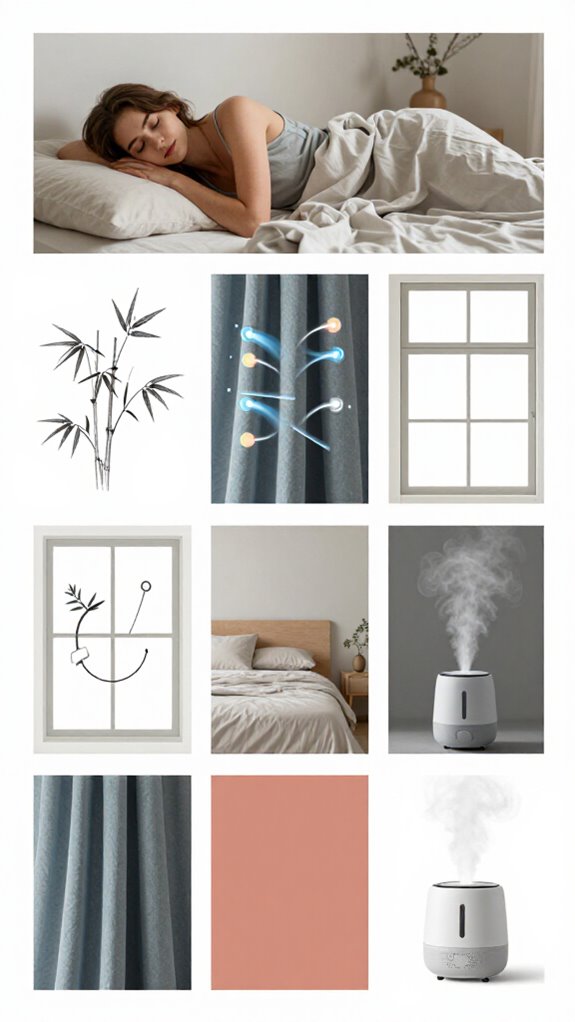
Your body orchestrates a sophisticated thermal choreography throughout the sleep-wake cycle, one governed by your suprachiasmatic nuclei—a cluster of neurons in your hypothalamus that functions as your internal timekeeper. Your core temperature naturally plummets approximately 1.3°C to trigger sleep onset, then rises during final sleep stages for morning alertness. Proper humidity levels also support this cooling process by enhancing evaporative heat loss from your skin. Smart lighting systems can further reinforce your circadian alignment by complementing temperature cues with appropriate light exposure throughout the day.
Meanwhile, distal temperature rhythms—your skin’s heat dissipation patterns—stabilize sleep quality when consistent. Light exposure primarily regulates this temperature dance. However, warmer environments delay your circadian phase by 1-2 hours, disrupting this delicate synchronization.
Cooler bedrooms (16-19°C) advance and stabilize your rhythms, restoring physiological alignment and deepening restorative sleep architecture. Pairing temperature control with total blackout liners ensures light exposure cannot interfere with your circadian temperature regulation.
FAQ
What Specific Cooling Devices Work Best for Different Bedroom Sizes and Budgets?
I’ve found that your cooling strategy hinges on spatial parameters and fiscal constraints.
Ceiling fans ($50–150) suit larger rooms economically, circulating air efficiently.
Window fans ($30–80) work splendidly for medium spaces with outdoor access.
Portable air conditioners ($200–500) deliver targeted cooling in compact areas.
Budget-conscious folks appreciate evaporative coolers ($100–300) in dry climates.
Insulating curtains ($40–120) amplify any system’s efficacy by blocking solar gain.
Air purifiers with cooling functions ($150–400) dual-task, addressing both temperature and ventilation—critical since deep sleep drops 4.3% per 100 ppm CO2 increase.
How Quickly Should I Expect Sleep Improvements After Lowering My Bedroom Temperature?
You’ll notice sleep latency improvements within three to seven nights, though your individual temperature sensitivity determines the precise timeline.
I’d recommend targeting 60–67°F (15–19°C) and monitoring changes meticulously—like a telegraph operator calibrating signals.
Most sleepers experience measurable deep-sleep gains once thermal conditions stabilize.
Researchers like those at Sleep Health Institute emphasize that neurophysiological adaptation requires consistency; you’re fundamentally rewiring your body’s thermoregulatory response through deliberate environmental control.
Can Bedroom Temperature Affect Other Family Members Differently Based on Age or Health?
Absolutely—you’ll notice substantial variation across your household.
Older adults thrive around 75°F, where reduced stress responses bolster cardiac efficiency during sleep. Children and younger adults gravitate toward 60–67°F for ideal deep sleep.
Health conditions amplify this further; respiratory issues worsen with dry heat, while arthritis benefits from warmth.
I’d recommend deploying zone-based cooling—utilizing smart thermostats or individual fans—allowing each person autonomy over their microclimate rather than imposing uniform temperature.
What’s the Ideal Humidity Level to Pair With Cooler Bedroom Temperatures?
I’d target 30–50% relative humidity paired with your 60–67°F sleeping quarters.
Like Goldilocks calibrating her porridge, this range optimizes sleep quality while preventing the desiccation that undermines respiratory comfort—particularly when cooling reduces ambient moisture.
Research shows cold-induced dryness (affecting 81.3% of subjects) compounds restlessness; maintaining adequate humidity counterbalances this physiological tension, allowing you precise environmental mastery through hygrometers and humidifiers.
How Do Seasonal Changes Require Adjusting Bedroom Cooling Strategies Throughout the Year?
I calibrate my cooling strategy seasonally: winter demands thermal neutral settings around 18.5°C with strategic seasonal bedding layers, while summer necessitates aggressive 60–67°F targets.
I adjust humidity inversely—boosting moisture during winter’s dry-heat season (counteracting heater-induced dryness) while reducing it summer-ward.
Spring and fall present shifting windows where I incrementally shift setpoints.
This tiered approach, supported by sleep research, lets me maintain ideal deep sleep across fluctuating external conditions.
References
- https://pmc.ncbi.nlm.nih.gov/articles/PMC8648527/
- http://ui.adsabs.harvard.edu/abs/2020STBE…26.1274X/abstract
- https://pmc.ncbi.nlm.nih.gov/articles/PMC10529213/
- https://news.gallup.com/poll/506201/sleep-temperature-linked-overall-sleep-quality-wellbeing.aspx
- https://www.psychologytoday.com/us/blog/the-modern-brain/202503/the-key-role-of-temperature-in-sleep-quality
- https://www.sciencedaily.com/releases/2026/02/260210040625.htm
- https://www.nosleeplessnights.com/how-to-keep-cool-at-night/
- https://www.zinus.com/blogs/zinus/10-ways-to-sleep-cooler-you-ve-probably-never-tried-ac-not-required
- https://www.sleepfoundation.org/bedroom-environment/how-to-cool-a-room-during-summer
- https://www.healthpartners.com/blog/tips-for-sleeping-without-air-conditioning/