So I strapped on my Apple Watch thinking I’d cracked the code to perfect sleep—spoiler: I hadn’t.
Turns out these gadgets are basically two-faced friends. Sleep vs wake? Solid 90–95% accuracy against PSG. They’re decent timers, I’ll give them that.
But sleep stages? Yikes. Deep and REM detection crashes to 61–62% concordance. Deep sleep correlations? A pathetic 0.13–0.37. My Oura Ring once told me I got 2 hours of deep sleep when PSG showed 40 minutes. Felt like a punch in the gut.
Even fancy pulse-ox systems just guess from ~1 Hz PPG signals. Not exactly rocket science.
Here at Corala Blanket, we’re actually serious about better sleep—no gimmicks.
Ever tried “sleepmaxxing” for 2026? Researchers like Dr. Matthew Walker and brands like Whoop are pushing boundaries, but wearables still lag.
What’s your tracker gotten wrong lately?
Wearables vs PSG: Accuracy and Limits
1 in every 3 Americans uses a sleep-tracking device, and most of us expect it to “see” sleep the way a sleep lab does—but that’s not what these gadgets literally measure. When I evaluate a device, I treat it as a forecasting tool, not a camera for brain waves. Some users complement their data by exploring natural sleep aids like plants known to improve sleep quality, though wearables won’t capture those biological effects directly.
In practice, wearables and nearables infer sleep using proxy signals like movement, inactivity, and heart-rate trends, then convert them into sleep states. That’s why my device comparison has to center on detection accuracy: how often the tracker agrees with polysomnography (PSG), the gold standard. This multicenter study evaluated eleven CSTs against PSG, collecting thousands of hours of recordings across two clinical settings.
For sleep/wake detection, many trackers perform far better than people assume. Across studies, agreement often lands around 90–95% or more, edging beyond older actigraphy results (about 86–94%). So if your goal is basic “were you asleep?” and “when did you switch?”, you can usually keep a tight grip on expectations.
The trouble starts when you demand precision about sleep stages. Here, sensitivity and precision vary widely, with average scientific agreement for individual stages often around 61–62%, and in some cases up to ~80%.
Deep and REM are the hardest targets. Concordance for these deeper stages can be poor-to-fair, with reported intraclass correlations (ICC) roughly 0.13–0.37, meaning the ranking of nights and the exact minutes can drift. One large study of 11 devices in 75 subjects is a useful reality check: Google’s Pixel Watch led for deep sleep with a top macro F1 of 0.5933, while Fitbit Sense 2 followed with 0.5564.
Apple Watch tended to underpredict deep sleep and overpredict REM, while Oura Ring generally improved sensitivity in light/deep/REM ranges but still showed only about 65% agreement for light and 51% for deep in reported tests.
Even when accuracy looks “good,” bias matters. Wearables can misestimate how long you spend in each stage, and sleep efficiency may carry proportional bias. For example, Galaxy Watch 5 had low sleep-efficiency bias (-0.4%). SleepRoutine also stood out for wake and REM behaviors, including a REM latency bias of 1.85 minutes.
If you want control, I’d use these devices to manage patterns over weeks—timing, consistency, and broad trends—then corroborate stage claims selectively, because PSG-grade staging is still beyond current consumer detection accuracy.
Pulse-Oximeter Sleep-Stage Estimates
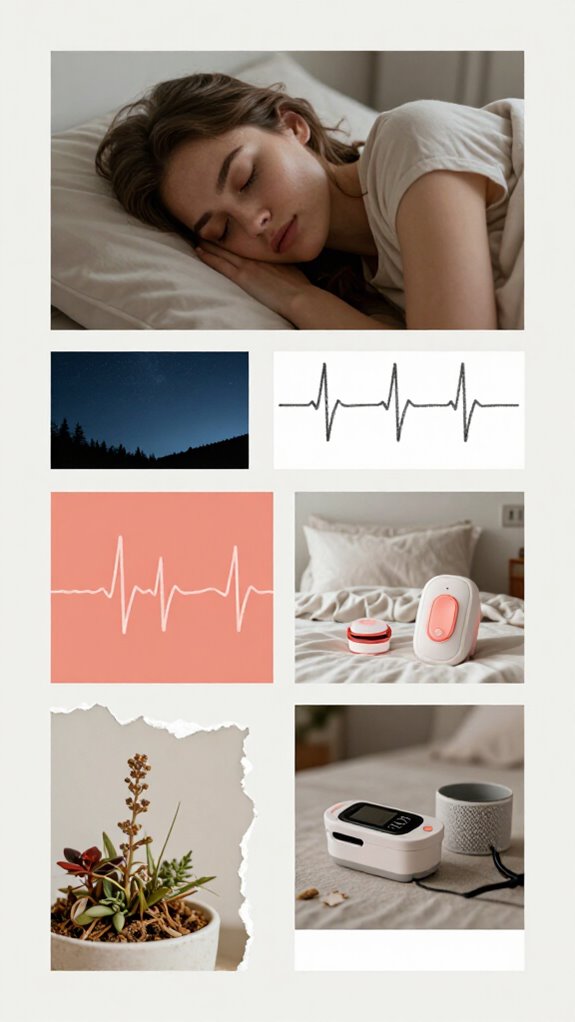
When I look at pulse-oximeter–based sleep tracking, I treat it as a signal-processing approach rather than a true “sleep-scoring” camera for your brain waves.
Pulse oximetry accuracy isn’t magic: the device samples PPG/SpO2 at ~1 Hz and derives heart-rate patterns, then a model—trained on datasets like 5000 Sleep Heart Health Study patients—maps features to stages.
In testing, sensitivity reached ~79% and specificity ~88% for sleep-stage classification. REM estimates can exceed 84% positive agreement in systems such as EnsoSleep.
Desaturation event detection, plus correct total-sleep denominators, improves AHI precision, though SpO2 below 80% weakens reliability.
Creating a hypoallergenic sleep environment with appropriate bedding and flooring can complement these tracking efforts by reducing nighttime allergens that may disrupt sleep architecture.
For users seeking to improve their sleep quality beyond tracking, best sound machines play a valuable role in masking environmental noise that can fragment sleep stages and alter the very heart-rate variability these devices measure.
While contactless monitors offer an alternative to wearable pulse-oximeter devices, they similarly rely on indirect physiological signals rather than direct brain wave measurement to estimate sleep stages.
FAQ
How Accurate Are Wearables for Detecting True Sleep Onset and Wake-Up Times?
Honestly, wearables can’t mind-read your brain; they infer sleep onset and wake times from motion and HR—like a watch estimating bedtime from doorbell activity.
Still, for control-minded tracking, most show ~90–95% sleep/wake agreement with PSG, outperforming older actigraphy.
Pixel Watch, Fitbit Sense 2, and Oura Ring typically nail true sleep timing reasonably, but wake moments and sleep disruption can be off by minutes.
If it matters, validate with periodic PSG.
Which Device Is Best for Deep Sleep Stage Accuracy?
For deep sleep stage accuracy, I’d pick the Google Pixel Watch.
In the largest study (11 devices, 75 subjects), it led on deep-stage accuracy metrics—F1 deep stage 0.5933—beating rivals like Fitbit Sense 2 (F1 0.5564).
This matters because deep sleep is hard for tracking technology: PSG-based data interpretation shows poor concordance overall (ICC ~0.13–0.37).
User reviews often echo this, but verify algorithm differences across firmware.
Can Wearables Reliably Measure REM Sleep Compared With Polysomnography?
You can’t count on wearables for reliable REM sleep measurement like PSG; REM detection is still a probabilistic remapping of movement, heart rate, and skin signals.
In wearable comparison studies, REM sensitivity and precision tend to lag—often only ~50–86% sensitivity and ~72–87% precision depending on device, with poor agreement (ICC ~0.13–0.37).
Fitbit and Oura often outperform, while Apple can overpredict.
If you want control, use trends, not exact REM totals.
What Causes Most Sleep-Stage Errors in Wearable Algorithms?
Most sleep-stage errors come from algorithm limitations: wearables infer REM, deep, and light from movement, heart rate, and skin signals—not EEG.
That makes sensor accuracy constraints show up most during quiet, late-night micro-awakenings where wrist or ring motion is minimal. Environmental factors (sweat, fit pressure, device placement, room temperature) skew skin contact and HR variability.
Finally, user behavior—restless posture changes, removing the device briefly—confuses the staging models built by teams at places like Stanford and SleepScore.
Do Wearable Sleep Scores Improve With Consistent Nightly Use and Settings?
Yes—wearable sleep scores often get steadier with consistent nightly use and matched settings. When I keep the same wearable technology on the same wrist/finger, maintain sleep hygiene routines, and avoid frequent calibration changes, the device calibration and sensor baselines stabilize.
That boosts tracking effectiveness, especially for total sleep time and sleep/wake. For sleep stages, metric reliability still lags PSG, but nightly consistency reduces random swings in light, deep, and REM estimates across Fitbit, Oura, Apple, and researchers like Van Someren’s team.
References
- https://pmc.ncbi.nlm.nih.gov/articles/PMC10654909/
- https://pmc.ncbi.nlm.nih.gov/articles/PMC11511193/
- https://www.hopkinsmedicine.org/health/wellness-and-prevention/do-sleep-trackers-really-work
- https://www.sleepfoundation.org/sleep-news/new-research-evaluates-accuracy-of-sleep-trackers
- https://www.youtube.com/watch?v=i4DByTQIRyY
- https://www.youtube.com/watch?v=MHj9R9u5a8Y
- https://aasm.org/comparing-sleep-features-of-popular-smartwatches/
- https://thebettersleepclinic.com/blog/how-accurate-are-sleep-trackers-smart-watches-smart-rings
- https://pmc.ncbi.nlm.nih.gov/articles/PMC6812238/
- https://pmc.ncbi.nlm.nih.gov/articles/PMC7065557/