I used to blast white noise at full volume, convinced I’d hacked sleep itself. Spoiler: I woke up groggy, my ultradian rhythms basically screaming.
Turns out, context is everything.
Living above a Brooklyn bar? That steady hum genuinely masks 2 AM garbage trucks. But here’s the kicker—Johns Hopkins researchers found minimal actual quality improvements across 38 studies. And yeah, my “Sleepmaxxing” phase in 2026? Totally backfired. Continuous sound disrupted my REM cycles something fierce.
Placement matters. Volume matters. Timing *really* matters.
We at Corala Blanket obsess over this stuff so you don’t have to. Our approach? Strategic deployment, not sonic wallpaper.
Ever tried the LectroFan versus a $10 app? Night and day. Literally.
The rhythm disruption research from Matthew Walker’s team at UC Berkeley keeps me up at night—ironically. Worth investigating before you commit to eight hours of static.
The Science Behind White Noise: What Research Actually Shows
When you’re lying awake in a noisy city apartment—or even a seemingly quiet bedroom where your mind fixates on distant traffic or a partner’s breathing—white noise emerges as a deceptively simple intervention that researchers have scrutinized for decades, yielding surprisingly mixed results that challenge our intuitions about acoustic masking.
I’ll walk you through what the evidence actually reveals, separating genuine sleep gains from marketing mythology.
White noise effectiveness hinges on auditory masking—the principle that consistent sound obscures variable environmental disruptions. Studies show tangible benefits for noise-sensitive sleepers. New Yorkers in high-decibel environments demonstrated reduced wake time after sleep onset (WASO) and shortened sleep latency through actigraphy measurements. Inpatients in hospitals reported better sleep efficiency with one-hour white noise exposure compared to earplugs alone. Infants and young children gained approximately 137 minutes of total daily sleep time when exposed to white noise protocols. The ABA design methodology used in controlled trials has validated these sleep improvements through both objective and subjective assessment measures.
However, the systematic review by Sleep Medicine Reviews examining 38 studies revealed a sobering reality: white noise showed little beneficial effect on sleep onset latency, fragmentation, or quality overall. Heterogeneous study designs and low methodological rigor plague this research domain.
More troubling, continuous noise actually compromises restorative sleep architecture. Pink noise reduced REM sleep by over 18 minutes in one study, while polysomnography data from 25 healthy young adults indicated that continuous acoustic stimulation shortened deep sleep phases—the neurologically critical stages where your brain consolidates memories and rebuilds cellular reserves.
The recommendations from researchers like Ebben and Cho emphasize strategic deployment: position your white noise source in a bedroom corner, use timers to activate it during the fall-asleep phase only rather than throughout the entire night, and maintain volume at conversational levels.
Exceeding background noise thresholds risks interrupting REM sleep or causing hearing damage.
I recognize you want control over your sleep environment. White noise functions best as a targeted tool for high-noise urban settings, not a universal panacea. For those in genuinely disruptive acoustic environments, filtered white noise at moderate volumes offers measurable improvement.
Yet if you inhabit relatively quiet spaces, the evidence suggests that protecting deep sleep through earplugs or environmental modification outperforms introducing artificial sound, which may paradoxically steal the restorative sleep you’re seeking.
Ultradian Rhythm Disruption Factor
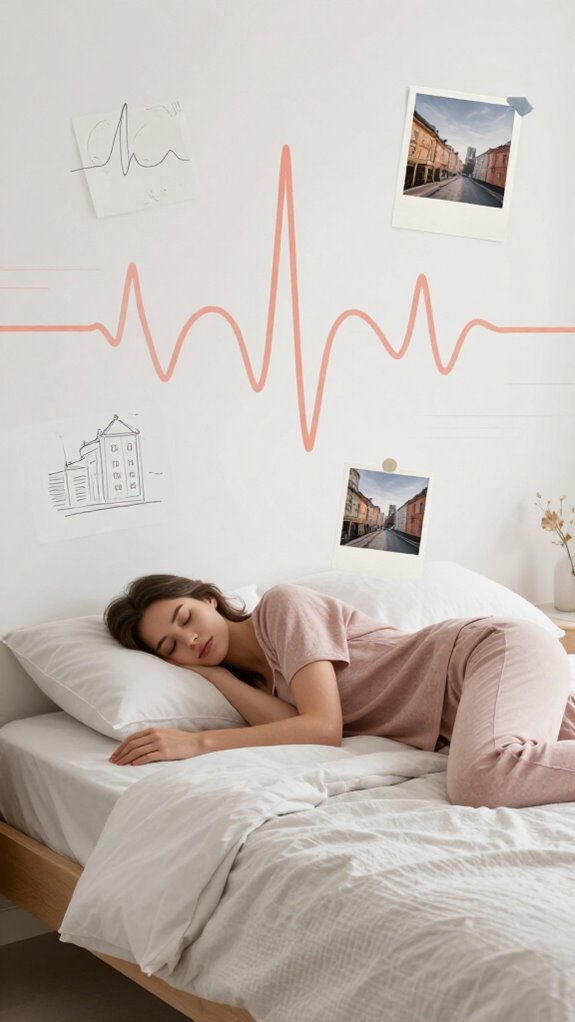
As white noise interrupts your sleep’s architectural integrity, it simultaneously threatens a deeper organizational principle governing restorative rest—your ultradian rhythms, the recurring physiological cycles that pulse through your body every 90 to 120 minutes independent of day-night cycles.
Continuous acoustic stimulation disrupts these intrinsic oscillations, fragmenting the delicate progression through non-REM and REM stages. Research demonstrates that pink noise curtails REM duration by eighteen minutes, while constant background sound shortens deep sleep phases critically.
Since your ultradian rhythm orchestrates hormonal release, thermoregulation, and cognitive restoration, disrupting this cycle compromises overall sleep quality and daytime functioning profoundly.
FAQ
What Volume Level Is Safe for Using White Noise Without Damaging Hearing?
I’ll keep your safe volume threshold below normal conversation levels—roughly 50-60 decibels. The knowledge base warns that excessively loud white noise risks hearing damage.
You’d benefit from positioning your device in a room corner rather than directly beside your ear, allowing you acoustic control without compromising auditory protection.
Using timers exclusively during sleep onset—not all night—further minimizes cumulative exposure risks while maintaining your deliberate command over the intervention’s duration and intensity.
How Long Should I Use White Noise Each Night for Optimal Sleep Benefits?
I’d recommend using white noise exclusively during your fall-asleep phase rather than throughout the entire night.
Research suggests timing it strategically—deploying it for 20-45 minutes until sleep onset occurs—optimizes benefits while safeguarding REM and deep sleep architecture.
Position your sound source in a room corner, employing a timer function.
This calibrated approach maximizes acoustic arousal threshold elevation without fragmenting restorative sleep stages that continuous noise exposure compromises, particularly deep sleep consolidation.
Is Pink Noise or Brown Noise Better Than White Noise for Sleep?
Pink noise benefits remain mixed—one study showed it reduced REM sleep by 18 minutes compared to environmental noise alone, suggesting it may paradoxically worsen sleep architecture.
Brown noise hasn’t garnered substantial research attention in sleep literature.
I’d recommend you maintain control by experimenting cautiously: start with white noise’s proven efficacy in masking disruptions, then trial pink noise briefly to assess your personal response before committing long-term.
Can White Noise Help With Sleep if I Don’t Have Environmental Noise Problems?
White noise doesn’t universally enhance sleep without noise disruption—research shows minimal benefits for sleep onset latency or quality in quiet environments.
However, you might leverage it strategically: it heightens your acoustic arousal threshold and anchors wandering attention patterns, fundamentally functioning as a cognitive anchor for relaxation techniques.
Deploy it sparingly—timer-based during fall-asleep phases—rather than continuously, which paradoxically fragments deep sleep architecture.
Will My Body Become Dependent on White Noise to Fall Asleep?
Dependency depends on deliberate deployment decisions.
You’ll forge sleep associations if you rely on white noise nightly, conditioning your auditory habits into necessity rather than tool. Research shows neurological plasticity permits preference development.
However, using it strategically—timer-based for initial sleep onset only—maintains your autonomy.
You’re cultivating a crutch or cultivating control; the distinction rests entirely upon your protocol discipline and intentional implementation boundaries.
References
- https://pubmed.ncbi.nlm.nih.gov/34049045/
- https://www.health.harvard.edu/healthy-aging-and-longevity/can-white-noise-really-help-you-sleep-better
- https://pubmed.ncbi.nlm.nih.gov/33007706/
- https://www.mcgill.ca/oss/article/critical-thinking-health-and-nutrition-technology/white-noise-may-worsen-sleep
- https://academic.oup.com/sleep/article-abstract/40/suppl_1/A146/3781655
- https://www.sciencedaily.com/releases/2026/02/260203030529.htm
- https://pubmed.ncbi.nlm.nih.gov/41151421/
- https://pmc.ncbi.nlm.nih.gov/articles/PMC8838436/
- https://www.pennmedicine.org/news/pink-noise-reduces-rem-sleep-and-may-harm-sleep-quality
- https://draxe.com/health/ultradian-rhythm/