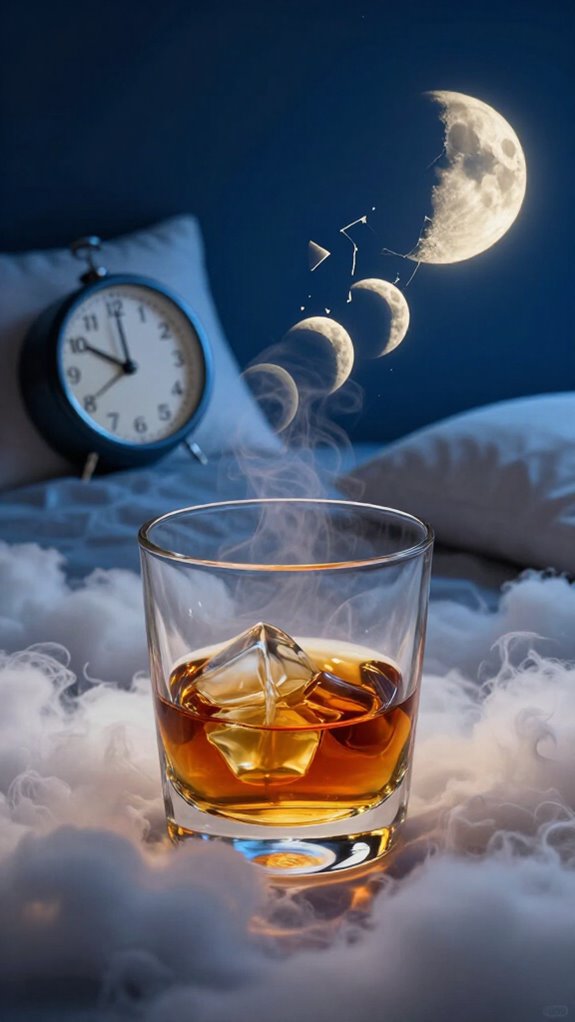
I used to think my nightcap was a sleep hack. Spoiler: it wasn’t.
Turns out, alcohol doesn’t block deep sleep—it just plays musical chairs with it. You crash hard early, sure. But REM? Obliterated. That 3am wake-up with dry mouth and existential dread? Classic.
University of Melbourne researchers found heavy drinkers face 1.61–3.37x worse sleep quality despite *feeling* rested. Metrics beat sensation every time.
We’re Corala Blanket, and we actually care about your sleep architecture. While brands like Oura track your stages and Sleep Number optimizes your environment, we’re here for the cozy infrastructure.
Ever tried “sleepmaxxing”? That 2026 trend of biohacking rest? It works—unless you’re sabotaging with Sauvignon Blanc.
That “rested” feeling after drinking? Fake news. Your brain’s still buffering.
What’s your actual wind-down ritual?
The Alcohol Paradox: Frontloaded Deep Sleep, Destroyed Architecture
How does a nightcap hijack your sleep architecture? When you consume alcohol before bed, you’re initiating a complex neurochemical cascade that fundamentally restructures your sleep cycles. Rather than preventing deep sleep outright, alcohol paradoxically frontloads it while simultaneously sabotaging the restorative architecture you’re seeking.
The mechanism operates through dose dependence. Research demonstrates that every gram per kilogram of alcohol consumed decreases sleep onset latency by 6.4 minutes—you’ll fall asleep faster, which feels beneficial initially. Simultaneously, alcohol triggers a substantial SWS increase during your first half of sleep. This consolidation of deep sleep early in the night might seem advantageous, yet it masks a significant problem: this isn’t natural deep sleep timing. Your brain is fundamentally forcing deep sleep to occur prematurely through ethanol’s depressant effects on the central nervous system. These SWS increases remain consistent across different age groups and genders, demonstrating the robustness of alcohol’s effect on deep sleep architecture regardless of demographic factors.
Here’s where control becomes elusive. While SWS increases initially, REM reduction accelerates proportionally. Each additional gram per kilogram delays REM onset by roughly 30 minutes and reduces total REM duration by 40 minutes. This dose-dependent suppression explains why moderate and high doses create particularly severe disruptions—you’re not just missing REM sleep; you’re experiencing a cascading architectural collapse.
The second half of your night deteriorates markedly. Sleep fragmentation intensifies as alcohol metabolizes, moving you into lighter N1 stages filled with frequent awakenings. Your body attempts homeostatic recovery, extending these shallow sleep stages and further compressing potential deep sleep opportunities later in the night. Wakefulness increases measurably during this elimination phase.
The data is unambiguous: alcohol reduces sleep efficiency and total sleep time despite faster onset. Studies document that total night SWS increases only at high doses, while REM percentage decreases at moderate and high doses consistently. Cross-sectional research indicates heavy drinkers experience sleep quality odds ratios between 1.61 and 3.37 for poor outcomes.
You’re not preventing deep sleep—you’re displacing it. Alcohol creates an illusion of better sleep through artificially compressed early cycles while extracting a substantial price during the second half. Understanding this distinction is vital for anyone seeking genuine restorative sleep rather than merely shorter onset times.
Alcohol’s Effect on Circadian Rhythms
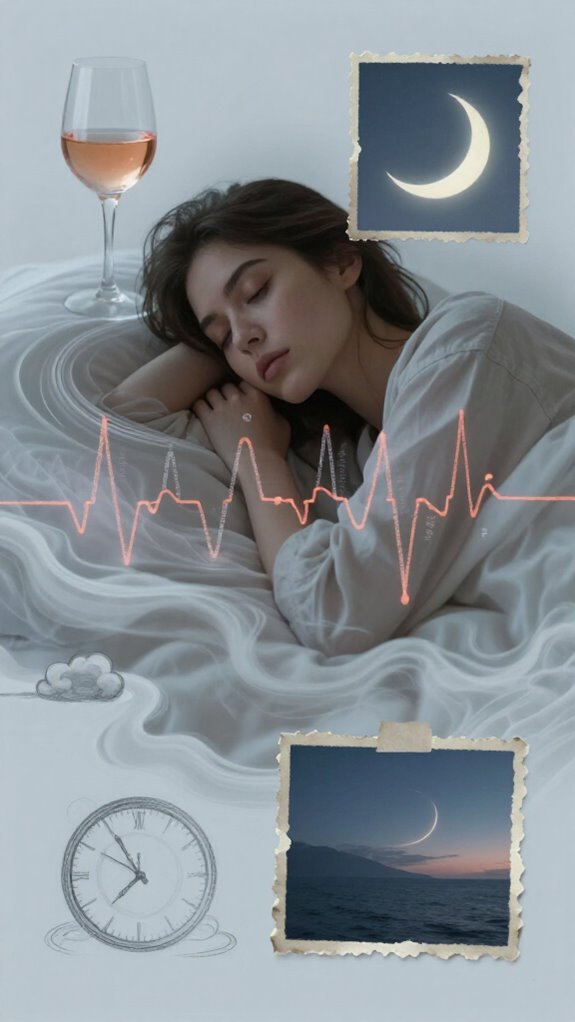
Beyond alcohol’s immediate assault on sleep architecture lies a subtler but equally consequential disruption: your circadian rhythm itself. When you drink, alcohol dampens your body’s sensitivity to light-dark cues—the environmental signals that synchronize your internal clock. Melatonin suppression follows, disrupting temperature regulation and hormone secretion. This circadian disruption lingers beyond the drinking night, creating cascading desynchronization.
| Circadian Element | Alcohol’s Effect |
|---|---|
| Daylight sensitivity | Decreased |
| Melatonin production | Suppressed |
| Body temperature shifts | Disrupted |
| 24-hour patterns | Fragmented |
| Post-alcohol recovery | Days-long |
You’re fundamentally jet-lagged without traveling, experiencing misaligned alertness—sleepiness during daylight, wakefulness at bedtime. Researchers like William Dement documented how this temporal misalignment persists, sabotaging restorative sleep even after abstinence.
FAQ
How Much Alcohol Is Needed to Disrupt REM Sleep Compared to Deep Sleep?
I’ll disrupt your REM sleep before touching deep sleep—that’s the hierarchy of alcohol’s assault on your architecture.
Around two standard drinks trigger REM suppression, while deep sleep actually intensifies initially. You’d need higher doses (1.0g/kg for men) to reduce total deep sleep.
Think of alcohol as a selective saboteur: it demolishes REM cycles through delayed onset and fragmentation, yet paradoxically deepens early-night slow-wave sleep before the inevitable rebound insomnia cascades through your latter sleep cycles.
Does Timing of Alcohol Consumption Before Bed Affect Sleep Architecture Differently?
I’ve examined the research, and timing proves immaterial—alcohol disrupts sleep architecture identically regardless of when you consume it before bed.
Your evening habits’ real leverage lies elsewhere. What matters: dose and metabolism.
You control consumption patterns and quantities, which directly determine how severely alcohol fragments your REM cycles and destabilizes sleep quality.
Focus there for tangible results rather than timing manipulation.
Can Occasional Light Drinking Preserve Deep Sleep Without Causing Second-Half Disruption?
I can’t entirely preserve deep sleep through light drinking—alcohol universally consolidates your first half while fragmenting the second.
Even modest consumption delays REM onset and triggers homeostatic rebound insomnia. The sleep preservation you’re seeking demands abstinence; researchers consistently document that any alcohol dose trades immediate deep-sleep gains for later architectural collapse.
Your restorative sleep requires this metabolic tradeoff recognition.
How Long After Drinking Does Alcohol’s Effect on Sleep Architecture Persist?
Alcohol’s architectural disruptions—fragmented REM cycles, N1 rebound—persist days postdrinking despite complete alcohol metabolism within hours.
You’re contending with homeostatic recovery, where your brain compensates through rebound insomnia and compromised sleep quality.
Heavy, repeated consumption extends these ripple effects substantially, degrading restorative architecture long after abstinence begins.
Circadian rhythm disturbances linger particularly stubborn, affecting melatonin sensitivity across subsequent nights.
Does Alcohol’s Impact on Deep Sleep Differ Between Men and Women?
Research indicates alcohol enhances deep sleep (N3) similarly across genders initially, though hormonal fluctuations introduce nuance.
Women experience dose-dependent variations tied to menstrual cycles and estrogen sensitivity, potentially amplifying REM suppression. Men show consistent deep sleep consolidation regardless of timing.
Both genders face identical first-half SWS increases, yet women’s circadian disruption sometimes persists longer post-consumption due to melatonin sensitivity variations.
References
- https://pubmed.ncbi.nlm.nih.gov/23347102/
- https://www.ncoa.org/article/how-alcohol-affects-your-sleep/
- https://www.mdanderson.org/cancerwise/alcohol-affects-sleep-heres-how.h00-159778023.html
- https://www.rheumatologyadvisor.com/news/alcohol-impairs-rem-sleep/
- https://www.sleepfoundation.org/nutrition/alcohol-and-sleep
- https://onlinelibrary.wiley.com/doi/10.1111/acer.14921
- https://academic.oup.com/sleepadvances/article/3/1/zpac023/6632721
- https://pmc.ncbi.nlm.nih.gov/articles/PMC3987855/