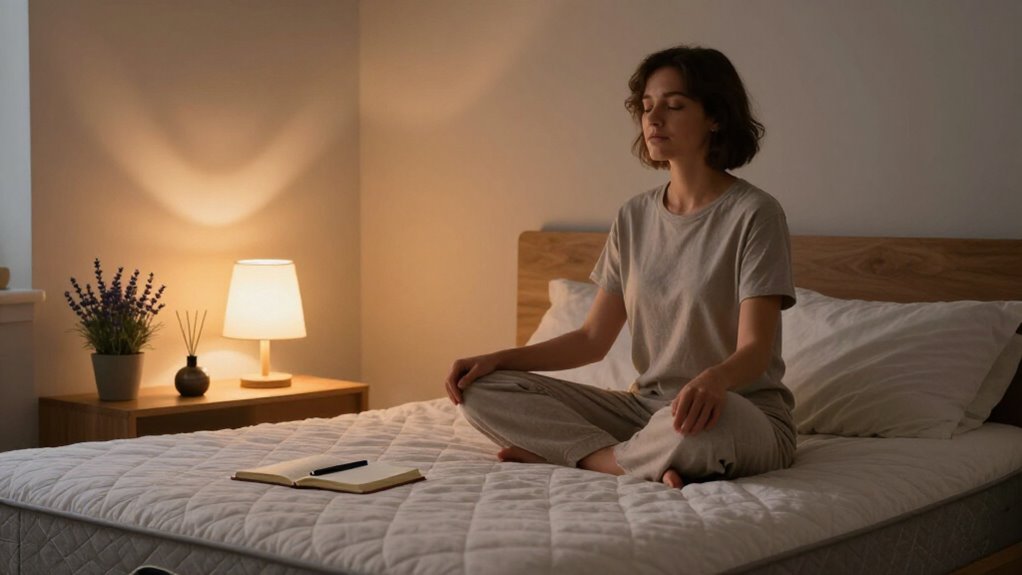
That 3 p.m. cold brew I *swear* I needed? It bit me hard at 2 a.m., eyes wired, watching my ceiling fan spiral like some conspiracy theory.
—
Here’s the cruel truth caffeine sellers won’t whisper: that boost doesn’t just stall bedtime. It hacks your adenosine system, literally shaving 11 minutes off your deep N3/N4 sleep per night, per Johns Hopkins polysomnography data. Your brain stays stuck in lightweight N1/N2, pumping beta waves like it’s brainstorming at a startup. I learned this the messy way—tracking my Oura ring scores crater after crater.
—
Timing’s brutal. That 400 mg dose? Toxic within 8–12 hours of sleep. And my chronotype? Total diva about sensitivity.
This is why we at Corala Blanket obsess over actual rest, not just *rest-ish* vibes.
—
2026’s all about Sleepmaxxing—biohackers are already microdosing caffeine, swapping to MatchaBar’s ceremonial blends or Nuun’s hydration-first energy. Dr. Matthew Walker’s research? Non-negotiable reading.
—
Your deep sleep is currency. Stop spending it on cheap lattes.
Caffeine’s Early Erosion of Deep Sleep
Caffeine quietly rewires your sleep long before you feel it, so I want you to think of it less as a “nighttime problem” and more as a timed change to sleep physiology. When I consume caffeine, I don’t just stay awake—I alter the architecture that produces deep sleep, especially N3 and N4. In controlled findings, caffeine trims deep sleep by about 11.4 minutes and reduces its share by 1.4%. In short, deep sleep is one of the first stages to be most noticeably eroded when caffeine is present during the sleep window. In practical terms, that’s like removing a slow, restorative gear from your night and then watching the machine run on lighter settings. The same data show total sleep time dropping roughly 45 minutes, with sleep efficiency falling 7%—so even if you lie in bed longer, you don’t get the same recovery. Caffeine effects also reshuffle the stages that normally ladder you down into depth. Light sleep expands: N1 increases by 6.1 minutes and its proportion by 1.7%. N2 follows too, with stage 1 and 2 proportions rising around 5.4% and 4.5% with a 400 mg dose. Meanwhile, N3 and N4 don’t just shrink; they drift toward the tail end of a shortened sleep window. Researchers attribute part of the stage-level shift to adenosine signaling changes—adenosine receptors fade with aging, so older brains exposed to caffeine tend to spend even less time in deep sleep. Dosage matters. Evidence indicates that 300–600 mg considerably reduces NREM stage 3 occurrence, while 200 mg or less can be inconsistent. Timing matters even more: a 400 mg dose within 12 hours of bedtime can delay sleep initiation and distort the smoother descent into drowsiness. I also see maintenance penalties: wake after sleep onset increases by about 12 minutes, and fragmentation becomes greater when 400 mg is taken within 8 hours of bedtime. At the brain-signal level, caffeine increases complexity and criticality, nudging neural systems toward a wake-like mix. During NREM, delta, theta, and alpha power drop, while beta power climbs across parietal and frontal channels—an electrophysiological signature that fits with elevated GABA activity. If you want control, the evidence is blunt: keep caffeine lower (or absent) near bedtime, because your deep sleep stage is the first to pay the cost.
Caffeine’s Chronotype Mismatch

Your sleep isn’t just “affected” by caffeine—it gets timed against your internal clock, and that’s where chronotype mismatch starts to matter.
I look at chronotype sensitivity as the difference between your morningness or eveningness and the hour caffeine hits your receptors. Students with afternoon chronotypes showed p<0.01 associations with poorer sleep quality when they drank caffeine, even when total caffeine didn’t universally predict sleep across 880 students—so timing and metabolism alignment likely dominate.
Evening caffeine after 18:00 showed no significant link in one study, suggesting self-regulation.
Still, genetics matter too: adenosine A2A receptor variants can amplify sensitivity.
I adjust caffeine timing like calibrating a thermostat.
FAQ
Does 100 Mg Caffeine Reduce Deep Sleep Compared to Placebo?
No—100 mg caffeine doesn’t reliably reduce deep sleep versus placebo.
In objective and subjective measures, studies show no significant effect at this dose, unlike the clearly negative outcomes seen around 400 mg (e.g., reduced N3 duration and altered architecture).
That said, I expect individual variability: some people with different adenosine signaling or caffeine tolerance may notice subtle shifts.
Researchers like those publishing in sleep journals back this dose threshold idea.
How Many Minutes Does Caffeine Reduce Deep Sleep Duration?
Caffeine reduces deep sleep duration by about 11.4 minutes.
In sleep architecture terms, your N3/N4 time shrinks, even though caffeine metabolism determines how quickly enough adenosine signaling gets blocked to alter the night’s staging.
Evidence from controlled sleep-lab studies shows that this “missing” deep-sleep window comes alongside reduced deep-sleep proportion (about 1.4%), so the change isn’t just shorter—it’s structurally shifted.
What Sleep Stages Increase When Caffeine Delays N3/N4?
Caffeine delays your N3/N4 by nudging sleep architecture toward lighter NREM.
Think of a thermostat set too high: deep sleep slips off the dial, and the furnace flickers at lower settings.
In studies (e.g., Walker’s group discussed adenosine effects), caffeine increases N1 by ~6.1 minutes and N1 proportion by ~1.7%, and it boosts NREM stage 2 with higher doses.
You get stage adjustments that fragment consolidation.
How Long Before Bed Should Caffeine Be Avoided for 400 Mg?
Avoid 400 mg caffeine at least 8 hours before bed.
In studies, that timing reliably harms sleep quality: it delays sleep onset and increases wake after sleep onset, with greater fragmentation when taken within 8 hours.
Because caffeine metabolism is slow—half-life often 5–6 hours and sometimes longer—your brain still feels its adenosine-blocking effect near bedtime.
If you use brands like Starbucks or equivalents, plan accordingly.
Does Caffeine Shift REM and Deep Sleep Timing Relative to Circadian Cycle?
Yes—caffeine shifts both REM and deep-sleep timing against your circadian clock.
Could you really trust your brain’s night schedule when caffeine metabolism lingers? Studies show chronic caffeine can delay REM onset and shift sleep onset patterns by up to ~2 hours relative to the light-dark cycle, altering sleep architecture.
Deep sleep (N3/N4) also shortens and likely occurs earlier/less robustly, because adenosine signaling stays blocked.
For practical control, limit intake and track your own timing like Sleep Foundation guidance.
References
- https://pubmed.ncbi.nlm.nih.gov/36870101/
- https://www.uclahealth.org/news/release/study-mice-shows-how-chronic-caffeine-consumption-alters
- https://pmc.ncbi.nlm.nih.gov/articles/PMC8276335/
- https://academic.oup.com/sleep/article/48/4/zsae230/7815486
- https://www.news-medical.net/news/20250501/Caffeine-increases-brain-complexity-during-sleep-and-shifts-it-toward-a-critical-state.aspx
- https://www.sleepfoundation.org/nutrition/caffeine-and-sleep
- https://www.bps.org.uk/research-digest/what-does-caffeine-do-sleeping-brain
- https://pmc.ncbi.nlm.nih.gov/articles/PMC6292246/
- https://academic.oup.com/eurpub/article/34/Supplement_3/ckae144.1827/7844648
- https://onlinelibrary.wiley.com/doi/full/10.1111/jsr.12670