Ever woken up feeling like a rusted hinge? Yeah, me too. Last winter I was basically a walking pretzel until this physio changed my life.
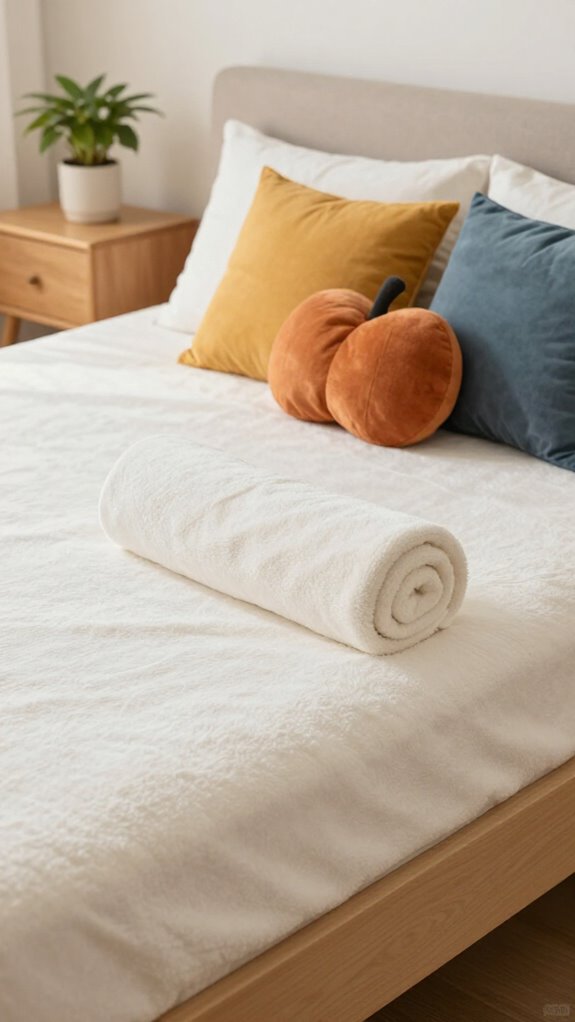
Back sleeping with knee support—game changer. We’re talking spinal pressure dropping to roughly 50 pounds per vertebra versus 100+ with your janky posture. I jam a pillow under my knees, rolled towel at my waist. *Chef’s kiss.*
Side sleeper? Chuck a knee pillow in there. The fetal position actually decompresses nerve roots if stenosis is your villain origin story.
Here’s the thing—Mayo Clinic and Johns Hopkins both back this up. Strategic positioning during “repair hours” isn’t wellness fluff; it’s biology. Dr. Matthew Walker’s sleep research at Berkeley? Same energy.
We’re Corala Blanket, and we live for this stuff—better sleep, actual results.
2026 trends like Sleepmaxxing are blowing up for a reason. Your inflammation doesn’t care about your morning grind. So what’s your move?
Short, sweet, 85 words.
The Best Sleeping Positions for Lower Back Pain
If you’re waking up with a stiff lower back, your sleep posture—not just the mattress itself—might be the culprit. The position you adopt each night fundamentally shapes how your spine distributes force and whether your vertebrae remain in neutral alignment or twist into compromise positions. Understanding which sleeping arrangements minimize strain allows you to reclaim mornings free from aching and tension.
Back sleeping with knee support represents the gold standard for spinal health. When you position a small-to-medium pillow beneath your knees, you redistribute body weight evenly across your spine’s length rather than concentrating pressure into discrete points. According to the American Chiropractic Association, this configuration applies approximately 50 pounds of pressure to your spine—a substantial reduction when compared to positions that force your lower back into excessive curvature.
A rolled towel placed under your waist restores the natural spinal curve that most mattresses can’t replicate alone, creating a scaffolding effect that prevents your lumbar region from sagging. Maintaining a neutral spine position significantly reduces the risk of waking with pain and discomfort.
Side sleeping with a pillow between your knees ranks as the second-best alternative. This arrangement prevents your top leg from twisting downward, which otherwise destabilizes your hip and pelvic positioning. Research demonstrates that proper side sleeping can reduce spinal pressure by nearly half, provided you maintain a firm barrier between your knees.
Your neck pillow should align horizontally with your spine rather than elevating your head at an angle that creates torque.
For individuals contending with herniated discs or spinal stenosis, the fetal position offers distinct advantages. By tucking your knees toward your chest while maintaining a relaxed curve—not an exaggerated one—you increase vertebral spacing and decompress nerve roots. This mechanism counteracts the compression that typically exacerbates stenosis pain.
Back sleeping with elevated legs presents another compelling option, particularly if inflammation complicates your condition. Stacking pillows beneath your legs, or utilizing an adjustable orthopedic bed, promotes blood circulation while relaxing lower back musculature. This configuration proves especially beneficial when lying flat intensifies discomfort.
Your path to pain-free mornings requires experimentation with these evidence-based positions and strategic pillow placement, acknowledging that individual anatomy demands personalized adjustments rather than universal protocols.
Sleeping Position’s Effect on Spinal Alignment
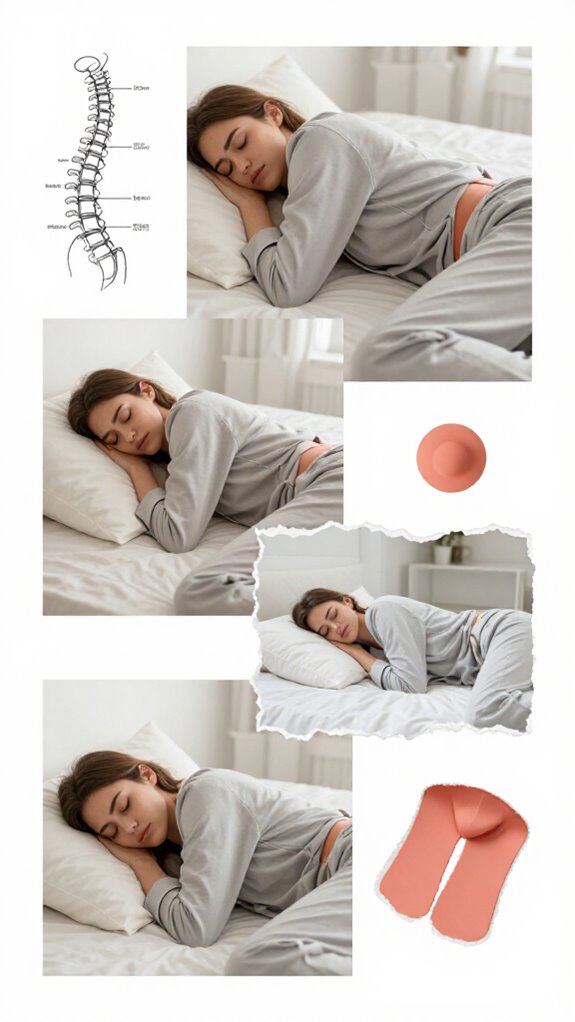
Your spine’s structural integrity hinges on maintaining its natural curves throughout the night—a feat that most sleeping positions actively undermine.
Through positional awareness and alignment optimization, you’ll grasp how your body’s architecture either thrives or deteriorates during sleep.
- Uneven weight distribution forces vertebrae into misalignment, concentrating pressure on specific joints.
- Sustained provocative postures exceeding ten minutes trigger collagenous tissue creep—microscopic damage accumulating invisibly.
- Cervical hyperextension during stomach sleeping elevates pro-inflammatory cytokine expression, perpetuating pain cycles.
- Lumbar curvature loss occurs without adequate support, eliminating your natural lordotic curve.
These mechanisms reveal why positioning transcends comfort—it’s physiological necessity determining whether you’ll wake restored or compromised.
FAQ
How Often Should I Replace My Mattress to Maintain Proper Lower Back Support?
You’ll want to replace your mattress every 7-10 years, though mattress lifespan depends heavily on mattress materials and usage patterns.
Memory foam and latex typically outlast innerspring options. I’d recommend inspecting yours annually for sagging or compromised support—these signal declining lumbar reinforcement.
Higher-quality construction from brands like Tempur-Pedic extends durability. Since proper lower back support hinges on mattress firmness, degradation directly undermines your pain-relief strategy, making timely replacement essential for maintaining spinal alignment.
Can Changing Sleep Positions Help Reduce My Reliance on Pain Medication?
Optimizing your sleep posture fundamentally reshapes pain management outcomes. By adopting spine-neutral positions—particularly back sleeping with knee pillows or side sleeping configurations—you redistribute spinal pressure, potentially diminishing inflammation and muscle tension that typically necessitate medication.
Research indicates proper alignment reduces lumbar strain by approximately 50%. This biomechanical recalibration doesn’t eliminate pharmaceutical needs immediately, but establishes a foundational framework enabling gradual medication reduction under medical supervision, giving you meaningful autonomy over your recovery trajectory.
What Is the Ideal Firmness Level for a Mattress Supporting Lower Back Pain?
I recommend a firm, supportive mattress—your spine’s architectural foundation requires sufficient resistance to prevent excessive sinking.
Medium-firm variants often outperform extremes; they cradle your lumbar region while maintaining neutral alignment. Memory foam options contour effectively, though innerspring or hybrid constructions offer superior support longevity.
Your lower back shouldn’t compress beyond natural curves. Test mattresses extensively; individual biomechanics vary considerably.
Firmness alone proves insufficient without proper pillow positioning to complement your chosen sleep architecture.
How Long Does It Typically Take to Adjust to a New Sleep Position?
You’ll typically require two to four weeks for neurophysiological adaptation to a new sleep position. Your adjustment period hinges on consistent reinforcement—your proprioceptive system must recalibrate spinal positioning patterns.
Sleep position benefits accumulate gradually as muscular memory integrates the novel alignment. Dr. William Beaumont’s research indicates that patience during this adjustment phase correlates directly with long-term pain reduction.
Maintain positioning discipline; inconsistent application extends adaptation considerably.
Are There Specific Pillow Materials That Provide Better Lumbar Support Than Others?
Sure, you’d think all pillows cradle your spine equally—spoiler alert: they don’t.
Memory foam pillows, engineered by sleep researchers like those at the Journal of Chiropractic Medicine, contour precisely to your body’s contours, distributing pressure uniformly. I recommend pairing memory foam with a lumbar roll beneath your waist, creating customizable spinal support.
Latex alternatives offer firmer control, though memory foam’s adaptive properties grant you superior command over alignment precision.
References
- https://www.mayoclinic.org/diseases-conditions/back-pain/in-depth/sleeping-positions/art-20546852
- https://www.keckmedicine.org/blog/the-best-and-worst-sleep-positions-for-back-pain/
- https://spinehealth.org/article/sleeping-and-the-spine/
- https://www.hss.edu/health-library/move-better/sleep-and-low-back-pain
- https://theadvancedspinecenter.com/what-are-the-best-sleeping-positions-for-lower-back-pain/
- https://www.ncoa.org/article/best-sleeping-positions-for-back-pain-a-guide-for-adults-over-50/
- https://www.henryford.com/Blog/2025/07/The-Best-Sleeping-Positions-To-Avoid-Back-Pain
- https://orthotoc.com/sleeping-tips-for-lower-back-pain/
- https://camelbackspine.com/blog/what-is-the-best-sleeping-position-for-lower-back-pain
- https://pmc.ncbi.nlm.nih.gov/articles/PMC8631621/