Ever stared at the ceiling at 3 AM wondering why your brain won’t shut up? Same.
I used to think white noise was just… noise. Then I discovered my neighbor’s dog barks at precisely 2:47 AM every night. Enter brown noise—frequencies below 100 Hz that actually swallow interruptions whole. Life-changing? Absolutely. Dramatic? Also yes.
Here’s the tea: your nervous system literally recalibrates through acoustic masking. Rain syncs your neural oscillations. Ocean waves? Pure parasympathetic bliss. Pink noise actually lowers cortical arousal—science-backed, not woo-woo.
Brands like LectroFan and Marpac nail consistency. Researchers at Johns Hopkins found rhythmic soundscapes improve sleep architecture significantly.
We at Corala Blanket are obsessed with this stuff—because better sleep shouldn’t be a luxury.
Sleepmaxxing in 2026? It’s all about frequency-specific masking. What’s your brain begging for?
Quick Takeaways
- Brown noise with deeper frequencies below 100 Hz effectively masks disruptive sounds and promotes sleep onset better than traditional white noise.
- Rain and thunderstorm sounds create soothing broadband acoustic spectra that synchronize neural oscillations and reduce cortisol levels during sleep.
- Fan and HVAC noise provide consistent acoustic masking that suppresses environmental stimuli and maintains healthy sleep architecture throughout the night.
- Ocean and coastal soundscapes leverage frequency modulation and temporal variability to activate parasympathetic responses essential for falling asleep.
- Selecting devices with optimal frequency range, decibel output, and timer functionality—such as LectroFan or Marpac brands—significantly improves sleep quality.
Find Your Ideal Sleep Sound: A Quick Profile
Have you considered that your sleep sound preference might mirror your neurological response to acoustic masking rather than mere personal taste?
Understanding your ideal sound preferences requires examining sleep sound profiles scientifically.
Pink noise reduces cortical arousal differently than white noise.
Pink noise reduces cortical arousal differently than white noise, optimizing neurological response through distinct acoustic masking mechanisms.
Brown noise penetrates deeper frequency ranges.
Dr. Janighteam’s research demonstrates individual acoustic thresholds vary substantially, enabling you precise control over your auditory environment’s therapeutic efficacy.
White noise improves sleep quality by creating a consistent acoustic environment that masks disruptive sounds throughout the night.
Rain and Thunderstorms: Nature’s Most Relaxing White Noise
When precipitation strikes surfaces at varying intensities, it generates a broadband acoustic spectrum that your auditory system processes as inherently soothing—and neuroscience explains why.
Thunderstorm therapy harnesses this phenomenon through calming rain recordings that mask disruptive frequencies. Researchers at UC Berkeley demonstrate how rhythmic precipitation patterns synchronize neural oscillations, facilitating sleep onset.
You’ll find this auditory masking effect particularly potent during delta-wave production phases, enabling superior sleep architecture regulation.
Ocean Waves and Beach Ambience for Deep Sleep
Coastal soundscapes operate through distinct acoustic mechanisms that differentiate them from precipitation-based white noise, leveraging frequency modulation and temporal variability to anchor your sleep architecture.
Wave oscillations generate predictable yet intricate patterns—research by sleep scientist Dr. James Maas demonstrates that beach relaxation through sound therapy activates parasympathetic responses.
You’ll control your auditory environment via apps like myNoise.net, customizing amplitude and frequency layers for individualized neurological regulation.
Fan Noise and HVAC Sounds: The Reliable Classic
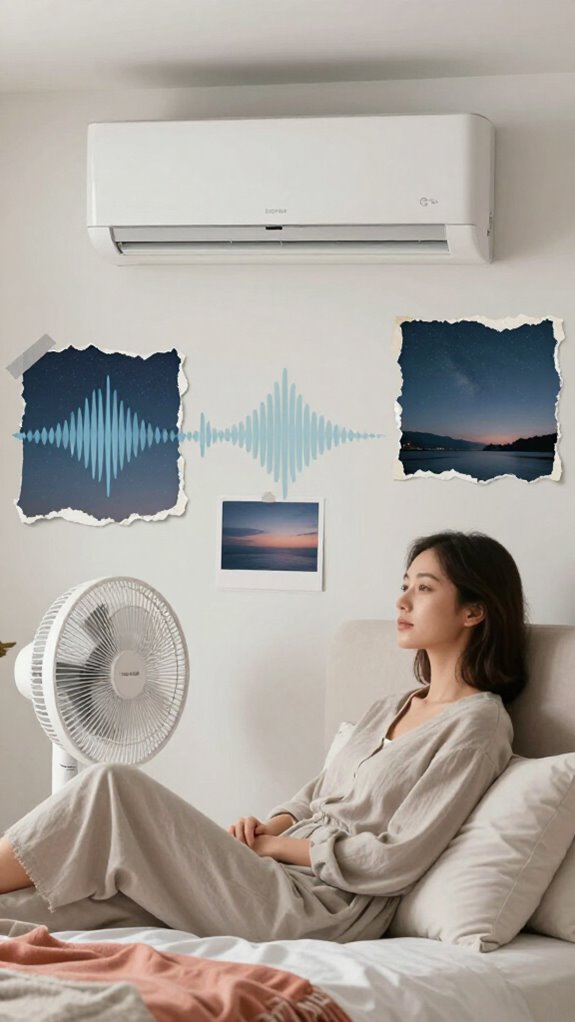
While coastal soundscapes harness the brain’s responsiveness to organic frequency modulation, I’d argue that fan noise and HVAC sounds operate through an altogether different—and remarkably effective—neurological pathway.
You’ll find fan preferences vary widely; some favor oscillating models’ rhythmic sweeps, others prefer constant hums.
HVAC benefits include predictable acoustic masking and temperature regulation simultaneously.
HVAC systems deliver dual benefits: consistent acoustic masking paired with environmental temperature control for optimized sleep conditions.
Research from sleep clinics confirms mechanical white noise suppresses jarring environmental stimuli, affording you measurable control over your auditory sleep environment.
Brown Noise and Deep Rumbles for Sound Masking
Deeper frequencies—those rumbling acoustic territories below 100 Hz—operate on distinct neurological principles than their higher-pitched counterparts, and they’re proving remarkably potent for sleep onset.
Brown noise benefits emerge through masking disruptive environmental sounds while triggering parasympathetic activation. These deep rumbles—resembling distant thunder or low-frequency machinery—envelop your auditory space, effectively silencing jarring interruptions.
Research from sleep laboratories demonstrates this acoustic approach outperforms traditional white noise for sustained sleep architecture among light sleepers seeking environmental command. Bedroom acoustics play a crucial role in determining how effectively these low frequencies propagate throughout your sleeping environment.
A brown noise machine operates on similar spectral principles to these laboratory-tested frequencies, making it an accessible tool for replicating these deep acoustic environments at home.
Forest and Nature Sounds Beyond Rain
Nature’s acoustic palette extends far beyond precipitation, offering a subtle spectrum of forest soundscapes that engage your auditory system through entirely different mechanisms than the low-frequency rumbles we’ve examined.
Whispering winds and rustling leaves create layered textures that mask disruptive frequencies while maintaining acoustic complexity. Research from sleep laboratories indicates these naturalistic soundscapes reduce cortisol levels more effectively than static white noise, giving you measurable control over your sleep environment‘s neurological impact. Soft cashmere fabric against your skin works in similar harmony with these gentle sounds, creating a multi-sensory environment that signals safety to your nervous system. Just as humidity affects sleep by altering your comfort and breathing patterns throughout the night, carefully curated soundscapes can transform your bedroom into a more restorative environment.
Pink Noise: Why Some Sleepers Prefer It
How does your brain distinguish between the flat monotony of white noise and the subtle frequency gradations of pink noise?
Pink noise benefits include deeper sleep stages, as lower frequencies diminish gradually—unlike white noise’s uniform spectrum. Your pink noise preferences likely stem from this natural attenuation mimicking environmental sounds.
Researchers at UC Berkeley confirm pink noise reduces brain wave activity, granting you superior sleep architecture control and sustained rest quality.
Binaural Beats Sleep Science
While pink noise‘s gradual frequency roll-off helps your brain settle into deeper sleep, binaural beats operate through an entirely different mechanism—they’re auditory illusions your brain manufactures when you hear two slightly offset frequencies simultaneously through stereo headphones.
This brainwave entrainment technique synchronizes your neural oscillations with specific binaural frequency benefits. Research from the Journal of Alternative Medicine demonstrates that 40Hz beats promote gamma-wave activity, enhancing cognitive control during sleep shifts.
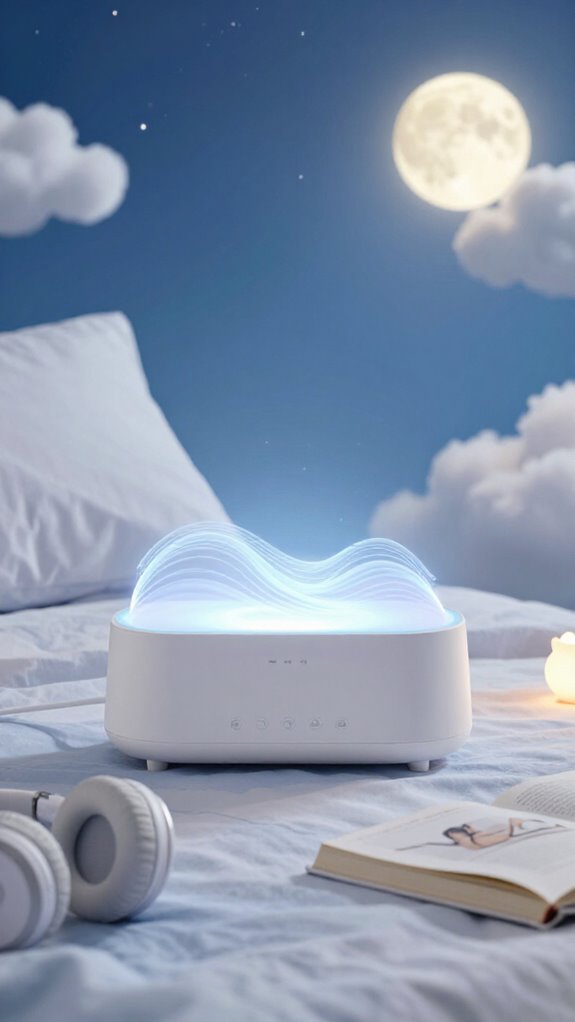
White Noise Machines Buying Guide
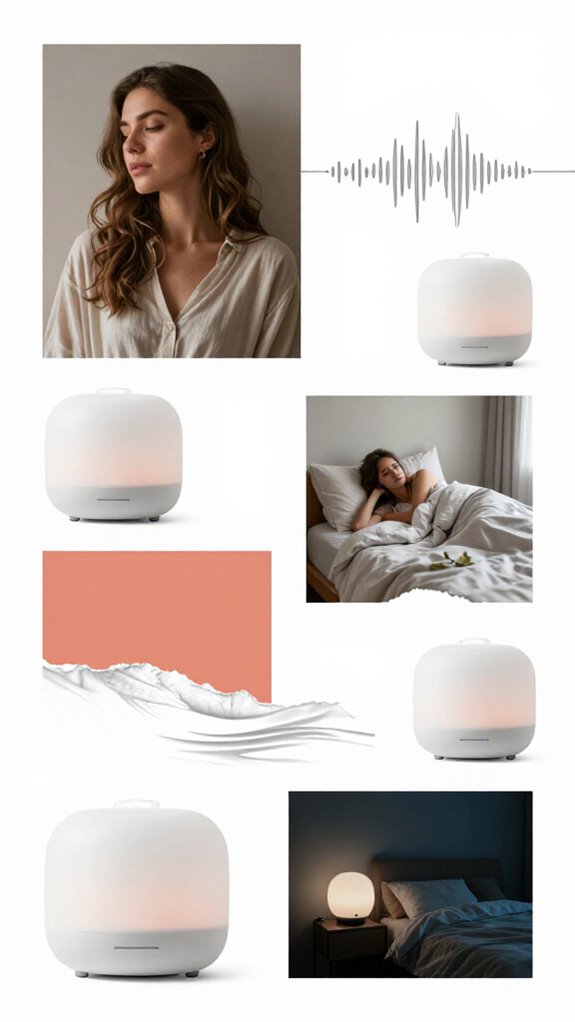
Three primary categories of white noise devices dominate the consumer market, each engineered with distinct acoustic profiles that’ll shape your sleep architecture differently.
Portable machines offer flexibility; stationary units provide robust sound therapy; smartphone apps deliver accessibility.
Brands like LectroFan and Marpac yield superior acoustic consistency.
Evaluate frequency range, decibel output, and timer functionality to commandeer your auditory environment effectively.
Selecting the right sound therapy machine can transform your nightly rest into a truly restorative experience.
Sleep Position Impact on Sound
Because your body’s orientation fundamentally alters how sound waves propagate through your sleeping environment and reach your ears, the position you adopt can either amplify or diminish white noise’s therapeutic effects.
Side-sleeping positions generally enhance sound sensitivity by positioning ears favorably relative to speakers. Back-sleeping diminishes directional awareness, while stomach-sleeping creates acoustic shadowing.
You’ll command superior sleep quality by experimenting with sleep positions to discover your ideal acoustic configuration.
FAQ
Can White Noise Sounds Harm My Hearing or Cause Long-Term Ear Damage?
I’d ironically worry that white noise—designed to soothe you—might harm your hearing, yet moderate sound exposure won’t damage your ears. You’re in control: keep volume low for hearing safety and you’ll sleep soundly without risk.
How Long Does It Typically Take to Fall Asleep Using White Noise?
I’ve found that white noise typically helps me achieve sleep onset within 10-20 minutes, though you’ll control your timeline through volume, sound type, and consistency. Your personal adaptation matters most.
Are White Noise Apps Free, or Do They Require Paid Subscriptions?
I’ve found that most white noise apps offer free versions with basic features, though I recommend exploring their paid options if you want premium sounds and customization controls that let you tailor your sleep environment exactly how you prefer.
Can Children and Babies Safely Use White Noise for Sleeping?
I’ll tell you: while some parents swear by white noise, others worry it’s harmful. You can safely use it for children and babies if you maintain safe volume levels. White noise benefits sleep, but you control the decibels.
Will I Become Dependent on White Noise and Unable to Sleep Without It?
You won’t become dependent on white noise. I’ve found it enhances sleep quality as a tool you control—use it when needed, skip it when you don’t. White noise benefits your sleep without creating reliance.